Solar Panel Installation in Mahopac, NY
Mahopac is a hamlet, not a village, so the Town of Carmel issues the permit. The lake, the trees and the slope decide most of the rest.
On this page 8 sections
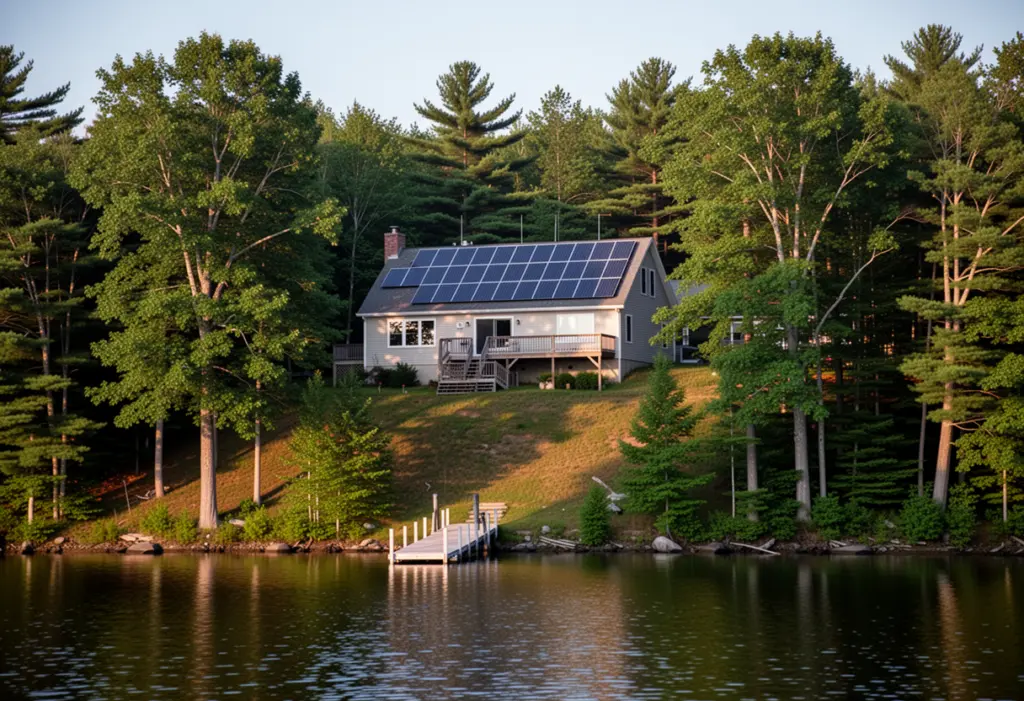
Mahopac is a hamlet in the Town of Carmel, Putnam County, wrapped around Lake Mahopac. ZIP code 10541. It reads like a small town and is often described as one, but it is not an incorporated village — and that single fact answers the first question most homeowners ask.
The Town of Carmel issues your permit
There is no village board and no separate village building department here. The Town of Carmel handles permitting across the hamlet, along with Mahopac Falls and Carmel hamlet. Putnam County has only three incorporated villages — Brewster, Cold Spring and Nelsonville — so if a friend elsewhere in the county describes a village approval step, that step does not exist for you.
What that removes is a layer. What it does not remove is the need to ask about setbacks, site plan review and inspection scheduling before a design is drawn, particularly on a lakeside lot where the buildable envelope is tight.
The lake, the slope and the trees
Lakeside and hillside properties around Mahopac raise three questions that a flat inland lot does not:
- Shading from mature trees. The wooded slopes here are the binding constraint on a great many roofs. The low December sun is what makes an obstruction decisive, because that is the month the net metering credit bank is being drawn down — a tree irrelevant in July can remove hours of production in January.
- The horizon. A property tight against a ridge loses the beginning or the end of the winter day regardless of how clear its own roof is. Ask what the production model says about December and January specifically, not only the annual total.
- Access and staging. Steep drives and narrow lakeside lanes affect where a delivery vehicle parks and whether a lift can be brought in. Get that priced before contract rather than discovered on the first morning.
None of that can be judged from imagery, so require a survey taken on the property itself. Where two quotes differ sharply on production, one of them has usually never visited. And if tree removal is proposed, treat it as your decision rather than an assumption buried in a production figure — around this lake the trees are frequently part of what the property is worth.
Watershed land and anything that breaks ground
Parts of Putnam County sit within the New York City water supply watershed, where additional review can apply to work that disturbs the ground. Establish early whether your parcel is affected rather than assuming it is not, and ask the town building department rather than relying on a sales answer.
It matters most for a ground mount, its foundations, a trench for the conductor run, or any regrading and access cutting. A roof array on an existing house is a far simpler proposition.
Wells, septic and ground mount siting
Well and septic are the norm on the larger lots. Neither the array nor its trench may sit over a leach field, which narrows the siting options before anything else is weighed, and the conductor run back to the house is charged by the foot. Get the run length in writing, and ask whether it forces a larger conductor size — the array quoted cheapest can lose that advantage entirely over a long trench.
Roofs, structure and service
Where a house has been extended over the years or converted from lighter seasonal construction, two things deserve checking before anything else. The roof structure, because an engineer’s letter is needed more often on older or altered framing than on modern engineered trusses, and it should be budgeted rather than discovered. And the service panel, because a 100 amp board is common in older housing here and a solar breaker with nowhere to land means an upgrade or a line-side tap.
Roof age is the usual sequencing question: under roughly a decade of shingle life left and the covering goes first, because taking an array down and putting it back is a second labour bill.
What the utility charges
A lakeside roof pays the same standing charge as any other. The Customer Benefit Contribution has attached to every system interconnected since 1 January 2022, and it is worked out from installed DC capacity rather than from anything the array generates. Central Hudson’s 2026 residential figure, $1.67 a kilowatt a month, is the highest in the state:
- An 8.5 kW system: $14.20 a month, about $170 a year.
- A 12 kW system: $20.04 a month, about $240 a year.
Parts of Putnam County are served by NYSEG instead, at $1.19, where that 12 kW system would pay $14.28 a month, about $171 a year — roughly $69 a year less for identical equipment. The utility name printed on your own bill is the only reliable answer, and any proposal ought to be using that rate. The charge follows capacity, not output, and it is recalculated each year rather than fixed at interconnection.
What you export is credited separately, at the full retail rate under Phase One net metering, and that structure runs for 20 years from the date of interconnection.
2026 incentives: check where you actually live first
There is no federal credit for a 2026 buyer to claim. Section 25D ended for expenditures made after 31 December 2025, and the statute fixes the moment of expenditure at the completion of the original installation rather than the day the utility energises the array. A quote still carrying a 30% federal line is wrong on its face.
That makes New York’s 25% credit, capped at $5,000 on Form IT-255, the largest thing a homeowner here still claims directly — and it turns on a test worth settling before a proposal is built around it. The system has to serve your principal residence in New York. A lakeside house used seasonally, a property held as a second home, or one that is rented out does not qualify, and on a lake that distinction is not academic. If the house is not where you actually live, that line is zero, the federal line is zero, and the case has to be made on the electricity and the property tax exemption instead. It is a fair case, but it is a different one, and it should be built that way from the start rather than corrected at tax time.
Where the house does pass that test, three further points govern what the credit is worth: your own New York State liability caps it in any single year, an unused balance survives for five, and a long lease or power purchase agreement of ten years or more counts alongside an outright purchase. Around it sit the state sales tax exemption and the 15-year RPTL 487 exemption on added assessed value, that last one available only where the Town of Carmel, Putnam County and your school district have each separately declined to opt out, and only for systems constructed before 1 January 2030. The contractor-applied items are gone: NYSERDA’s last Upstate residential NY-Sun block closed on 17 December 2025 and the Upstate Affordable Solar block on 9 March 2026, and as of September 2026 NYSERDA has no open NY-Sun block for homes in any utility territory; check NYSERDA’s NY-Sun dashboard for a new one.
Where the trees win, community solar needs no roof and no ground disturbance, and its subscribers pay no Customer Benefit Contribution at all. Programmes are revised, so check the current position with NYSERDA before committing.
Frequently Asked Questions
Does Mahopac issue its own solar permits?
No. Mahopac is a hamlet rather than an incorporated village, so the Town of Carmel permits work across it. Putnam's three villages are Brewster, Cold Spring and Nelsonville, so a village approval step described by a friend elsewhere does not apply here.
Will the trees around the lake make solar not worth it?
Sometimes, and the honest way to find out is an on-site shading assessment rather than a satellite estimate. Ask what the model says about December and January specifically, since that is when the net metering credit bank is being drawn down.
Does watershed review apply to a ground mount here?
It can. Parts of Putnam County lie within the New York City water supply watershed, where additional review can apply to ground disturbance. Establish early with the town building department whether your parcel is affected, before a design is drawn.
What does the utility charge a Mahopac solar customer?
The Customer Benefit Contribution for 2026 is $1.67 per kW-month on Central Hudson, about $240 a year on a 12 kW system, and $1.19 on NYSEG, about $171 for the same array. Confirm which utility is printed on your own bill.
This article is general information, not tax, legal or financial advice. Incentive amounts, eligibility rules and deadlines change and depend on your utility, your tax situation and your property. Confirm current terms with NYSERDA, your utility and a qualified tax professional before making a decision.
NY Solar Incentives
Independent New York solar research. We summarise NYSERDA, NY-Sun and federal programme rules from published sources and state plainly when a figure is an estimate. We are not a government agency and do not sell equipment.
Run the arithmetic on your own system
Check the dated program table and your arrangement before counting an incentive. Standard residential NY-Sun blocks are closed; Long Island Affordable Solar has a conditional income-verification route. The NY credit depends on qualified costs and tax liability, while the NYC abatement reduces future property-tax bills. The estimator keeps those timings separate.