Solar Incentives in Brewster, NY: What Is Left in 2026
The federal credit has ended, so what is left in Brewster is a state credit, a contractor-applied incentive and a property tax exemption with four separate opt-outs to check.
On this page 9 sections
- 01Start with what is gone
- 02The New York State credit
- 03NY-Sun and Affordable Solar: no open block for homes
- 04RPTL 487 means four separate checks inside a village
- 05Sales tax
- 06The charge that runs the other way
- 07Community solar pays no contribution at all
- 08The ten-year rule, and why third-party offers look different in 2026
- 09Frequently Asked Questions
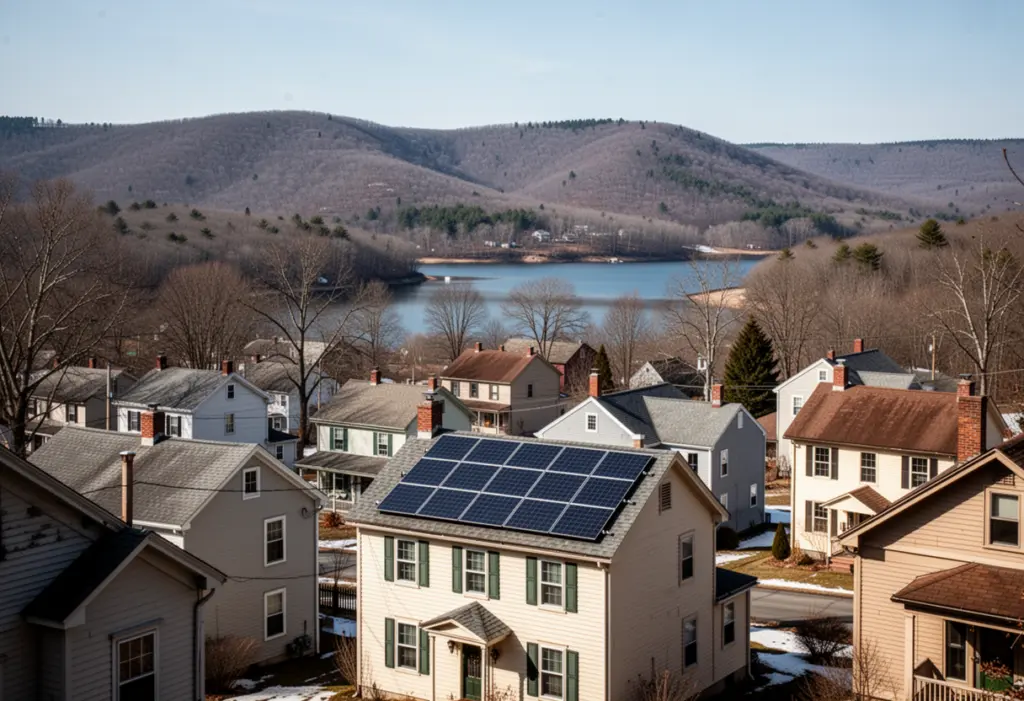
Brewster is a village inside the Town of Southeast, in eastern Putnam County. ZIP code 10509. It is small, densely built and surrounded by reservoir land, and the incentive picture there in 2026 is very different from the one most solar proposals still describe.
Start with what is gone
The 30% federal residential credit no longer exists. Section 25D was terminated for expenditures made after 31 December 2025, and an expenditure is treated as made when the original installation is completed. A homeowner buying a system in 2026 claims nothing federally — there is no phase-down and no carryover of a credit never earned.
If a proposal you have been given still shows a 30% federal line, that proposal is materially wrong and every number below it is wrong too. Ask for it to be rebuilt before you compare it with anything else.
The New York State credit
This is the largest incentive a Brewster homeowner claims directly. It is 25% of qualified solar energy system equipment expenditure, capped at $5,000, claimed on Form IT-255.
- The system must serve your principal residence in New York. A second home, a seasonal property or a rental does not qualify.
- It reaches leases and power purchase agreements of ten years or more as well as outright purchases. The ten-year minimum applies to the lease as well as to the PPA, so a shorter agreement does not qualify.
- It is limited by your actual New York State tax liability, which is what most often makes the first-year figure smaller than the headline. It is not refundable, but unused credit carries forward up to five years.
NY-Sun and Affordable Solar: no open block for homes
NY-Sun was applied by your contractor as a reduction in the price, not claimed by you on a form. NYSERDA’s last standard Upstate residential block for Central Hudson and Orange & Rockland customers (Block 13, $0.15 a watt) closed on 4 August 2025; the last for NYSEG, RG&E and National Grid customers (Block 14, $0.15 a watt) closed on 17 December 2025. As of September 2026 NYSERDA has no open NY-Sun block for homes in any utility territory; check NYSERDA’s NY-Sun dashboard for a new one. If a quote still shows an NY-Sun reduction, ask which open block it comes from.
Affordable Solar, the NYSERDA incentive for lower-income households that the contractor also applied, is closed as well: the Upstate Affordable Solar block, at $0.80 a watt, ran only from 18 December 2025 to 9 March 2026. An installer who still offers it should be able to show you the open block it comes from.
RPTL 487 means four separate checks inside a village
RPTL 487 gives a 15-year exemption on the added property value of the system. It applies only where the taxing authorities have not opted out, and each of them decides separately. Inside Brewster that is four bodies to check, not one:
- the Village of Brewster,
- the Town of Southeast,
- Putnam County,
- and your school district.
A village address carries one more layer than a town address, and a partial position is normal — one authority may have opted out while the others have not. The exemption also requires the system to be constructed before 1 January 2030.
Sales tax
New York exempts residential solar energy system equipment from state sales tax, and localities may separately elect to exempt their local share, so the total varies by county and city. Ask how the exemption is reflected in your quote.
The charge that runs the other way
Against those incentives sits the Customer Benefit Contribution, a monthly charge on the DC size of the system for anyone interconnecting on or after 1 January 2022. Putnam County is split between utilities and the difference is material. On NYSEG at $1.19 per kW-month for 2026, a 5 kW system pays $5.95 a month, about $71 a year, and a 13 kW system $15.47, about $186. On Central Hudson at $1.67, the highest residential rate in New York, the same two systems pay $8.35 and $21.71 a month — roughly $100 and $261 a year.
Read the utility name off your own bill before accepting either figure. The charge follows capacity rather than production, and it is recalculated annually instead of being fixed at interconnection. Exports run under Phase One net metering, credited at the full retail rate, with that structure held for 20 years from interconnection — worth having confirmed in writing.
Community solar pays no contribution at all
Community solar subscribers pay no Customer Benefit Contribution, need no roof and pay nothing up front. In a village of small, closely spaced and frequently rented houses, and on a high utility rate, that is a serious option rather than a consolation prize — particularly for a tenant, since a rooftop system offsets only the meter it is connected behind.
The ten-year rule, and why third-party offers look different in 2026
One consequence of the federal change deserves its own heading, because it is where most Brewster households will meet it in practice. The credit that survived 2025 is the business-side one, claimed by the company that owns a leased or PPA system — not by the homeowner. That is why third-party offers still price in a federal incentive you will never see on your own return, and why the tax arithmetic in 2026 leans toward leases, power purchase agreements and community solar rather than buying outright.
If you are handed one of those contracts, three things decide whether the New York credit reaches you at all:
- The term must be ten years or more. This applies to a lease exactly as it applies to a PPA — a five or seven year agreement does not qualify, however it is described in the brochure.
- Past fifteen years, nothing more is allowed. On an agreement running longer than 15 years, no credit is available after the fifteenth year even if the $5,000 has not been used up.
- The $5,000 is a lifetime ceiling for that agreement, not an annual figure. IT-255 requires you to subtract what was claimed for the same agreement in earlier years. For a lease the annual amount is that year’s payments, capped by 25% of the total contracted payments or $5,000, whichever is less; for a PPA it is 25% of that year’s payments. A flat “25%” describes the PPA mechanic and not the lease one.
Incentive programmes are revised and the contribution rate is reset every year. Check the current position with NYSERDA and the New York State Department of Taxation and Finance, and settle two local questions before you sign anything: which authority issues the permit — the Village of Brewster and the Town of Southeast are separate — and whether your parcel sits in the New York City water supply watershed, where additional review can apply to work that disturbs the ground.
Frequently Asked Questions
Can I still get 30% off my solar system from the federal government?
No. Section 25D was terminated for expenditures made after 31 December 2025, with an expenditure treated as made when the original installation is completed. A 2026 proposal showing a 30% federal line is materially wrong.
What is the New York State solar credit worth in Brewster?
25% of qualified expenditure capped at $5,000 on Form IT-255, for a principal residence in New York. It reaches leases and power purchase agreements of ten years or more, and it is limited by your actual state tax liability, though unused credit carries forward up to five years.
How many authorities decide my property tax exemption?
Inside the village, four: the Village of Brewster, the Town of Southeast, Putnam County and your school district each opt out of RPTL 487 separately. Check all four, and note the system must be constructed before 1 January 2030.
Does the utility charge differ across Putnam County?
Yes. The 2026 Customer Benefit Contribution is $1.19 per kW-month on NYSEG and $1.67 on Central Hudson, the highest in the state. On a 13 kW system that is about $186 a year against $261. Confirm which appears on your own bill.
This article is general information, not tax, legal or financial advice. Incentive amounts, eligibility rules and deadlines change and depend on your utility, your tax situation and your property. Confirm current terms with NYSERDA, your utility and a qualified tax professional before making a decision.
NY Solar Incentives
Independent New York solar research. We summarise NYSERDA, NY-Sun and federal programme rules from published sources and state plainly when a figure is an estimate. We are not a government agency and do not sell equipment.
Run the arithmetic on your own system
Check the dated program table and your arrangement before counting an incentive. Standard residential NY-Sun blocks are closed; Long Island Affordable Solar has a conditional income-verification route. The NY credit depends on qualified costs and tax liability, while the NYC abatement reduces future property-tax bills. The estimator keeps those timings separate.