Solar Panel Cost in Goshen, NY
Goshen is a village inside a town, with farmland around it. Which of the two you are in, and whether the array serves a house or a business, change the price and the credit.
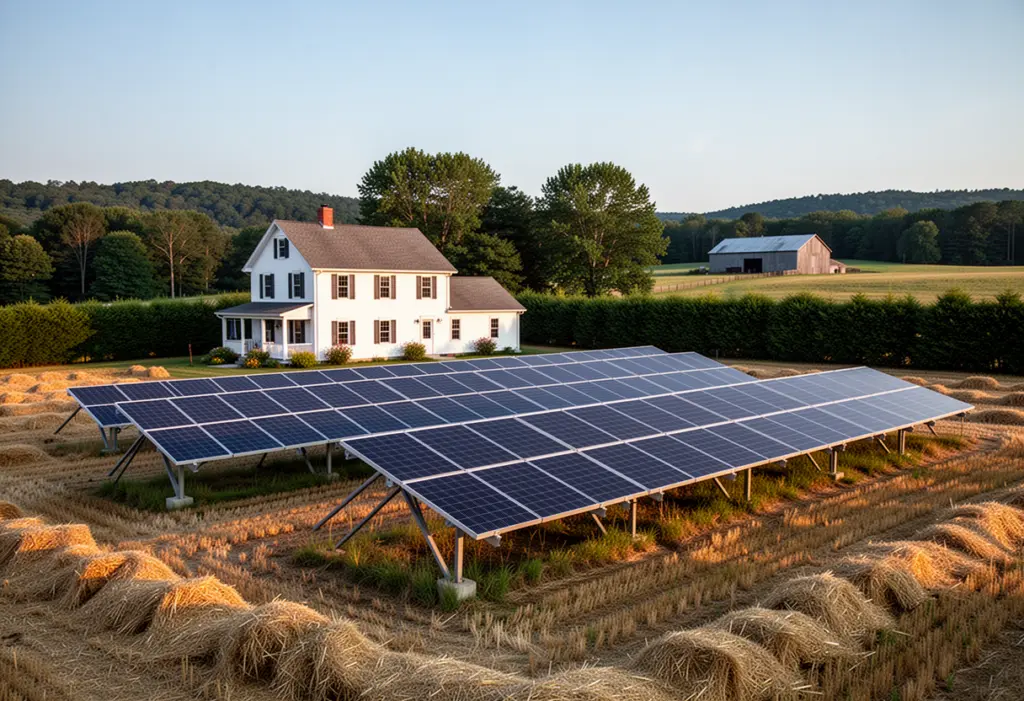
Goshen is the seat of Orange County: an incorporated village inside a town of the same name, with working farmland around it. ZIP code 10924. What a system costs here depends heavily on which side of the village line the parcel sits, and on whether the array is serving a house or a business.
Village or town, and the four levels of RPTL 487
The Village of Goshen and the Town of Goshen are separate authorities with their own building departments, review schedules and fees, so establish which covers your parcel before anything is filed. The split matters again for RPTL 487, the fifteen-year exemption on the added value of a system. Inside the village four authorities decide independently: the village, the town, Orange County, and your school district, which opts out by resolution rather than by local law. Outside the village there are three. The village level is the one most often forgotten, because it is the smallest of the tax bills. Construction must be complete before 1 January 2030.
Ground mount or roof: where the money goes
On a village lot the array goes on the roof, because there is nowhere else to put it. Give the same house four acres and the ground becomes the better site, and a different price sheet applies:
- Trench length. The run from the array back to the house scales with distance and is the line most often underestimated. Ask where the array is proposed and how far the trench runs.
- Foundations. Two questions: how deep, relative to the frost line, and on the strength of what soil information? A design produced without anyone testing your ground is a template with your address typed onto it.
- Clearance under the lowest row. An array set too low is buried in drifted snow for weeks, and that is production you paid for.
- Site plan review. A ground mount can require setbacks and a planning step a roof array does not, which is a schedule cost as much as a money one.
What you get in exchange is real: orientation and tilt are chosen rather than inherited from the roof, the roof-age question disappears entirely, and cleaning and snow clearing happen at ground level.
The farm business trap in the tax credit
Form IT-255 gives the credit only for equipment installed and used at your principal residence in New York State, which on a working farm is not a formality. An array wired to the farm business meter — barns, wells, cooling, irrigation — is not equipment at a principal residence, so IT-255 is the wrong instrument for it. An array serving the house is, provided the house is where you actually live rather than a second or seasonal property. Where a property has more than one meter, establish which meter the array will be connected behind before a design is drawn, because a system offsets only the meter it sits behind. A farm project is a different conversation with different rules and should be priced and advised as one; take the tax question to your own accountant rather than to the sales proposal.
The historic village centre
Goshen’s older streets carry significant character, and where architectural review applies it comes ahead of the building permit and can restrict street-visible placement. Establish whether it applies to your address before signing, and design for approval: a rear or secondary roof plane, all-black modules in black frames, flush mounting that follows the plane, concealed conduit. Older village housing also raises roof age, where under roughly ten years of remaining shingle life means re-roofing first, and 100 amp service, where a solar breaker can require a panel upgrade or a line-side tap. Both belong in the quote rather than in a later change order.
The running charge
Orange County is split between two utilities, so read the name off your own bill. On Orange & Rockland the 2026 residential Customer Benefit Contribution is $1.00 per kW-month of DC system size for anyone interconnecting on or after 1 January 2022: $9.00 a month on a 9 kW roof array, about $108 a year, and $15.00 a month on a 15 kW ground mount, about $180. On Central Hudson the rate is $1.67, so those same two systems carry $15.03 and $25.05 a month, roughly $180 and $300 a year. It is charged on capacity regardless of production and recalculated annually, so a larger ground mount carries it whether or not the winter was sunny.
What is left in 2026, and why NY-Sun is not on the list
On a ground mount, NY-Sun was the one incentive whose value moved while you were still deciding. It was never a fixed rate. NYSERDA runs it as a megawatt block: each region holds capacity blocks, and the per-watt incentive steps down as each block fills, by design, so that the programme phases out as the market matures. It came off the contractor’s price rather than being something you claimed, as did the Affordable Solar incentive for households at or below 80% of area median income. As of September 2026 NYSERDA has no open NY-Sun block for homes in any utility territory, standard or Affordable Solar; check NYSERDA’s NY-Sun dashboard for a new one. A figure quoted from an older proposal, or from a neighbour’s job last year, is therefore not evidence of anything you will receive: if a proposal still shows a NY-Sun or Affordable Solar deduction, ask the contractor to name the open block it relies on, in writing. NYSERDA financing through Energy Finance Solutions — an On-Bill Recovery Loan repaid on the utility bill, or a Smart Energy Loan — is worth comparing against a contractor’s own finance offer.
What is left are the tax items: New York’s 25% credit on Form IT-255, capped at $5,000, limited by your state tax liability in any one year with unused credit carrying forward for five years, and reaching leases and power purchase agreements of ten years or more; the state sales tax exemption on residential solar equipment; and RPTL 487 subject to the levels above. The federal residential credit is not among them, since section 25D was terminated for expenditures made after 31 December 2025, an expenditure being treated as made when the original installation is completed, so a 2026 buyer claims nothing federally. Programmes change; verify each before you commit.
Frequently Asked Questions
Does a ground mount cost more than a roof array in Goshen?
It can, and the difference is usually trench length, foundation depth relative to frost, and a site plan review a roof array does not need. In exchange you choose orientation and tilt, drop the roof-age question, and clear snow at ground level.
Can I claim the state credit on panels for the farm?
Not on Form IT-255. That credit requires equipment installed and used at your principal residence. An array behind the farm business meter is a different project with different rules — take it to your accountant rather than the sales proposal.
Village of Goshen or Town of Goshen?
They are separate authorities with their own building departments and their own fees, and they are separate for the RPTL 487 exemption as well. Inside the village there are four levels to check, outside it there are three.
Why does my NY-Sun figure need a date on it?
Because NY-Sun runs in megawatt blocks and the per-watt value steps down as each block fills, by design, so a number from last year's job or an older proposal is not evidence of what you will receive. As of September 2026 NYSERDA has no open NY-Sun block for homes in any utility territory; check NYSERDA’s NY-Sun dashboard for a new one. If a proposal still shows a NY-Sun figure, ask the contractor to name the open block in writing.
This article is general information, not tax, legal or financial advice. Incentive amounts, eligibility rules and deadlines change and depend on your utility, your tax situation and your property. Confirm current terms with NYSERDA, your utility and a qualified tax professional before making a decision.
NY Solar Incentives
Independent New York solar research. We summarise NYSERDA, NY-Sun and federal programme rules from published sources and state plainly when a figure is an estimate. We are not a government agency and do not sell equipment.
Run the arithmetic on your own system
Check the dated program table and your arrangement before counting an incentive. Standard residential NY-Sun blocks are closed; Long Island Affordable Solar has a conditional income-verification route. The NY credit depends on qualified costs and tax liability, while the NYC abatement reduces future property-tax bills. The estimator keeps those timings separate.