Solar Panel Cost in Middletown, NY
Middletown is a city with its own building department, small lots and old housing. The utility on your bill can change the running cost by two thirds.
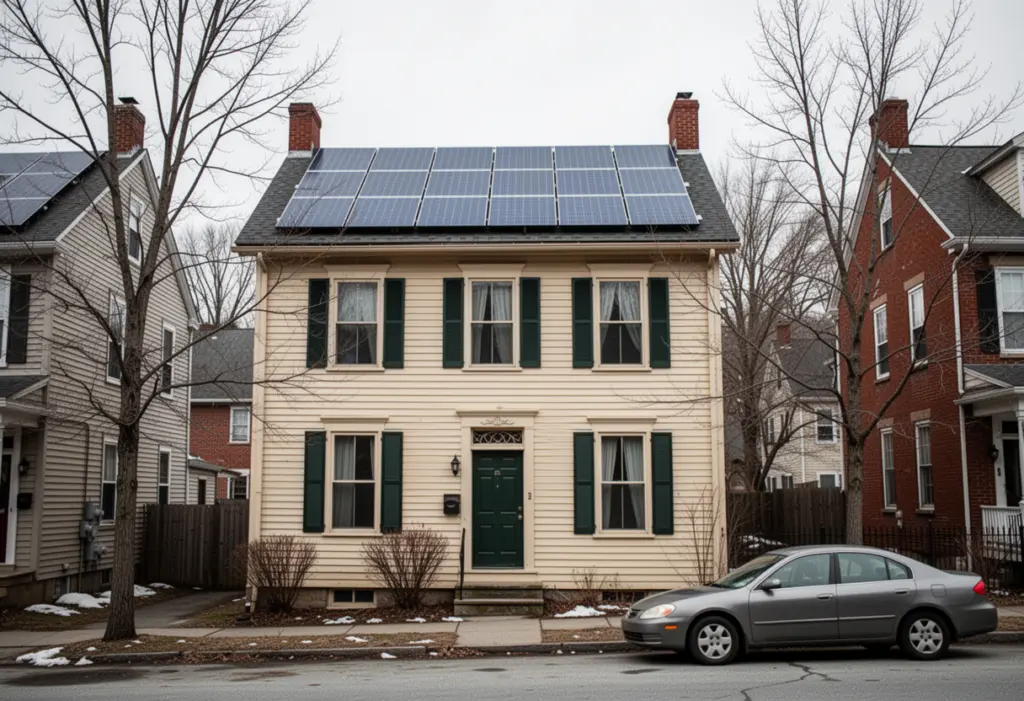
Middletown is a city in Orange County — not a town, and not part of one. ZIP codes 10940 and 10941. Its own building department, its own school district and its own compact street grid all feed into what a system costs here, and for a large share of the housing the cheapest workable answer is not a roof at all.
The city is its own authority
A city address is permitted by the City of Middletown building department; an address just past the line is permitted by the surrounding Town of Wallkill, on a different schedule with different fees. Both use Middletown mailing addresses, so the postmark settles nothing. The same split reaches RPTL 487, the fifteen-year exemption on the added value of the system: for a city address you check the city, Orange County and your school district, and for a Wallkill address you check the town instead of the city, plus a fourth level if the parcel sits inside an incorporated village. Construction must be complete before 1 January 2030.
The utility on your bill changes the running cost by two thirds
Orange County is split between two utilities. Orange & Rockland serves part of it at a 2026 residential Customer Benefit Contribution of $1.00 per kW-month of DC system size; Central Hudson serves part of it at $1.67, the highest residential rate in the state. On a 5 kW system that is $5.00 a month against $8.35, about $60 a year against $100. On an 11 kW system it is $11.00 against $18.37, roughly $132 a year against $220. Two houses a short drive apart can therefore carry a difference of nearly $90 a year on the same array. Read the utility name off your own bill and check that the proposal in front of you used the matching rate. The charge reaches anyone interconnecting on or after 1 January 2022, is billed on capacity regardless of production, and is recalculated annually rather than fixed.
What actually drives the installed price
- Roof area, not your consumption. City lots are small and much of the housing is narrow and tall with cut-up rooflines. Fire-access pathways and setbacks take proportionally more of a modest roof, and a chimney or a dormer removes a real fraction of a small plane rather than being worked around. Ask directly what is limiting the system size.
- The service panel. Older housing here frequently has 100 amp service, and fitting a solar breaker can require an upgrade or a line-side tap. That is a legitimate cost, but it should be visible in the quote rather than arriving later as a change order.
- Structural work. Older wood-frame roofs draw an engineer’s letter more often than newer construction. Budget it rather than discover it.
- Roof age. A shingle roof with under a decade left is a re-roof first and an array second, and that order is cheaper than the other one.
- Review calendars. On the older downtown streets architectural review can apply ahead of the building permit; where it does, design for approval — a rear or secondary plane, all-black modules in black frames, flush mounting, concealed conduit — and ask when the board sits, because a missed deadline can cost a month.
The meter decides who the system is for
A large part of the housing here is rented or two-family, and in those buildings one question outranks the design: whose meter is the array behind? Generation reduces consumption at a single meter and nowhere else, so an owner-side system pays for hallway lights, the boiler and the common areas while the apartment beneath the panels is billed exactly as it was before. Count the meters in the building, decide which one the array serves, and check whose name is on that account, all three before a design exists.
What is left in 2026, and why community solar leads it here
For a tenant, and for an owner whose tenants hold the meters, community solar is the only version of this that reaches the person actually paying. There is no roof to qualify, no up-front cost, no structural letter and no roof-age gate, and because community solar projects sit in front of the meter, subscribers pay no Customer Benefit Contribution at all. On a small, cut-up or shaded city roof it is frequently the better arithmetic even for an owner-occupier, because the constraint on a rooftop system here is usable area rather than appetite.
For an owner-occupier who does have the roof: New York’s credit is 25% of qualified expenditure but capped at $5,000 and limited by your actual state tax liability, so a proposal quoting 25% as though it applied to the whole cost is overstating what arrives. It is not refundable, though unused credit carries forward for up to five years. It requires your principal residence in New York State, and it reaches leases and power purchase agreements of ten years or more as well as purchases. NY-Sun and the Affordable Solar incentive for households at or below 80% of area median income used to come through the contractor as a price reduction. As of September 2026 NYSERDA has no open NY-Sun block for homes in any utility territory; check NYSERDA’s NY-Sun dashboard for a new one. The state sales tax exemption applies to the equipment.
The federal credit is gone for buyers. Section 25D was terminated for expenditures made after 31 December 2025, and an expenditure is treated as made when the original installation is completed, so any 2026 quote still showing 30% federal is materially wrong at the bottom line — which on a cost page is the whole point, because that line is worth thousands and it is not there. Check the current standing of everything above before you sign, because these programmes move.
Frequently Asked Questions
Why do two Middletown quotes show different monthly utility charges?
Usually because Orange County is split between two utilities. The 2026 Customer Benefit Contribution is $1.00 per kW-month on Orange and Rockland against $1.67 on Central Hudson, so an 11 kW system costs about $132 a year on one and $220 on the other. Read the name off your bill.
Who issues the permit for a Middletown address?
The City of Middletown building department inside the city line, and the Town of Wallkill just outside it. Both share Middletown mailing addresses, so confirm the parcel rather than trusting the postmark.
Why is the system smaller than my usage suggests?
On small city lots roof area is usually the binding constraint rather than consumption. Fire-access pathways and setbacks take proportionally more of a modest roof, and a chimney or dormer removes a real fraction of a small plane.
Does solar help if I rent in Middletown?
A rooftop system offsets only the meter it is connected behind, so a landlord's array does not reach a tenant's apartment. Community solar does: no roof, no up-front cost, and subscribers pay no Customer Benefit Contribution.
This article is general information, not tax, legal or financial advice. Incentive amounts, eligibility rules and deadlines change and depend on your utility, your tax situation and your property. Confirm current terms with NYSERDA, your utility and a qualified tax professional before making a decision.
NY Solar Incentives
Independent New York solar research. We summarise NYSERDA, NY-Sun and federal programme rules from published sources and state plainly when a figure is an estimate. We are not a government agency and do not sell equipment.
Run the arithmetic on your own system
Check the dated program table and your arrangement before counting an incentive. Standard residential NY-Sun blocks are closed; Long Island Affordable Solar has a conditional income-verification route. The NY credit depends on qualified costs and tax liability, while the NYC abatement reduces future property-tax bills. The estimator keeps those timings separate.