Solar Panel Installation in Gowanda, NY
Gowanda straddles a county line and a creek, and both of those facts change a solar project in ways a standard New York quote never mentions.
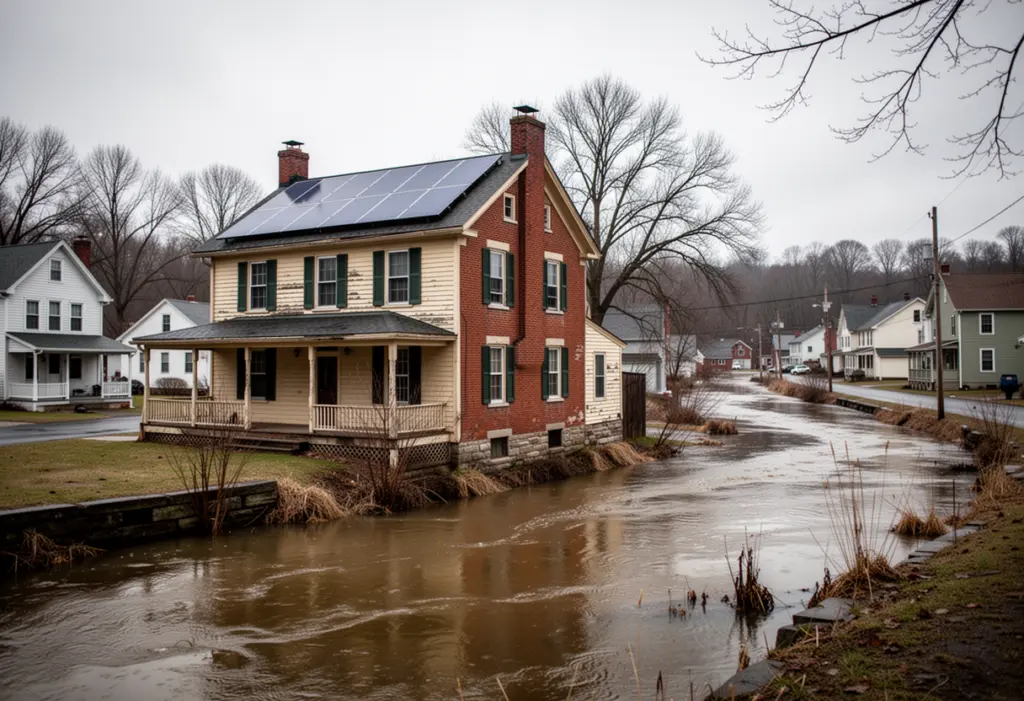
Gowanda is a village on Cattaraugus Creek in the far south-west of Erie County, and it does not sit tidily inside one municipality: the village straddles the Erie and Cattaraugus county line, falling partly in the Town of Persia in Cattaraugus County and partly in the Town of Collins in Erie County. ZIP code 14070. Sorting out which side your parcel is on comes before everything else, because two incentives hang on the answer.
A county line running through the tax exemption
RPTL 487 exempts the added value of a solar system from real property tax for fifteen years, but only where the taxing body has not opted out, and the opt-out belongs to a county, city, town or village by local law and to a school district by resolution. In Gowanda that means four separate answers, and two of them turn on a boundary running through the village: your village, your town (Persia or Collins, which are not the same), your county (Cattaraugus or Erie, which are not the same either), and your school district. An installer who says the exemption applies because a county has not opted out may not have established which county you are in. Construction has to be complete before 1 January 2030.
The same boundary can reach the sales tax exemption. The state exemption on residential solar equipment applies throughout New York, but localities may separately elect to exempt their own share, so total relief is not necessarily identical on the two sides of the line.
The creek, and where the equipment is allowed to sit
Cattaraugus Creek runs through the middle of the village, and low-lying parcels along it are in mapped flood plain. Where that applies it governs the electrical equipment rather than the panels: the inverter, the AC and DC disconnects, the production meter and any battery generally have to sit above a specified elevation, which in practice can mean a different wall, a greater height, or an interior position instead of the default spot beside the meter. A basement is frequently the wrong home for a battery on these properties, however convenient it would otherwise be, and the design has to be right the first time because relocating equipment after inspection is expensive. Put the question to the village before a design exists rather than after: is this parcel inside a mapped zone, and what does that impose? An installer who has not worked along this creek may never think to raise it.
Your utility is not a safe assumption here either
A few miles up the road Springville runs its own municipal electric utility, as do Salamanca and Little Valley further into Cattaraugus County. Municipal customers sit outside Public Service Commission jurisdiction, with no state net metering, no Customer Benefit Contribution and no standardised interconnection process, so a figure quoted by a neighbour may describe a different world from yours. The name on your own bill decides it.
Where that name is an investor-owned utility, the Customer Benefit Contribution applies: monthly, on the DC size of the array, for anyone interconnecting on or after 1 January 2022, levied on capacity rather than output and recalculated each year. A 10 kW system pays $9.70 a month at National Grid’s 2026 residential rate of $0.97 per kW-month and $11.90 at NYSEG’s $1.19, about $116 and $143 a year; a 15 kW ground mount pays $14.55 and $17.85, roughly $175 and $214. Phase One net metering credits exports at the full retail rate and holds that structure for twenty years from interconnection, and community solar subscribers pay no Customer Benefit Contribution at all.
Permits, and one boundary worth naming
The Village of Gowanda, the Town of Persia and the Town of Collins each run their own building department. Establish which covers your address before an installer files anything, and ask whether the New York State Unified Solar Permit is in use locally, since it standardises residential permitting for systems of 25 kW DC and under. Gowanda also sits beside the Cattaraugus Territory of the Seneca Nation, and land tenure and approvals inside a territory boundary are not the standard New York arrangement, so an address there should confirm requirements locally rather than assume standard practice, and get the answers in writing before signing an installation contract.
Snow, old roofs, open land
This is lake-effect country, so ask what ground snow load the racking, attachments and roof structure are specified for, whether a structural engineer’s letter is required, whether snow guards are needed where the array can shed onto a door, a walkway or a driveway, and what snow-cover assumption is inside the production estimate. Village housing is largely nineteenth and early twentieth century, which raises the familiar pair: 100 amp service, where a solar breaker can require a panel upgrade or a line-side tap, and roof age, where with under roughly ten years of remaining shingle life the right move is to re-roof first. Slate and standing-seam metal both appear on these streets, and standing seam is the best case, because the racking clamps to the seams without penetrating the roof. Outside the village there is acreage, and a ground mount brings chosen orientation and tilt, no roof-age question and ground-level snow clearing, against a trench run, a frost-depth foundation, setbacks and possibly site plan review.
2026 incentives
Beyond the property tax and sales tax positions above, a Gowanda homeowner in 2026 has New York’s 25% credit capped at $5,000 on Form IT-255, for equipment serving your principal residence in this state, reaching leases and power purchase agreements of ten years or more as well as outright purchases and limited by your actual state tax liability, with unused credit carrying forward for five years. NY-Sun and the Affordable Solar incentive for households at or below 80% of area median income used to sit alongside it, both applied by your contractor as a reduction on the price rather than claimed by you. As of September 2026 NYSERDA has no open NY-Sun block for homes in any utility territory; check NYSERDA’s NY-Sun dashboard for a new one.
The federal credit is not on that list. Section 25D was terminated for expenditures made after 31 December 2025, and the statute counts the expenditure at the point the original installation is finished, not at the point the meter is changed. A 2026 buyer therefore earns nothing federally, and any proposal still showing 30% belongs to last year’s rules. Programmes change, so verify the current position before you commit.
Frequently Asked Questions
Which county am I in for the Gowanda property tax exemption?
It depends on your parcel. The village straddles the Erie and Cattaraugus county line, in the Town of Collins on the Erie side and the Town of Persia on the Cattaraugus side. RPTL 487 needs the village, your town, your county and your school district each separately not to have opted out.
Can the county line change my sales tax relief too?
It can. The state exemption on residential solar equipment applies throughout New York, but localities may separately elect to exempt their own share, so the total is not automatically identical on the two sides of the boundary running through the village.
Am I on the same utility as Springville?
Probably not. Springville runs its own municipal electric utility, as do Salamanca and Little Valley, and municipal customers have no state net metering and no Customer Benefit Contribution. Confirm your own utility from the name printed on your bill.
What does the Customer Benefit Contribution cost in Gowanda?
On National Grid it is $0.97 per kW-month in 2026, so about $116 a year on a 10 kW system and $175 on a 15 kW ground mount. On NYSEG at $1.19 the same systems come to roughly $143 and $214. It is charged on capacity regardless of production.
This article is general information, not tax, legal or financial advice. Incentive amounts, eligibility rules and deadlines change and depend on your utility, your tax situation and your property. Confirm current terms with NYSERDA, your utility and a qualified tax professional before making a decision.
NY Solar Incentives
Independent New York solar research. We summarise NYSERDA, NY-Sun and federal programme rules from published sources and state plainly when a figure is an estimate. We are not a government agency and do not sell equipment.
Run the arithmetic on your own system
Check the dated program table and your arrangement before counting an incentive. Standard residential NY-Sun blocks are closed; Long Island Affordable Solar has a conditional income-verification route. The NY credit depends on qualified costs and tax liability, while the NYC abatement reduces future property-tax bills. The estimator keeps those timings separate.