Solar Panel Cost in Olean, NY
Olean sits in a river valley ringed by hills. The southern horizon and the flood plain are the two things that move the number here.
On this page 7 sections
- 01A southern ridge, and what it does to the price per kilowatt-hour
- 02The flood plain decides where the equipment can go
- 03Snow specification is a line item, not a preference
- 04The running charge, and why it differs across the county
- 05Permits, roofs and land
- 06What 2026 does to the arithmetic
- 07Frequently Asked Questions
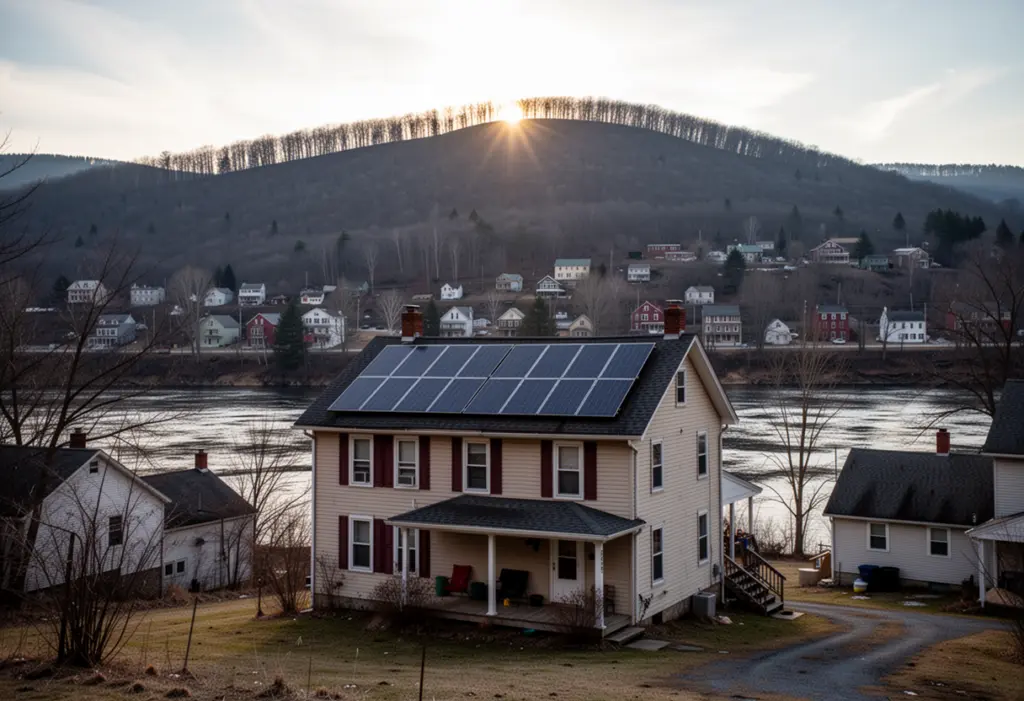
Olean is a city in Cattaraugus County on the Allegheny River, in the far south-western Southern Tier. ZIP code 14760. Two features of the site itself move the cost of an installation here in ways a quote drawn from an aerial photograph will not show.
A southern ridge, and what it does to the price per kilowatt-hour
The city sits in a river valley with wooded hills close in on both sides. The annual production number in a proposal can look entirely normal while the December and January numbers quietly do not, because the sun is low in those months and a ridge that is irrelevant in July removes hours of generation exactly when a net metering credit bank is being drawn down rather than built up. An overstated production estimate makes a system look cheaper per kilowatt-hour than it is, which is why this belongs in a cost article rather than a design one.
Three things to insist on. An on-site shading assessment that measures the horizon, because a remote tool models trees and buildings far better than it models a ridge line. Monthly production figures rather than an annual total, compared December against December between competing quotes, since a wide gap usually means one installer never visited the property. And an explicit decision about sizing, because covering a real winter shortfall with a larger array is a larger price and a larger monthly utility charge, which should be chosen rather than defaulted into.
The flood plain decides where the equipment can go
Low-lying parcels along the Allegheny and its tributaries sit in mapped flood plain. Where that applies it governs where the electrical equipment may be mounted:
- Every electrical component has a minimum mounting height fixed by the mapped elevation rather than by convenience: inverter, disconnects, production meter, battery.
- Meeting it usually forces the equipment onto another wall, higher up it, or indoors, instead of the default position beside the meter.
- A basement is the location that most often fails the test, and it is also the one an installer will suggest first for a battery.
- Getting it wrong is not an adjustment. Equipment moved after inspection is a change order with a price attached.
Ask whether your parcel is in a mapped zone, and what the city requires, before a design is drawn rather than after it is priced.
Snow specification is a line item, not a preference
Southern Cattaraugus County takes serious snow, and equipment specified for a generic New York installation may simply not meet the local ground snow load. Racking and attachments rated for it cost more than baseline hardware; a structural engineer’s letter is needed more often here than downstate and should be budgeted rather than discovered; and snow guards over any door, walkway or driveway the array can shed onto are a safety item, because a full array sheds as a slab rather than in pieces. What heavy snow does not justify is steepening a roof array to shed faster, which raises wind load, complicates the mounting and usually costs more annual production than the snow it clears.
The running charge, and why it differs across the county
The Customer Benefit Contribution is a monthly charge on the DC size of the system for anyone interconnecting on or after 1 January 2022. It is levied on capacity regardless of production and recalculated annually, so it is a running cost for the life of the array rather than a one-off. An 8 kW system pays $7.76 a month at National Grid’s 2026 residential rate of $0.97 per kW-month and $9.52 at NYSEG’s $1.19; at 12 kW the figures are $11.64 and $14.28. Annualised, that is about $93 against $114 on the smaller system and $140 against $171 on the larger, and over twenty years the gap is not a rounding error, so check the name printed on your own bill rather than assuming. Cattaraugus County also contains municipal electric utilities — Salamanca and Little Valley both run their own — and municipal customers pay no Customer Benefit Contribution, have no state net metering and use no standardised state interconnection process. Community solar subscribers pay no Customer Benefit Contribution either.
Permits, roofs and land
The City of Olean and the Town of Olean are separate authorities with their own building departments, so settle which covers your address before an installer files anything. On older city housing two costs recur: 100 amp service, where fitting a solar breaker can require a panel upgrade or a line-side tap, and roof age, where with under roughly ten years of remaining shingle life the right sequence is to re-roof first. Outside the city a rural parcel makes a ground mount a real option — orientation and tilt are chosen rather than inherited, the roof-age question disappears, and snow clearing happens at ground level — at the cost of a trench run, a foundation taken below the frost line, setbacks and possibly site plan review.
What 2026 does to the arithmetic
The number that matters most on a cost page is the cap. New York’s credit is 25% of qualified expenditure but stops at $5,000, so the moment qualified expenditure passes $20,000 the percentage stops describing anything: a $20,000 system and a $34,000 system both receive $5,000, and the effective rate on the larger one is under 15%. That interacts directly with the valley problem above, because if the answer to a winter shortfall is a bigger array, the credit does not scale with it. The credit is limited by your actual state tax liability as well, though it is not refundable and unused credit carries forward for five years, and it needs the equipment to serve your principal residence in New York.
The rest of the 2026 position, briefly. NY-Sun used to arrive as a price reduction through your contractor, with the Affordable Solar incentive for households at or below 80% of area median income. As of September 2026 NYSERDA has no open NY-Sun block for homes in any utility territory; check NYSERDA’s NY-Sun dashboard for a new one. The state sales tax exemption applies to the equipment. RPTL 487 exempts the added value from property tax for fifteen years where the city or town, Cattaraugus County and your school district have each separately not opted out, for construction completed before 1 January 2030. And the federal credit is not part of the arithmetic at all: section 25D was terminated for expenditures made after 31 December 2025, an expenditure being treated as made when the original installation is completed, so a quote still carrying a 30% federal line is understating your net cost by thousands. Check every one of these yourself before signing, because they change.
Frequently Asked Questions
Why should an Olean quote show monthly production, not just annual?
Because the city sits in a valley ringed by hills. A ridge to the south is irrelevant in July and decisive in December and January, when a net metering credit bank is being drawn down. Compare the winter months between competing quotes.
Does the Allegheny flood plain affect a solar installation?
On low-lying parcels, yes. The inverter, disconnects, production meter and any battery usually have to sit above a specified elevation, so a basement battery is frequently the wrong answer however convenient that location would otherwise be. Ask what the city requires before a design is drawn.
What does the utility charge add to the cost in Olean?
The Customer Benefit Contribution is charged monthly on DC system size for systems interconnected on or after 1 January 2022. On National Grid at $0.97 per kW-month that is about $93 a year on 8 kW; on NYSEG at $1.19 it is about $114.
Does the state credit scale with a bigger system?
Only up to a point. It is 25% of qualified expenditure but capped at $5,000, so beyond about $20,000 of qualified expenditure the cap binds and the effective rate falls with every panel added. That matters if a winter shortfall is being answered with a larger array.
This article is general information, not tax, legal or financial advice. Incentive amounts, eligibility rules and deadlines change and depend on your utility, your tax situation and your property. Confirm current terms with NYSERDA, your utility and a qualified tax professional before making a decision.
NY Solar Incentives
Independent New York solar research. We summarise NYSERDA, NY-Sun and federal programme rules from published sources and state plainly when a figure is an estimate. We are not a government agency and do not sell equipment.
Run the arithmetic on your own system
Check the dated program table and your arrangement before counting an incentive. Standard residential NY-Sun blocks are closed; Long Island Affordable Solar has a conditional income-verification route. The NY credit depends on qualified costs and tax liability, while the NYC abatement reduces future property-tax bills. The estimator keeps those timings separate.