Solar Panel Installation in Springville, NY
Springville is served by its own municipal electric utility, so the state net metering rules an installer quotes you may not be the ones that govern your bill.
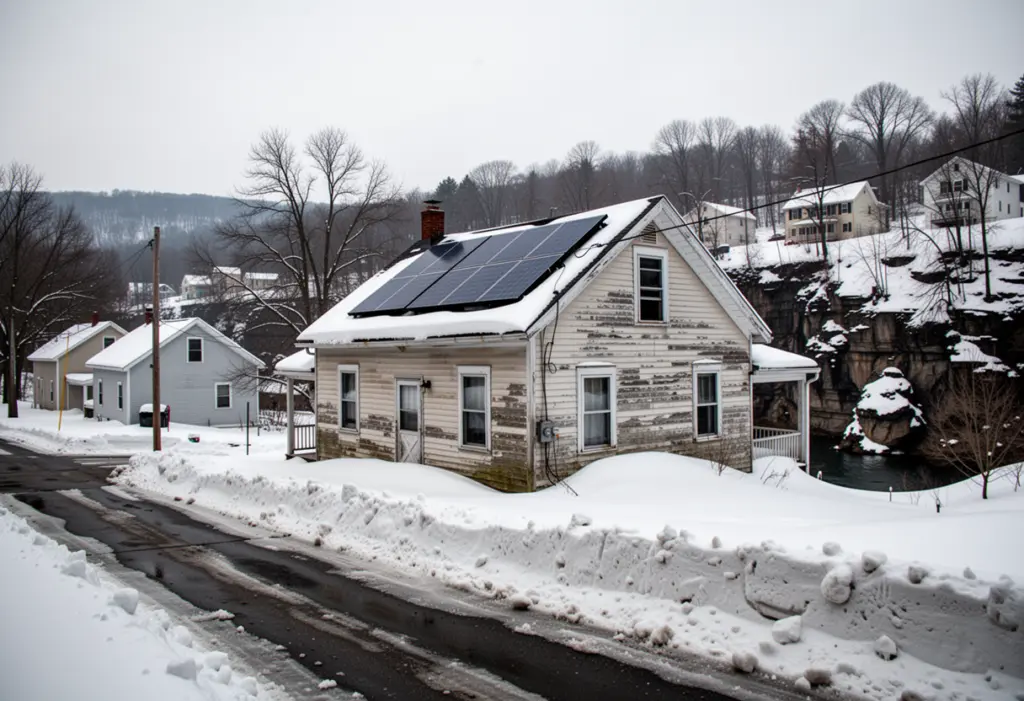
Springville is a village in Erie County, inside the Town of Concord, on high ground above the Cattaraugus Creek gorge at the southern end of the county. ZIP code 14141. Two conditions dominate a project here, and the first one is not the weather.
Four things to do before you take a quote seriously
The village is served by its own municipal electric utility, and municipal utilities sit outside Public Service Commission jurisdiction, which means several statements that sound like law in a sales conversation are not law at this address. Work through these in order:
- Read the utility name off your own bill. Addresses in the surrounding Town of Concord, outside the village line, may well be on an investor-owned utility, where every state rule does apply.
- If it is the village utility, ask it in writing what it credits for exported electricity and at what rate against the rate you pay; whether credits carry month to month or expire at an annual true-up; what the interconnection application costs and how long it takes; whether system size is capped against your own historical usage; and whether a generating customer picks up a standby or minimum charge. Phase One net metering and the standardised state interconnection process are Commission constructs, and neither is a promise made here.
- Check the quote for a Customer Benefit Contribution line. Municipal customers do not pay it, and a proposal generated from a statewide template can carry it anyway.
- Settle which building department holds your parcel, since the village and the Town of Concord are distinct authorities. Ask that department whether it has taken up the New York State Unified Solar Permit, which standardises the residential application at 25 kW DC and under and is in use at over 300 authorities having jurisdiction.
What a Concord address on an investor-owned utility pays
The charge is monthly, based on DC system size rather than generation, applies to anyone interconnecting on or after 1 January 2022, and is reset annually rather than fixed at interconnection. At 2026 residential rates a 13 kW system costs $12.61 a month at National Grid’s $0.97 per kW-month and $15.47 at NYSEG’s $1.19, about $151 and $186 across a year. A 16 kW array costs $15.52 and $19.04 a month, roughly $186 and $228. Subscribers to community solar pay none of it.
The heavy end of the snow belt
High ground in southern Erie County is where lake-effect snow off Lake Erie falls hardest, and the totals are materially above what a generic New York specification assumes. That is a structural question rather than a matter of taste. Ask what ground snow load the racking, the attachments and the roof structure are rated for, because equipment specified for a downstate job may not meet it and a structural engineer’s letter is needed here more often than elsewhere — budget it rather than discover it. Ask where the array discharges, because panels are slicker than shingle and a full array sheds as a slab, which makes snow guards above a door, a walkway or a driveway a safety item. And ask what snow-cover assumption sits inside the production estimate, since a downstate profile overstates a Springville winter substantially and every payback figure built on it is optimistic by the same margin. What none of this justifies is steepening a roof array to shed faster: that raises wind load, complicates the mounting and usually costs more annual production than the snow it clears.
Land, and old roofs
Outside the village there is real acreage, and a ground mount is a genuine option — orientation and tilt chosen rather than inherited, no roof-age question, and maintenance at ground level, which in this particular snow belt is worth more than it sounds. Ask about setbacks, site plan review, foundation depth below the frost line, the trench run back to the house, and above all how much clearance sits beneath the lowest row, because an array set low here is buried in drifted snow for weeks at a time.
On the older village streets 100 amp service is common, and fitting a solar breaker can need a panel upgrade or a line-side tap, which belongs in the quote rather than a change order. Roof age is the usual gate: with under roughly ten years of remaining shingle life, re-roof first. Standing-seam metal is common on farm buildings and older houses here and is the best case of all, because the racking clamps to the seams, puts no holes in the roof, and the roof commonly outlasts the panels.
2026 incentives, starting with the school district
RPTL 487’s fifteen-year exemption on the added value of the system is the incentive most often described loosely, and in a rural Erie County town the loose description costs the most, because the school levy is usually the largest line on the tax bill. Four bodies decide independently — the Village of Springville, the Town of Concord, Erie County, and your school district, which opts out by resolution rather than by local law — and the school district is the one to ask about first rather than last. Three yes answers and one no still leaves part of the added value taxable. Construction must be complete before 1 January 2030.
Then the rest. New York’s 25% credit capped at $5,000 on Form IT-255 is a tax matter that does not depend on your utility: it needs the equipment to serve your principal residence in New York, reaches leases and power purchase agreements of ten years or more as well as purchases, and is limited by your actual state tax liability, with unused credit carrying forward for five years. The state sales tax exemption applies to the equipment. NY-Sun and the Affordable Solar incentive for households at or below 80% of area median income used to be applied by the contractor. As of September 2026 NYSERDA has no open NY-Sun block for homes in any utility territory; check NYSERDA’s NY-Sun dashboard for a new one. If one opens, on a municipal electric address you should hold written confirmation that it is available before a proposal is priced around it.
Nothing federal remains for a purchase. Section 25D was terminated for expenditures made after 31 December 2025, and the expenditure counts as made when the original installation is completed. One exception runs the other way and matters on a new build: where the work forms part of constructing or reconstructing a structure, the expenditure is treated as made when your original use of that structure begins, so panels fitted in December 2025 to a house first occupied in 2026 do not qualify either. Programmes change, so check where each of these stands before you commit.
Frequently Asked Questions
Which rules govern export credits in Springville?
The village utility's own. It is a municipal electric utility and therefore outside Public Service Commission jurisdiction, so Phase One net metering and the standardised interconnection process do not reach it, and the Customer Benefit Contribution is not charged. Ask the utility for its terms in writing.
How much snow does a Springville array have to be designed for?
More than a generic New York specification assumes. The village sits on high ground in southern Erie County where lake-effect snow falls hardest. Ask what ground snow load the racking, attachments and roof structure are rated for, and expect a structural engineer's letter more often than elsewhere.
Village of Springville or Town of Concord?
They are separate authorities with their own building departments, and your utility may differ too. Establish which covers your address before an installer files anything, and confirm the utility from your own bill rather than from a neighbour.
Which RPTL 487 level should I check first here?
The school district, because the school levy is usually the largest line on the tax bill. It opts out by resolution rather than by local law, and it decides independently of the village, the town and Erie County, so one opt-out out of four still leaves part of the added value taxable.
This article is general information, not tax, legal or financial advice. Incentive amounts, eligibility rules and deadlines change and depend on your utility, your tax situation and your property. Confirm current terms with NYSERDA, your utility and a qualified tax professional before making a decision.
NY Solar Incentives
Independent New York solar research. We summarise NYSERDA, NY-Sun and federal programme rules from published sources and state plainly when a figure is an estimate. We are not a government agency and do not sell equipment.
Run the arithmetic on your own system
Check the dated program table and your arrangement before counting an incentive. Standard residential NY-Sun blocks are closed; Long Island Affordable Solar has a conditional income-verification route. The NY credit depends on qualified costs and tax liability, while the NYC abatement reduces future property-tax bills. The estimator keeps those timings separate.