Solar Incentives in Fredonia, NY
Fredonia is a village inside the Town of Pomfret, and the property tax exemption has to be checked against both of them plus the county and the school district.
On this page 7 sections
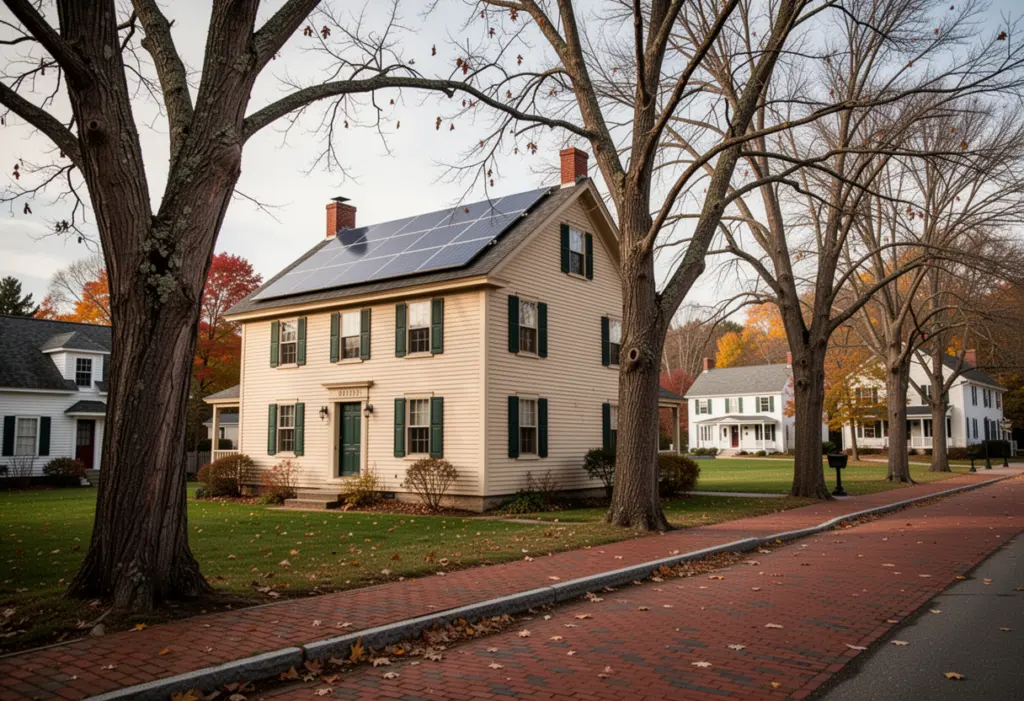
Fredonia is a village in Chautauqua County, inside the Town of Pomfret and a couple of miles inland from Dunkirk and the Lake Erie shore. ZIP code 14063. The 2026 list of incentives here is shorter than the 2025 one, and the first question is not which incentives exist but whether the house they are quoted against is the one you actually live in.
The principal residence test decides most of it
New York’s solar energy system equipment credit — 25% of qualified expenditure, capped at $5,000, claimed on Form IT-255 — requires the equipment to be installed and used at your principal residence in New York State. In a village with a university campus and a large share of investor-owned rental housing, that sentence does more work than anything else on this page.
- A house you rent out does not qualify, however local it is and however much of its roof faces south.
- A second home or a seasonal property does not qualify either. The test is where you live, not where the meter is.
- A tenant cannot claim it, because the tenant does not own the equipment.
- Where you do live in the house, the credit is limited by your actual New York State tax liability. It is not refundable, but unused credit carries forward for up to five years, so a shortfall in year one is deferred rather than lost.
The credit reaches leases and power purchase agreements as well as outright purchases, but only where the agreement runs for ten years or more. That ten-year minimum applies to the lease exactly as it applies to the PPA, so a five- or seven-year lease earns nothing at all. Where an agreement runs beyond fifteen years, no credit is allowed after the fifteenth year even if the $5,000 has not been used up.
NY-Sun and its adder: closed for homes
NY-Sun used to reach you through the contractor as a reduction on the price rather than through a form you file, and the Affordable Solar incentive increased it for households at or below 80% of area median income. Neither is available to a home now. As of September 2026 NYSERDA has no open NY-Sun block for homes in any utility territory; check NYSERDA’s NY-Sun dashboard for a new one. The last standard upstate residential block (Block 14, $0.15/W, NYSEG, RG&E and National Grid territories) closed on 17 December 2025 and the upstate Affordable Solar block on 9 March 2026, so a quote that still shows either needs explaining. NYSERDA also runs financing through Energy Finance Solutions, including an On-Bill Recovery Loan repaid on the utility bill and a Smart Energy Loan, both worth pricing against a contractor’s own finance offer rather than assuming they are the same thing.
The state sales tax exemption on residential solar equipment applies as well, and localities may separately elect to exempt their own share, so total relief differs between one county and the next.
RPTL 487 takes four signatures here, not one
The fifteen-year exemption on the added value of the system exists only where the taxing body has not opted out, and in a village inside a town that is four bodies deciding independently: the Village of Fredonia, the Town of Pomfret, Chautauqua County, and your school district, which opts out by resolution rather than by local law. An installer who tells you the exemption applies because the county has not opted out has answered a quarter of the question. Construction has to be complete before 1 January 2030.
The charge on the other side of the ledger
Set against those incentives is the Customer Benefit Contribution, billed monthly on the DC size of the array for anyone interconnecting on or after 1 January 2022, levied on capacity whatever the weather does, and recalculated annually. At National Grid’s 2026 residential rate of $0.97 per kW-month, a 5 kW system pays $4.85 a month and an 8 kW system $7.76, about $58 and $93 a year. At NYSEG’s $1.19 the same two systems pay $5.95 and $9.52, roughly $71 and $114. Confirm which of them bills you by reading your own bill rather than asking a neighbour: Brocton and Westfield, both a short drive away, run their own municipal electric departments, and a municipal customer is outside Public Service Commission jurisdiction altogether, with no state net metering, no Customer Benefit Contribution and no standardised interconnection. Community solar subscribers pay no Customer Benefit Contribution either, wherever they live.
One local step that can cost you a programme
The older streets around the village green carry genuine nineteenth-century character, and where architectural review applies it runs ahead of the building permit and can restrict street-visible placement. Boards often sit monthly, so a missed submission deadline is four weeks, and a project held in review across a year boundary can lose a programme that was open when it was quoted — a live risk in a year when the rules have already moved once. Design for approval rather than arguing after refusal: a rear or secondary roof plane, all-black modules in black frames, flush mounting that follows the plane of the roof, and conduit run out of sight.
And the one that has gone
There is no federal residential credit for a 2026 buyer. Section 25D was terminated for expenditures made after 31 December 2025, with the expenditure treated as made when the original installation is completed rather than when the system is energised, so a job finished last December still qualifies even if it was switched on in January and a job finished this year does not, at any point in the year. Any total resting on a 30% federal line is not a total. Check the current position of every programme above before you commit, because they change.
Frequently Asked Questions
Can I claim the New York credit on a house I rent out in Fredonia?
No. Form IT-255 requires the equipment to be installed and used at your principal residence in New York State, so a rental, a second home or a seasonal property does not qualify, and a tenant cannot claim it either because the tenant does not own the equipment.
Who has to have not opted out for RPTL 487 to apply in Fredonia?
Four bodies, each separately: the Village of Fredonia, the Town of Pomfret, Chautauqua County and your school district. Check all four. The section also requires construction before 1 January 2030.
Does a solar lease qualify for the New York credit?
Only a lease of ten years or more. The ten-year minimum applies to a lease as well as to a power purchase agreement, so a five- or seven-year lease does not qualify for the 25% credit on Form IT-255. Beyond fifteen years no credit is allowed after the fifteenth year.
What is Affordable Solar and why might my quote not mention it?
It was a NYSERDA adder that increased the NY-Sun incentive for households at or below 80% of area median income, applied by the contractor as a price reduction. A 2026 quote should not mention it: the upstate Affordable Solar block closed on 9 March 2026. As of September 2026 NYSERDA has no open NY-Sun block for homes in any utility territory; check NYSERDA's NY-Sun dashboard for a new one.
This article is general information, not tax, legal or financial advice. Incentive amounts, eligibility rules and deadlines change and depend on your utility, your tax situation and your property. Confirm current terms with NYSERDA, your utility and a qualified tax professional before making a decision.
NY Solar Incentives
Independent New York solar research. We summarise NYSERDA, NY-Sun and federal programme rules from published sources and state plainly when a figure is an estimate. We are not a government agency and do not sell equipment.
Run the arithmetic on your own system
Check the dated program table and your arrangement before counting an incentive. Standard residential NY-Sun blocks are closed; Long Island Affordable Solar has a conditional income-verification route. The NY credit depends on qualified costs and tax liability, while the NYC abatement reduces future property-tax bills. The estimator keeps those timings separate.