Why Solar Quotes Vary So Much in New York
Three installers can price the same New York roof very differently without any of them being dishonest. The spread has an order to it, and most of it is not equipment.
On this page 8 sections
- 011. They are not the same system
- 022. The sales channel is inside the price
- 033. The scope is different, and nobody says so
- 044. The savings model, not the system, does the persuading
- 055. Equipment tier and what the warranty actually promises
- 066. Where your roof is, which nobody in the quote controls
- 07Why the incentives are rarely the explanation
- 08Frequently Asked Questions
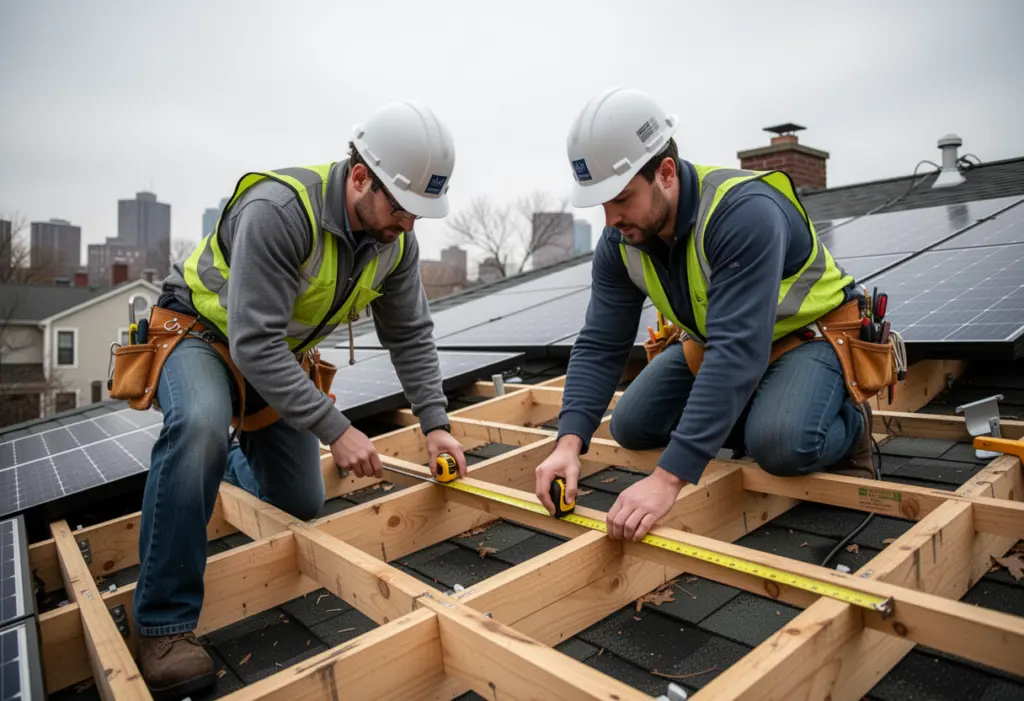
Three quotes for one roof can differ by an amount that looks like a mistake. Usually it is not. The spread has a predictable order, and once you know it you can reduce three incomparable documents to one table. Start at the top of this list, because the first item alone explains more of the difference than everything below it.
1. They are not the same system
The most common reason two quotes differ is that one is bigger. Convert every offer to dollars per DC watt — total price divided by module rated wattage multiplied by module count — before you compare anything. A designer who assumes you will add an electric vehicle or a heat pump will size upward; one working purely from last year’s bills will not. Neither is wrong, but they are answering different questions, and the totals cannot be read side by side until you normalise them.
2. The sales channel is inside the price
A company that buys leads, runs a call centre and pays a commissioned closer carries a cost per sale that a two-truck local outfit does not. That cost is in your number and it never appears as a line. The financed version is more specific still: a very low interest rate is generally funded by a dealer fee folded into the system price, which is why the cash price for the identical design can be materially lower. Ask every installer for the cash price, even if you intend to finance.
3. The scope is different, and nobody says so
Read what each quote includes before you read what it costs:
- A service panel upgrade included by one and written as if required by another.
- Roof repairs, or a full reroof, in or out.
- Tree removal in or out, and whether future growth was modelled.
- A ground mount with trenching, versus a roof array.
- Critter guard, snow retention, conduit routed inside or outside.
- Who pays the interconnection and permit fees.
4. The savings model, not the system, does the persuading
Two identical arrays can be projected to save very different amounts, because the projection rests on assumptions the reader never sees: the annual utility rate escalator, the shading method — a measured on-site assessment against a satellite estimate — and the module degradation rate. Ask for all three in writing. An optimistic escalator produces a short payback without a single change to the hardware.
5. Equipment tier and what the warranty actually promises
Module and inverter choices genuinely differ in price, and the warranty terms differ more than the panels do. Compare the product warranty and the performance warranty separately, and compare the workmanship warranty separately again. A long warranty from a company that has traded for two years is a different asset from a long warranty from a company that has traded for twenty.
6. Where your roof is, which nobody in the quote controls
The Customer Benefit Contribution is billed monthly on DC size regardless of production, on systems interconnected on or after 1 January 2022, and the 2026 residential rate depends only on your utility. A 10 kW array pays 10 x $1.67 = $16.70 a month on Central Hudson, about $200 a year, against 10 x $0.97 = $9.70 on National Grid, about $116. Same array, same installer, different bill — and the rates are recalculated annually rather than fixed at interconnection.
Permitting varies too. The New York State Unified Solar Permit standardises residential and small commercial solar permitting for systems 25 kW DC and under and has been adopted by over 300 authorities having jurisdiction, but it does not apply in the five boroughs, where the Department of Buildings process applies instead. And if the name on your electricity bill is a village or city electric department rather than one of the investor-owned utilities, you are outside Public Service Commission jurisdiction entirely: no state net metering rules, no capacity charge, no state interconnection process, and terms set by that utility. Confirm the utility from your own bill before you take any quote at face value.
Why the incentives are rarely the explanation
It is tempting to assume the least expensive quote found an incentive the others missed. It almost never did. NY-Sun is set by region and megawatt block, not by installer, and applies as a price reduction whoever does the work, when a block for homes is open. As of September 2026 NYSERDA has no open NY-Sun block for homes in any utility territory; check NYSERDA’s NY-Sun dashboard for a new one. The state sales tax exemption applies to residential solar equipment regardless of who sells it. The 25% state credit capped at $5,000 on Form IT-255 is yours to claim for your principal residence, limited by the tax you owe, and no installer improves it. RPTL 487 runs for 15 years on the added value, requires construction before 1 January 2030, and depends on whether your municipality, county and school district have each opted out — three separate checks you make yourself. So a quote that appears to win on incentives is usually claiming a larger one than it can deliver, and that is worth one direct question before it is worth a signature.
Frequently Asked Questions
Why are solar quotes for the same house so different?
Most often because the systems are different sizes. Convert every offer to dollars per DC watt before comparing, then check scope differences such as a service panel upgrade, roof work or tree removal being in one quote and out of another.
Does the utility affect what solar costs me?
It affects the running cost. The Customer Benefit Contribution is billed on DC size, so a 10 kW array pays about $16.70 a month on Central Hudson against about $9.70 on National Grid, and no installer controls that.
Can one installer get me a better incentive than another?
Rarely. NY-Sun is set by region and megawatt block, and as of September 2026 NYSERDA has no open NY-Sun block for homes in any utility territory; the sales tax exemption applies to the equipment, and the 25% state credit capped at $5,000 is claimed by you on Form IT-255 and limited by your state tax liability.
How do I make three quotes comparable?
Put them in one table: DC watts, dollars per watt, module and inverter model, year one production with the escalator and shading method stated, scope inclusions, each warranty, and the cash price alongside the financed price.
This article is general information, not tax, legal or financial advice. Incentive amounts, eligibility rules and deadlines change and depend on your utility, your tax situation and your property. Confirm current terms with NYSERDA, your utility and a qualified tax professional before making a decision.
NY Solar Incentives
Independent New York solar research. We summarise NYSERDA, NY-Sun and federal programme rules from published sources and state plainly when a figure is an estimate. We are not a government agency and do not sell equipment.
Run the arithmetic on your own system
Check the dated program table and your arrangement before counting an incentive. Standard residential NY-Sun blocks are closed; Long Island Affordable Solar has a conditional income-verification route. The NY credit depends on qualified costs and tax liability, while the NYC abatement reduces future property-tax bills. The estimator keeps those timings separate.