Solar Panels and a Whole House Generator Together in NY
Solar panels and a standby generator can share a house, but they do not cooperate by default. The decision that matters is made by the electrician at the panel, not by the salesperson.
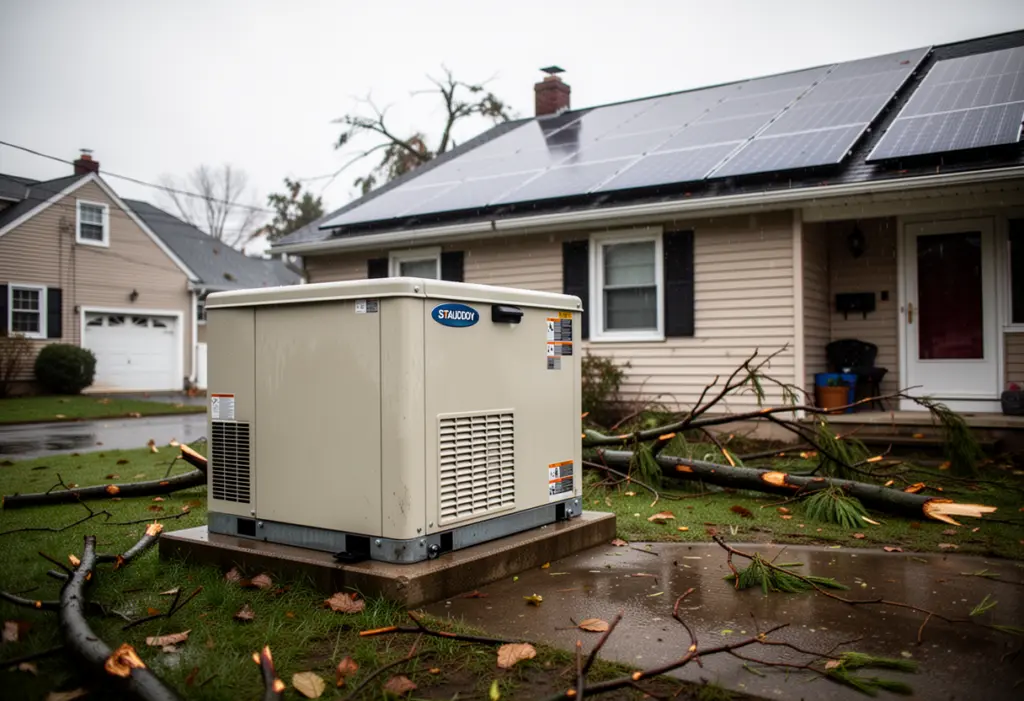
Solar panels and a standby generator can live on the same house, and plenty do. What they will not do is cooperate by default. A grid-tied solar array shuts itself down the moment the utility supply fails, and starting a generator does not bring it back unless the equipment was specified to work that way. If you want both, the decision that matters is made by the electrician at the service panel, not by whoever sells you either box.
Why your solar stops when the power does
A standard grid-tied inverter is required to disconnect when it loses the grid. The reason is not commercial: a line that everybody believes is dead has to actually be dead while a lineworker is on it. So on a bright afternoon during an outage, an array with no additional equipment produces nothing at all, and the household with panels sits in the same dark as the household without.
That surprises people who bought solar partly for resilience, and it is much better learned before the first storm than during it.
Where the generator sits
A whole house generator works through a transfer switch that separates your house from the grid and feeds it from the generator instead. The question that decides everything is whether the solar breaker sits inside or outside the portion of the panel the transfer switch feeds.
- Solar outside the backed-up section. Simplest and most common. During an outage the array is simply off. Nothing conflicts, nothing needs configuring, and you get exactly the generator you paid for.
- Solar inside the backed-up section. This is where it becomes technical. Some inverters will not run from generator power at all, some will and can push power toward a generator that has nowhere to send it, and the interaction has to be designed rather than discovered.
Three questions to put to the electrician in writing: is the solar breaker inside or outside the backed-up panel; can this specific inverter operate on generator power, and what does its manufacturer say about that; and is the generator sized for the loads you actually intend to run.
Generator or battery, honestly
People usually compare these on price and reach the wrong conclusion, because the two answer different questions.
A battery in New York is a resilience purchase, not an economic one. Under Phase One net metering your exports are credited at the full retail rate for 20 years from interconnection, so a kilowatt-hour you store and use tonight is worth what a kilowatt-hour you exported and bought back would have been worth. Storing it does not reduce the bill. What it buys is that the lights stay on, quietly, automatically, with no fuel to think about.
A generator buys a longer outage at lower capital cost, because it runs as long as you feed it. It also brings fuel storage or a gas connection, an annual service, exercise cycles, noise, and no benefit whatsoever on any bill in a normal month. Neither device makes money. Choose on how long your outages are, how often they happen, and what you cannot afford to lose — a well pump, a sump pump, medical equipment, a full freezer.
What neither of them changes
The Customer Benefit Contribution follows the solar and ignores everything else on the property, and it applies only to systems interconnected on or after 1 January 2022. A 12 kW array on National Grid interconnected since that date pays 12 multiplied by $0.97, which is $11.64 a month or $139.68 a year, whether or not there is a generator beside the house and whether or not there was an outage that month. A generator attracts no solar incentive of its own, and adding one moves the solar arithmetic in neither direction.
Where 2026 incentives stand
Two things are worth knowing before you sit down with an installer. As of September 2026 NYSERDA has no open NY-Sun block for homes in any utility territory, and its Affordable Solar blocks for lower-income households have closed too; check NYSERDA’s NY-Sun dashboard for a new one, and ask which open block any NY-Sun line on a quote comes from. NYSERDA financing through Energy Finance Solutions, including an On-Bill Recovery Loan repaid on the utility bill, is a separate conversation from whatever finance the installer offers at the kitchen table.
On the tax side, the New York credit is 25% capped at $5,000 on Form IT-255 for a principal residence, and it is a solar energy system equipment credit. Which portion of a combined solar, storage and generator job counts as qualified expenditure is a question for your accountant and the Form IT-255 instructions, not for a sales team. The 30% federal residential credit is gone — section 25D ended for expenditures made after 31 December 2025, measured by when the original installation is completed — so there is no federal help toward a battery or a generator bought this year either. Confirm current programme terms with NYSERDA before committing to anything.
Frequently Asked Questions
Do I still need a generator if I already have solar panels?
For outage cover, yes. A grid-tied inverter must disconnect when the grid fails, so that a line everyone believes is dead really is dead while a lineworker is on it. Panels alone leave you in the same dark as a house without them.
Can a generator run my solar panels during an outage?
Not automatically. Some inverters will not run on generator power at all, and some can push power toward a generator with nowhere to send it. Ask your electrician whether the solar breaker sits inside or outside the backed-up panel.
Should I buy a battery or a generator?
They answer different questions. A generator runs as long as you feed it and costs less up front. A battery is silent and automatic. Under full retail net metering neither one saves money on your bill.
Does adding a generator change my solar costs?
No. The Customer Benefit Contribution follows the array alone. A 12 kW system interconnected in 2022 or later on National Grid pays 12 x $0.97 = $11.64 a month either way, and a generator attracts no solar incentive of its own.
This article is general information, not tax, legal or financial advice. Incentive amounts, eligibility rules and deadlines change and depend on your utility, your tax situation and your property. Confirm current terms with NYSERDA, your utility and a qualified tax professional before making a decision.
NY Solar Incentives
Independent New York solar research. We summarise NYSERDA, NY-Sun and federal programme rules from published sources and state plainly when a figure is an estimate. We are not a government agency and do not sell equipment.
Run the arithmetic on your own system
Check the dated program table and your arrangement before counting an incentive. Standard residential NY-Sun blocks are closed; Long Island Affordable Solar has a conditional income-verification route. The NY credit depends on qualified costs and tax liability, while the NYC abatement reduces future property-tax bills. The estimator keeps those timings separate.