Solar Panel Roof Leak: Who Is Responsible in New York?
A leak under a solar array is a warranty question before it is a repair job. Which of three documents covers it is something to settle before installation, not after a stain appears.
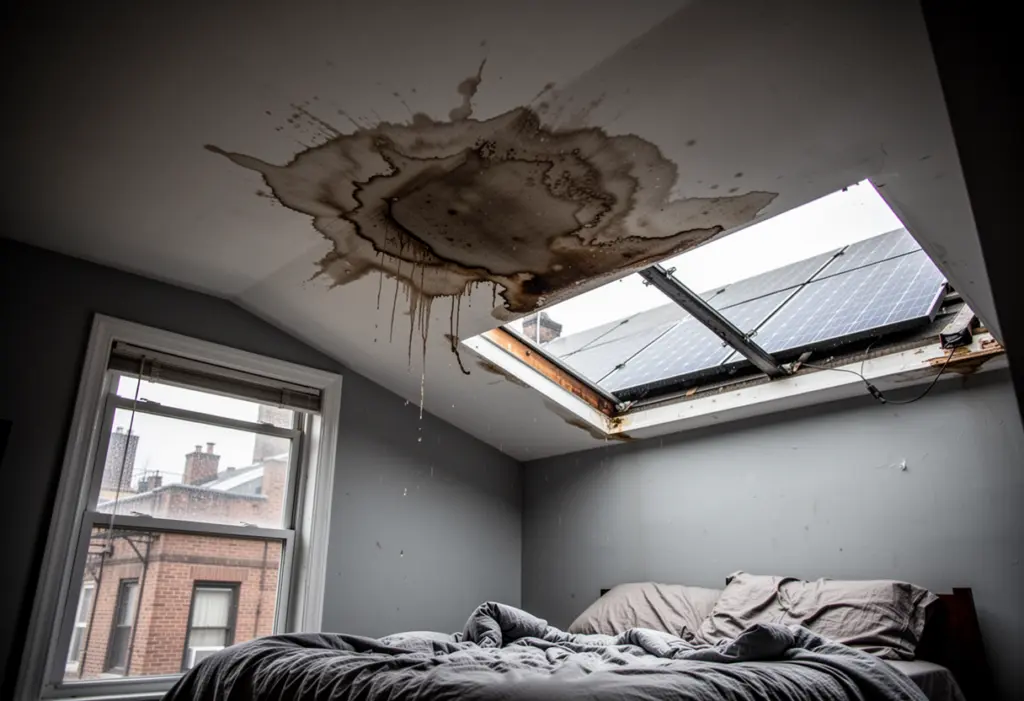
A leak near a solar array is a warranty question before it is a repair job. Whether the installer, the roofer or nobody at all is responsible depends on which document covers the penetration where the water is getting in, and the time to establish that is before the array goes up rather than after a stain appears on a bedroom ceiling. Ask for all of it in writing at quotation stage.
Where the leaks actually happen
- At the attachments. Every mount is a hole through the roof covering with a flashing over it. Correctly detailed, it is watertight for decades. Detailed badly, it leaks in the first heavy driven rain.
- At an existing weakness the array now covers. A roof close to the end of its life does not improve under panels, and the array makes the failure much harder and dearer to reach.
- At the conduit penetration. The run carrying wiring into the building is a separate hole made by a separate part of the crew, and it is easy to overlook when apportioning blame.
- Around the array edge. Leaves and needles dam against the lower edge of a low-mounted array, water backs up under the covering, and that is not a hole at all — it is drainage.
The three documents
The installer workmanship warranty. This is the one that normally covers a leak at a mount. Read the term, read what it excludes, and read what it obliges the company to do — repair the roof, repair the ceiling below, or only reseal the flashing.
The roof warranty. A manufacturer warranty on the roof covering can be affected by another trade penetrating it, sometimes unless the work is done to that manufacturer’s specification by an approved installer. Ask before installation whether your roof carries such a warranty and what the array does to it. That question is nearly free to ask in advance and nearly impossible to fix afterwards.
The mount and flashing manufacturer warranty. Usually covers the part rather than the consequences. A free replacement flashing does not dry a ceiling.
What to do when you see a stain
- Photograph it, note the date and the weather, and check whether it appears only in driven rain or in any rain. That distinction points at different causes.
- Report it in writing to the installer, referencing the workmanship warranty. A phone call leaves no record of when you told them.
- Do not have a general contractor patch it first. Another trade working on the roof is exactly the argument a reluctant warranty provider needs.
- Look for a second cause before assuming the panels. Flashing at a chimney, a vent boot, an ice dam or a blocked gutter can put water in the same place.
The uncomfortable parts
A workmanship warranty is worth what the company behind it is worth. A twenty-five year promise from a business that stops trading in year six is a piece of paper, and there is no way to fully insure against that beyond preferring an established local installer and keeping the paperwork somewhere you can find it.
The second one is removal and reinstatement. If the roof underneath has to be worked on, the array comes off and goes back, and that labour is usually nobody’s warranty obligation. Ask for the price of a removal and refit as a line on the original quotation, so you know the number before you need it. That single question also tends to produce an honest answer about how much life the roof has left.
Settle these before signing
- How long is the workmanship warranty, and does it cover interior damage or only the roof?
- What attachment and flashing system is used, and is a roofer involved in fitting it?
- Does my roof carry a manufacturer warranty, and does this work affect it?
- What does removal and reinstatement cost if the roof needs work later?
- Who do I call, and what is the response time commitment for a reported leak?
Where 2026 incentives stand
Nothing on this page is incentivised, and that is worth stating plainly because it changes how you should budget. Repairs, removal and reinstatement, and roof work are maintenance and roofing rather than solar energy system equipment, and the programmes are aimed at the original installation.
On a new installation the New York State credit is 25% of qualified expenditure capped at $5,000 on Form IT-255 for a principal residence. A $16,000 solar job calculates to $4,000. Adding $3,000 of roof work to the same contract does not automatically make the credit $4,750, because roofing is not obviously solar energy system equipment — ask for those lines to be separated on the contract and ask your accountant which of them belong on the form. The state sales tax exemption covers residential solar equipment, and RPTL 487 exempts the added value of the system from property tax for 15 years where the municipality, the county and the school district have each not opted out, with construction required before 1 January 2030. NY-Sun does not apply: as of September 2026 NYSERDA has no open NY-Sun block for homes in any utility territory; check NYSERDA’s NY-Sun dashboard for a new one. The 30% federal residential credit is gone — section 25D was terminated for expenditures made after 31 December 2025, measured by when the original installation is completed. Confirm current terms with NYSERDA and the New York State Department of Taxation and Finance rather than relying on a proposal.
Frequently Asked Questions
Who is responsible if my roof leaks after solar panels are installed?
Normally the installer, under the workmanship warranty, where the leak is at a mount or flashing they fitted. Read that document for its term, its exclusions, and whether it covers interior damage or only the roof.
Can installing solar void my roof warranty?
It can. A manufacturer warranty on the roof covering may be affected by another trade penetrating it, sometimes unless the work follows their specification. Ask before installation, because it cannot be fixed afterwards.
What should I do first when I see a water stain?
Photograph it with the date and weather, report it in writing to the installer citing the workmanship warranty, and do not let another contractor patch it first. A second trade on the roof complicates any claim.
Who pays to take the panels off if the roof needs repair?
Usually you. Removal and reinstatement is rarely a warranty obligation, so ask for that price as a line on the original quotation. The answer also tells you a lot about the remaining life of the roof.
This article is general information, not tax, legal or financial advice. Incentive amounts, eligibility rules and deadlines change and depend on your utility, your tax situation and your property. Confirm current terms with NYSERDA, your utility and a qualified tax professional before making a decision.
NY Solar Incentives
Independent New York solar research. We summarise NYSERDA, NY-Sun and federal programme rules from published sources and state plainly when a figure is an estimate. We are not a government agency and do not sell equipment.
Run the arithmetic on your own system
Check the dated program table and your arrangement before counting an incentive. Standard residential NY-Sun blocks are closed; Long Island Affordable Solar has a conditional income-verification route. The NY credit depends on qualified costs and tax liability, while the NYC abatement reduces future property-tax bills. The estimator keeps those timings separate.