Solar Panel Installation in Rye NY: Coast, Trees and Con Ed
Rye is a city, which simplifies the permit and shortens the property tax checklist. What it complicates is coastal flood zones, salt air and a tree canopy that owns the low winter sun.
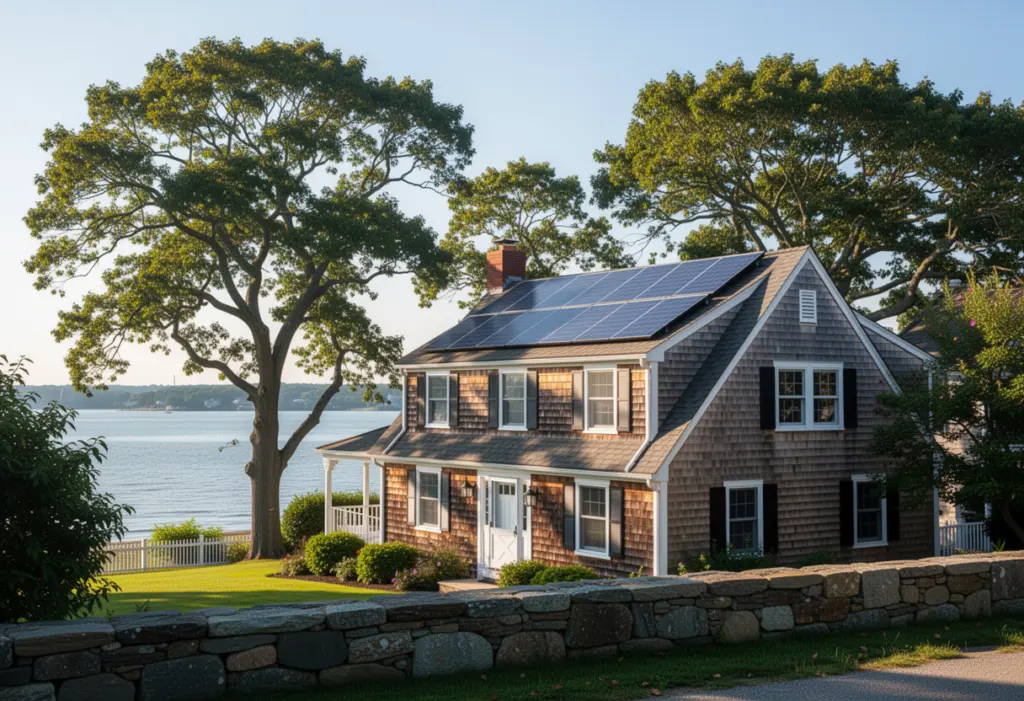
Rye is a city rather than a village inside a town, and that single fact removes two of the complications that slow solar projects elsewhere in the Hudson Valley. The City of Rye building department is the authority having jurisdiction for parcels inside the city, so there is no village-versus-town question to resolve. And because there is no town layer levying on your parcel, the property tax exemption involves three checks rather than four.
What Rye adds instead is a coastline. Parcels near Long Island Sound and the tidal creeks sit in mapped flood zones, and that changes equipment placement rather than eligibility.
What a flood zone actually changes
- Equipment height. Inverters, disconnects, meters and any battery have a minimum mounting height where flood requirements apply. Ask where each will be placed and at what height, and get it on the drawing rather than agreed verbally on installation day.
- Battery siting. A basement is the default location in most of Westchester and the worst one near the water. If storage is part of the proposal, ask where it goes and why.
- Salt air. Coastal exposure is hard on fasteners, rails and flashings. Ask what the mounting hardware is specified as and what the corrosion warranty says, since the warranty on the racking is a separate document from the panel warranty.
Con Edison territory, and the charge on capacity
Westchester County is Con Edison territory. Confirm it from the utility name printed on your bill anyway, because that is the document that decides your interconnection process.
Con Edison’s 2026 residential Customer Benefit Contribution is $1.29 per kW-month, billed on the DC size of the array rather than on production, for systems interconnected on or after 1 January 2022. An 8.5 kW array therefore pays $10.97 a month, about $132 a year, in every month of the year including the ones with the shortest days. That is the specific reason an oversized array is not a free hedge: extra capacity costs a fixed monthly amount whether or not you ever consume the credits it earns.
Under Phase One net metering, exports are credited at the full retail rate and the structure holds for 20 years from interconnection, which is what makes a correctly sized system work well here. It is also why a battery in Rye is best understood as a resilience purchase for outage coverage rather than an economic one, because full retail-rate credit already does the storing.
Trees, roofs and the local housing stock
The obstacle in Rye is rarely roof area. It is a mature canopy, and the low winter sun is what it takes first. Ask for a shade assessment taken on site rather than from satellite imagery, and ask specifically what the model assumes for December and January. Ask, too, what the design does if a neighbouring tree comes down or grows, since panel-level electronics and string layout respond to partial shade differently.
Rye also has a large stock of older housing with slate, cedar and complex roof geometry. Two questions follow. Whether a structural engineer letter is required and who pays for it, and how many roof planes the design uses, because a design broken across four small planes with different orientations behaves nothing like the single clean array a proposal illustration implies. And if the roof has under ten years left, replace it first.
Three property tax checks, and a school district that may surprise you
RPTL 487 exempts the added assessed value of the system for 15 years and requires construction before 1 January 2030. The opt-out is available to the county and the city by local law and to the school district by resolution. Rye is not one of the five Big Five city school districts, so there is a separate school levy to check here. School district lines in this corner of Westchester do not follow city lines neatly, so read the district name off your own tax bill rather than assuming it from your address, and then ask that district whether it has opted out.
The 2026 incentive picture
The 30% federal residential credit is gone. Section 25D was terminated for expenditures made after 31 December 2025, and an expenditure is treated as made when the original installation is completed. Treat any Rye proposal in 2026 that still shows a 30% federal line as materially wrong.
What is live is the New York State credit at 25% of qualified expenditure capped at $5,000 on Form IT-255 for a principal residence, which also reaches leases and power purchase agreements of ten years or more, with the $5,000 acting as a lifetime ceiling per agreement rather than an annual figure. Add the state sales tax exemption on residential solar equipment and the property tax exemption above. The NY-Sun price reduction that contractors used to apply is not available: Con Edison’s last standard residential block closed on 29 May 2025 and its income-qualified Affordable Solar block on 15 October 2025, and as of September 2026 NYSERDA has no open NY-Sun block for homes in any utility territory; check NYSERDA’s NY-Sun dashboard for a new one. Confirm the current terms with NYSERDA and the Department of Taxation and Finance before you sign.
Frequently Asked Questions
Does a flood zone stop me installing solar in Rye?
No, but it governs where equipment can sit. Inverters, disconnects and any battery have minimum mounting heights where flood requirements apply, so get the placement and the height onto the drawing rather than agreed on installation day.
What does Con Edison charge on system size?
The 2026 residential Customer Benefit Contribution is $1.29 per kW-month of DC size, charged regardless of production on systems interconnected on or after 1 January 2022. An 8.5 kW array pays $10.97 a month, roughly $132 a year.
Is a battery worth it in Rye?
Treat it as a resilience purchase rather than an economic one. Under Phase One net metering exports are credited at the full retail rate for 20 years from interconnection, so the grid is already doing the storing at no capital cost.
How many property tax opt-outs do I need to check?
Three, because Rye is a city and no town levies on your parcel: the county, the city and the school district. Read the district name off your own tax bill, since school lines in this part of Westchester do not follow city lines.
This article is general information, not tax, legal or financial advice. Incentive amounts, eligibility rules and deadlines change and depend on your utility, your tax situation and your property. Confirm current terms with NYSERDA, your utility and a qualified tax professional before making a decision.
NY Solar Incentives
Independent New York solar research. We summarise NYSERDA, NY-Sun and federal programme rules from published sources and state plainly when a figure is an estimate. We are not a government agency and do not sell equipment.
Run the arithmetic on your own system
Check the dated program table and your arrangement before counting an incentive. Standard residential NY-Sun blocks are closed; Long Island Affordable Solar has a conditional income-verification route. The NY credit depends on qualified costs and tax liability, while the NYC abatement reduces future property-tax bills. The estimator keeps those timings separate.