Solar Panel Installation in New Hartford, NY
New Hartford has two permitting authorities inside one town line and housing that ranges over a century. Both decide what you should be asking an installer.
On this page 8 sections
- 01Two building departments, one town line
- 02Sauquoit Creek and the low ground
- 03Which name is printed on your bill?
- 04What the Customer Benefit Contribution costs here
- 05Two housing eras, two sets of questions
- 06Snow, canopy and the December sun
- 07What 2026 leaves you, starting with the cap
- 08Frequently Asked Questions
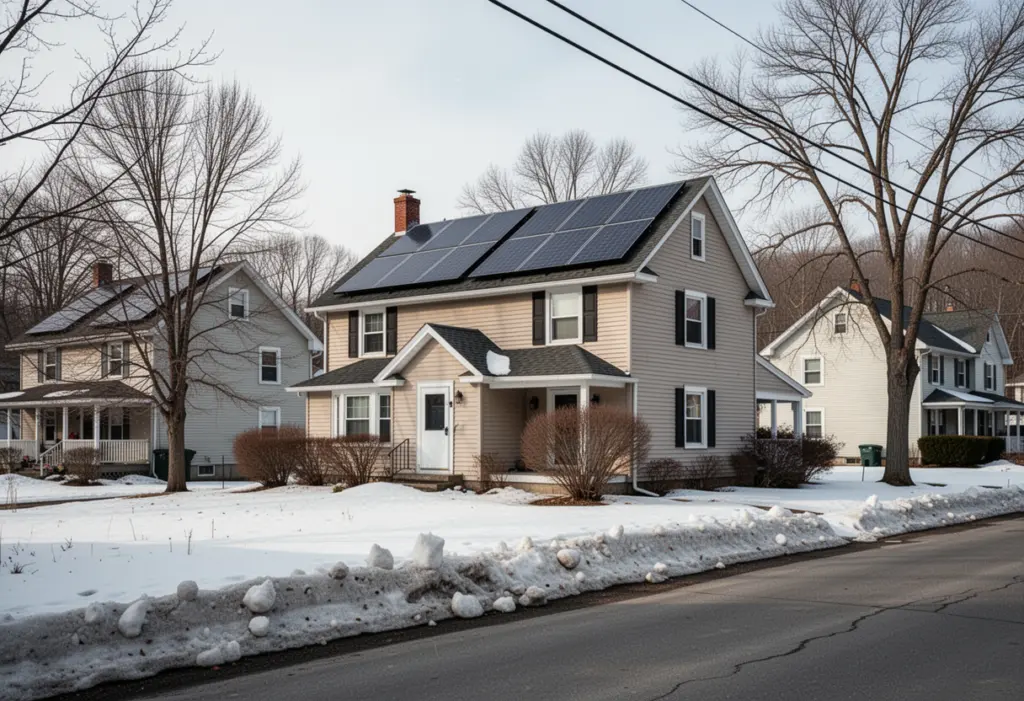
New Hartford is a town and a village in Oneida County, immediately south of Utica. ZIP code 13413. Nineteenth century village housing, post-war suburban streets and recent subdivision building all sit inside one town line, and which of those your house belongs to changes almost every question worth putting to an installer.
Two building departments, one town line
The Town of New Hartford and the Village of New Hartford issue permits separately, and the village sits inside the town. Work out which one holds your address before a single form is filed: fee schedules and turnarounds are not the same, and an application lodged in the wrong office is time gone rather than a correction. Ask as well whether that department works from New York’s Unified Solar Permit. The standardised form covers residential systems of 25 kW DC and under, more than 300 authorities having jurisdiction across the state have taken it up, and a standardised application usually moves faster than a bespoke one.
Sauquoit Creek and the low ground
Sauquoit Creek runs north through the town towards the Mohawk, and parcels on the low ground beside it can fall inside mapped flood plain. That does not stop an installation. What it governs is the height and the position of the electrical hardware — inverter, AC and DC disconnects, production meter, and a battery if you are having one — which normally has to sit above a specified elevation. On a house where the obvious spot is the basement wall beside the meter, that can mean a different wall, a greater height or an interior room, and it very often rules the basement out as a battery location. Your building department will say what applies to your parcel. Ask before the design is drawn rather than after an inspector has seen it.
Which name is printed on your bill?
In most of New York that question is a formality. In the Mohawk Valley it is not. Most of New Hartford takes power from National Grid, but this corner of the state holds an unusual concentration of municipal electric utilities: Sherrill and Boonville within Oneida County, and Ilion, Mohawk and Frankfort in Herkimer County a short way east.
Those systems sit outside Public Service Commission jurisdiction, so a municipal customer gets no state net metering, no Customer Benefit Contribution and no standardised state interconnection process. Terms there belong to the utility and have to be requested from it. Everything below assumes the bill says National Grid.
What the Customer Benefit Contribution costs here
The Customer Benefit Contribution is a monthly charge on the DC size of a system, and it reaches anyone interconnected on or after 1 January 2022. National Grid’s 2026 residential figure is $0.97 per kW-month, the lowest residential rate in the state. A 7 kW array therefore carries $6.79 a month, roughly $81 across a year. The 11 kW system a larger subdivision house often ends up with carries $10.67 a month, about $128. Capacity is what is billed, not output, and the rate is reset annually rather than fixed at interconnection, so a bigger array costs a little more every month whether or not the extra kilowatts earn their keep. Against that, Phase One net metering credits your exports at the full retail rate and holds that structure for 20 years from interconnection.
Two housing eras, two sets of questions
The older village streets
Age drives three checks. Shingle with less than roughly ten years left should be replaced before an array goes on, because taking a system off and putting it back costs considerably more than mounting on a bare roof. Older wood frame draws a structural engineer’s letter more often than newer construction, so put it in the budget rather than meeting it as a change order. And 100 amp service is common, where fitting a solar breaker may need a panel upgrade or a line-side tap. Ask what your service is, ask whether the busbar has room, and have the answer written into the quote.
The post-war and subdivision streets
Engineered trusses and 200 amp service usually clear all three of those at once. What replaces them is private rather than municipal: a covenant or a homeowners’ association rule about street-visible equipment. Nobody at the building department will raise it for you, so read your own paperwork and apply early if approval is required.
Snow, canopy and the December sun
Ask what ground snow load the racking, the attachments and the roof structure are specified for, and ask where a loaded array would discharge. Panels are slicker than shingle and shed as a slab, so snow guards above a door, a walkway or a driveway are a safety item rather than an upsell. Then ask what the production model assumes about snow cover.
Mature street trees are the other half of it. A canopy that clears the roof in June can still take the low December sun, and December is the month when the net metering credit bank is being drawn down rather than built. An on-site shading assessment answers that; a satellite estimate does not. Ask for the December and January numbers, not only the annual total.
What 2026 leaves you, starting with the cap
New York’s solar energy system equipment credit is 25% of qualified expenditure but capped at $5,000, claimed on Form IT-255 for equipment at your principal residence in the state. On a large roof that ceiling is the number deciding the arithmetic: once 25% has reached $5,000, every further dollar of system cost is entirely yours, and a proposal quoting a flat 25% against a big system is describing a credit you cannot collect. The credit is limited by your actual New York State tax liability too, although it is not refundable and unused amounts carry forward for up to five years.
Alongside it: the state sales tax exemption on residential solar equipment; and RPTL 487, a 15-year exemption on the added property value, available where the town or village, Oneida County and your school district have each declined to opt out, only for systems constructed before 1 January 2030, and only if you file form RP-487 with the assessor by the taxable status date. NY-Sun and its Affordable Solar block for lower-income households are no longer on the list: as of September 2026 NYSERDA has no open NY-Sun block for homes in any utility territory; check NYSERDA’s NY-Sun dashboard for a new one.
The 30% federal residential credit is gone. Under the terminating legislation nothing spent after 31 December 2025 qualifies under section 25D, and the date that governs is the completion of the original installation. A 2026 proposal still carrying a 30% federal line is materially wrong, and every figure derived from it is wrong with it. Incentive programmes move, so confirm the current position with NYSERDA and the New York State Department of Taxation and Finance before you sign.
Frequently Asked Questions
Who issues my solar permit in New Hartford?
The Town of New Hartford and the Village of New Hartford run separate building departments and the village sits inside the town, so establish which office holds your address before a form is filed. Ask whether it works from the state Unified Solar Permit, which covers systems of 25 kW DC and under.
Does the Sauquoit Creek flood plain stop a solar installation?
No, but on the low ground it governs where the hardware may sit. Mapped zones normally require the inverter, disconnects, meter and any battery above a specified elevation, which frequently rules the basement out as a battery location. Ask the building department before a design is drawn.
What will National Grid add to my bill each month?
The Customer Benefit Contribution, charged on DC capacity at $0.97 per kW-month for 2026. That is $6.79 a month on a 7 kW array, roughly $81 a year, and $10.67 on 11 kW, about $128. It follows capacity rather than output and is reset annually.
Why does the $5,000 cap matter more on a newer house here?
Because subdivision roofs and 200 amp service allow larger systems. The New York credit is 25% only until it reaches $5,000, after which further system cost attracts no further credit, so a flat 25% quoted against a large array overstates what you can collect.
This article is general information, not tax, legal or financial advice. Incentive amounts, eligibility rules and deadlines change and depend on your utility, your tax situation and your property. Confirm current terms with NYSERDA, your utility and a qualified tax professional before making a decision.
NY Solar Incentives
Independent New York solar research. We summarise NYSERDA, NY-Sun and federal programme rules from published sources and state plainly when a figure is an estimate. We are not a government agency and do not sell equipment.
Run the arithmetic on your own system
Check the dated program table and your arrangement before counting an incentive. Standard residential NY-Sun blocks are closed; Long Island Affordable Solar has a conditional income-verification route. The NY credit depends on qualified costs and tax liability, while the NYC abatement reduces future property-tax bills. The estimator keeps those timings separate.