Solar Panel Installation in Dunkirk, NY
Dunkirk sits directly on Lake Erie, and wind exposure rather than snow is what most often changes the specification on a lakefront roof.
On this page 6 sections
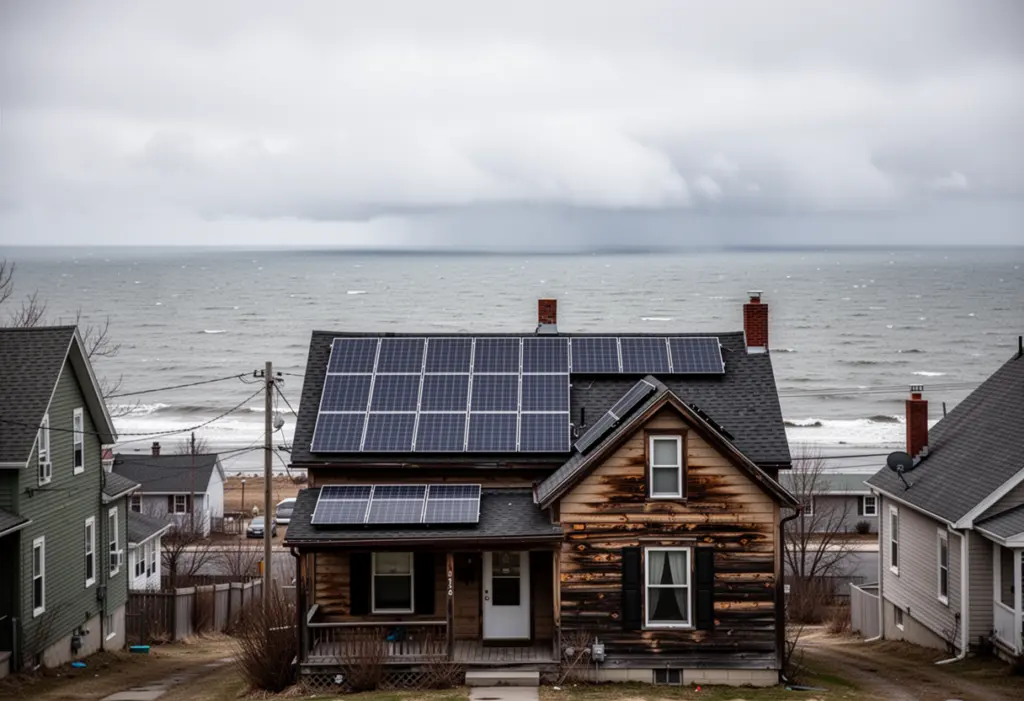
Dunkirk is a small city on the Lake Erie shore in northern Chautauqua County, about forty miles south-west of Buffalo. ZIP code 14048. Its position on open water changes the specification of a rooftop array more than anything else about the place does.
On this shoreline, wind is the binding constraint
Most guidance written for New York treats snow as the northern design problem and stops there. A few streets back from an open lake there is no terrain between the water and your roof, and wind uplift is frequently what decides the attachment layout. Four questions get you the answer:
- What design wind speed and exposure category was the array engineered to? A lakefront parcel usually falls into a more severe exposure category than an inland one, and that is a change to the design rather than to the paperwork.
- How many attachment points, and at what spacing? More uplift means more penetrations set closer together, which is a legitimate line in the price rather than padding.
- What are the fasteners, clamps and outdoor enclosures rated for in a damp lake environment? Hardware works harder here than it does twenty miles inland.
- Who stamps the design? Where wind and snow loading are both marginal, an engineer’s letter is a budget item rather than a surprise.
Snow has not gone away. The heaviest lake-effect totals in this county fall on the higher ground inland rather than on the shoreline plain, but the ground snow load the structure carries is still a serious number, and a production estimate built on a downstate snow-cover assumption will read high for a Dunkirk winter. Snow guards belong above any door, path or driveway the array can shed onto.
Three building departments, three fee schedules
The City of Dunkirk, the Town of Dunkirk and the neighbouring Village of Fredonia are three separate authorities, each with its own building department, its own turnaround and its own fees. Filing with the wrong one is not a small correction; it is weeks. Establish which covers your parcel first, and ask whether it has adopted the New York State Unified Solar Permit, the standardised application for residential systems of 25 kW DC and under that has been taken up by over 300 authorities having jurisdiction statewide.
In this county, do not assume your utility
Chautauqua County is one of the places where a neighbour’s experience genuinely does not describe yours. Brocton, a short way down the shore, and Westfield, further along toward the Pennsylvania line, both run their own municipal electric departments, as do Mayville on Chautauqua Lake and the City of Jamestown inland. A municipal electric customer sits outside Public Service Commission jurisdiction: no state net metering, no Customer Benefit Contribution, no standardised interconnection process, and terms set by the utility itself. Read the utility’s name off your own bill before you accept a single figure in a proposal.
Where that name belongs to an investor-owned utility, the Customer Benefit Contribution applies to you. It is billed monthly on the DC size of the array regardless of what the array produces, it reaches anyone who interconnected on or after 1 January 2022, and the rate is recalculated each year rather than locked in on the day you connect. At the 2026 residential rates a 6 kW system runs $5.82 a month on National Grid’s $0.97 per kW-month and $7.14 on NYSEG’s $1.19, about $70 and $86 a year. At 9 kW those become $8.73 and $10.71 a month, roughly $105 and $129. Set against it, Phase One net metering credits your exports at the full retail rate and holds that structure for twenty years from interconnection.
Industrial-era housing, and who holds the meter
A large share of Dunkirk’s housing dates from its industrial decades. Service capacity is the first check, because 100 amp panels are common and fitting a solar breaker may need an upgrade or a line-side tap, which belongs in the quote and not in a change order after contract. Roof age is the second: with under roughly ten years of shingle life left, re-roof first, because removing and refitting an array later costs considerably more than mounting it on a bare deck. Structure is the third, and older wood frame combined with lake wind draws an engineer’s letter more often than a newer roof would.
Then there is the meter. A great deal of the stock here is rented or two-family, and an array offsets only the meter it is wired behind, so a landlord’s system reduces the landlord’s bill and not the tenant’s, even where the panels sit directly over the tenant’s rooms.
2026 incentives: start with the one that reaches the most households
Community solar is the route that reaches whoever actually pays the bill. A subscriber needs no roof, no up-front cost and no structural letter, and because community solar projects sit in front of the meter, subscribers pay no Customer Benefit Contribution at all. In a city with this much rented and two-family housing that is not a consolation prize; for a tenant it is the only version of this that works.
For an owner-occupier, Affordable Solar used to be the next thing to raise: the NY-Sun incentive arrived as a reduction on your contractor’s price, and the Affordable Solar incentive increased it for households at or below 80% of area median income. Neither is available to a home now. As of September 2026 NYSERDA has no open NY-Sun block for homes in any utility territory; check NYSERDA’s NY-Sun dashboard for a new one. The last standard upstate residential block (Block 14, $0.15/W, NYSEG, RG&E and National Grid territories) closed on 17 December 2025 and the upstate Affordable Solar block on 9 March 2026, so treat a NY-Sun figure copied from an older proposal as a reason to ask questions.
What remains for an owner-occupier: New York’s 25% credit on Form IT-255, capped at $5,000 and limited by your actual state tax liability, though unused credit carries forward for five years, and available on a lease or a power purchase agreement only where that agreement runs ten years or more; the state sales tax exemption on residential solar equipment; and RPTL 487’s fifteen-year exemption on the added value, which needs the city or town, Chautauqua County and your school district each separately not to have opted out, with construction complete before 1 January 2030.
What is not on that list is the federal credit. Section 25D ended for expenditures made after 31 December 2025, and the statute fixes the expenditure at the moment the original installation is completed, so a 2026 buyer earns nothing federally — no phase-down, and no carryover of a credit that never existed. The business-side credit survives for whoever owns a leased or PPA system, which is why third-party offers can still price in an incentive you will never see on your own return. Verify the current position yourself before you commit, because these programmes move.
Frequently Asked Questions
Does being on Lake Erie change the solar design in Dunkirk?
Yes. Wind exposure is often the binding constraint rather than snow. Ask what design wind speed and exposure category were used, how many attachment points and at what spacing, and what the hardware and enclosures are rated for in a damp lake environment.
Which authority issues a solar permit in Dunkirk?
The City of Dunkirk and the Town of Dunkirk are separate authorities with their own building departments, and neighbouring Fredonia is a third. Establish which covers your address before anything is filed, since turnarounds and fees differ.
How do I know which utility I am on?
Read the name printed on your own bill. Brocton and Westfield along the shore, Mayville on the lake and Jamestown inland all run municipal electric departments, whose customers have no state net metering and no Customer Benefit Contribution, so a neighbour's experience may not describe yours.
What is the monthly solar charge in Dunkirk?
On National Grid the Customer Benefit Contribution is $0.97 per kW-month in 2026, so about $70 a year on 6 kW. On NYSEG it is $1.19, about $86 a year on the same system. It is charged on capacity regardless of production.
This article is general information, not tax, legal or financial advice. Incentive amounts, eligibility rules and deadlines change and depend on your utility, your tax situation and your property. Confirm current terms with NYSERDA, your utility and a qualified tax professional before making a decision.
NY Solar Incentives
Independent New York solar research. We summarise NYSERDA, NY-Sun and federal programme rules from published sources and state plainly when a figure is an estimate. We are not a government agency and do not sell equipment.
Run the arithmetic on your own system
Check the dated program table and your arrangement before counting an incentive. Standard residential NY-Sun blocks are closed; Long Island Affordable Solar has a conditional income-verification route. The NY credit depends on qualified costs and tax liability, while the NYC abatement reduces future property-tax bills. The estimator keeps those timings separate.