Solar Panel Cost in Peekskill, NY: Terrain, Roof, Utility
Peekskill is a city in the Hudson Highlands, which means one permit office and a great deal of terrain. A ridge line that looks harmless in July is the thing that decides a December bill.
On this page 8 sections
- 01One city, and neighbours that are not it
- 02The winter sun here is about 25 degrees above the horizon
- 03Two-family houses and the meter question
- 04Old roofs, small services, real prices
- 05What Con Edison adds every month
- 06The ceiling on the New York credit, in numbers
- 07Where 2026 leaves you
- 08Frequently Asked Questions
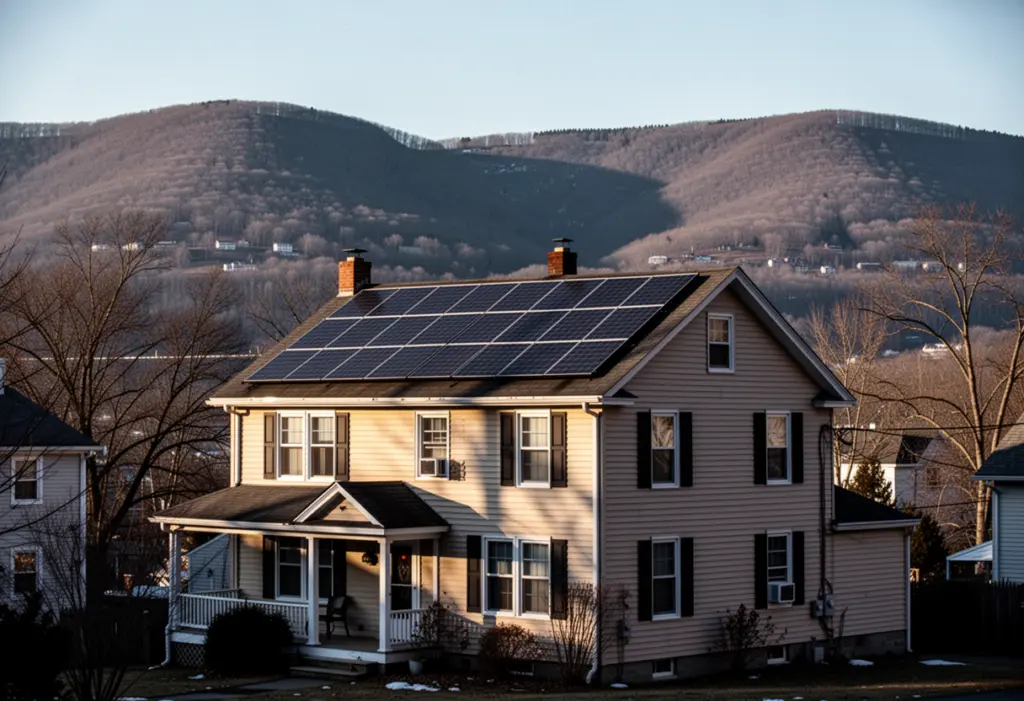
Peekskill, ZIP code 10566, sits in the Hudson Highlands at the northern edge of Westchester County, in Con Edison territory. The equipment costs what it costs. What varies between one Peekskill quote and the next is terrain, the age and division of the housing, and whether anyone has done the winter arithmetic honestly.
One city, and neighbours that are not it
Peekskill is a city, so a single municipal building department covers every address inside the city line, which is simpler than most of northern Westchester. The catch is the mailing address: 10566 also reaches parcels outside the city, in the Town of Cortlandt and nearby, where a different building department applies. Confirm which authority holds your parcel before an installer files, and ask that department whether it uses the New York State Unified Solar Permit for residential systems of 25 kW DC and under.
The winter sun here is about 25 degrees above the horizon
This is the fact that decides a Highlands array, and it is geometry rather than opinion. At this latitude the midday sun in late December stands only around 25 degrees above the horizon. A wooded ridge to the south, a rock face across the road or a tree line that clears the roof easily in July will cut straight across the array in the months your heating bill is highest.
So do two things. Ask for a shade assessment measured at the roof, with a horizon profile rather than a satellite estimate, and ask for the modelled output month by month, specifically December and January, instead of an annual figure. On a Peekskill hillside the difference between two proposals is usually not the panels, it is that one of them looked at the ridge and the other did not. South-facing slopes here are genuinely good sites, and parcels under a north-facing slope are genuinely not, and a quote should be able to tell you which you have.
Two-family houses and the meter question
A large share of the older housing stock is divided into two or more units, and an array does not care how many families live under it. It is interconnected behind one meter and it offsets one account. Before design work starts, decide which account the system serves, and check whether that account is the one you actually pay. If a tenant holds the meter the array reduces the tenant’s bill while the capital cost and the monthly capacity charge sit with the owner. Where the property is not your own residence, read the state credit rule at the end of this page before assuming you can claim it.
Old roofs, small services, real prices
Nineteenth and early twentieth century framing draws an engineer’s structural letter far more often than a modern truss roof does. Slate and steep pitch add staging and fall protection, which is crew time. And 100 amp service is common enough here that it should be verified at the property rather than guessed from the year the house was built: a solar breaker may not fit without a panel upgrade or a line-side connection. Get the rating, the busbar capacity and the consequence written into the contract price before signing.
What Con Edison adds every month
Systems interconnected on or after 1 January 2022 pay a Customer Benefit Contribution based on the DC size of the array rather than its production. Con Edison’s 2026 residential figure is $1.29 per kW-month, and the name printed on your own bill rather than a coverage map is what confirms it applies to you. A modest 4.8 kW system, which is a realistic size for a small divided house with limited roof area, pays $6.19 a month, about $74 a year, and it pays it in December when the ridge has taken half the sun as surely as it does in June. The rate is recalculated annually and is not locked at interconnection.
In the other direction, Phase One net metering credits your exports at the full retail rate and holds that arrangement for 20 years from interconnection, which is what lets a summer surplus carry a shaded winter.
The ceiling on the New York credit, in numbers
New York’s 25% solar credit is capped at $5,000 on Form IT-255, which means the cap starts biting at $20,000 of qualified expenditure. On a $16,000 system the credit is $4,000 and the percentage is doing the work; on a $26,000 system it is still $5,000, so the last $6,000 of spend earns nothing back from the state. Two further limits matter as much as the cap. The credit is not refundable, so it cannot exceed your actual New York tax liability in the year, although unused credit carries forward for up to five years. And it requires the system to serve your principal residence in New York, which a rental property you own is not.
Where 2026 leaves you
Nothing federal is available to a homeowner buying this year. Section 25D was terminated for expenditures made after 31 December 2025, and an expenditure counts as made when the original installation is completed. What survives locally is the state credit above, the state sales tax exemption on residential equipment, and the RPTL 487 15-year exemption on added value where the city, Westchester County and the school district have each not opted out, for construction completed before 1 January 2030. NY-Sun, which a contractor used to apply as a price reduction, is not on that list: as of September 2026 NYSERDA has no open NY-Sun block for homes in any utility territory; check NYSERDA’s NY-Sun dashboard for a new one. All of it changes without warning to you, so check the live position at tax.ny.gov and nyserda.ny.gov rather than trusting a figure printed in a proposal.
Frequently Asked Questions
Do the Hudson Highlands ridges really affect solar in Peekskill?
Yes. At this latitude the midday sun in late December sits only about 25 degrees above the horizon, so a ridge or tree line that clears the roof in July can shade it completely in winter. Ask for a horizon profile measured at the roof.
Which building department covers a 10566 address?
Peekskill is a city with one building department for everything inside the city line, but the 10566 ZIP also reaches parcels outside it, in the Town of Cortlandt and nearby. Confirm the jurisdiction of your parcel before filing.
Can one solar array serve both units of a two-family house?
An array is interconnected behind one meter and offsets one account. Decide which account it serves before design, and check whether that is the account you pay rather than one your tenant holds.
How large a system does the $5,000 New York credit cover?
The credit is 25% of qualified expenditure capped at $5,000, so the cap starts biting above $20,000 of spend. It is also non-refundable and limited by your actual state tax liability, with unused credit carried forward up to five years.
This article is general information, not tax, legal or financial advice. Incentive amounts, eligibility rules and deadlines change and depend on your utility, your tax situation and your property. Confirm current terms with NYSERDA, your utility and a qualified tax professional before making a decision.
NY Solar Incentives
Independent New York solar research. We summarise NYSERDA, NY-Sun and federal programme rules from published sources and state plainly when a figure is an estimate. We are not a government agency and do not sell equipment.
Run the arithmetic on your own system
Check the dated program table and your arrangement before counting an incentive. Standard residential NY-Sun blocks are closed; Long Island Affordable Solar has a conditional income-verification route. The NY credit depends on qualified costs and tax liability, while the NYC abatement reduces future property-tax bills. The estimator keeps those timings separate.