Solar Panel Cost in New Rochelle, NY: The Local Line Items
New Rochelle gives you one building department instead of the village-and-town tangle around it. What it adds instead is a shoreline, a lot of pre-war roofs, and a housing stock where the roof frequently belongs to a corporation rather than to you.
On this page 7 sections
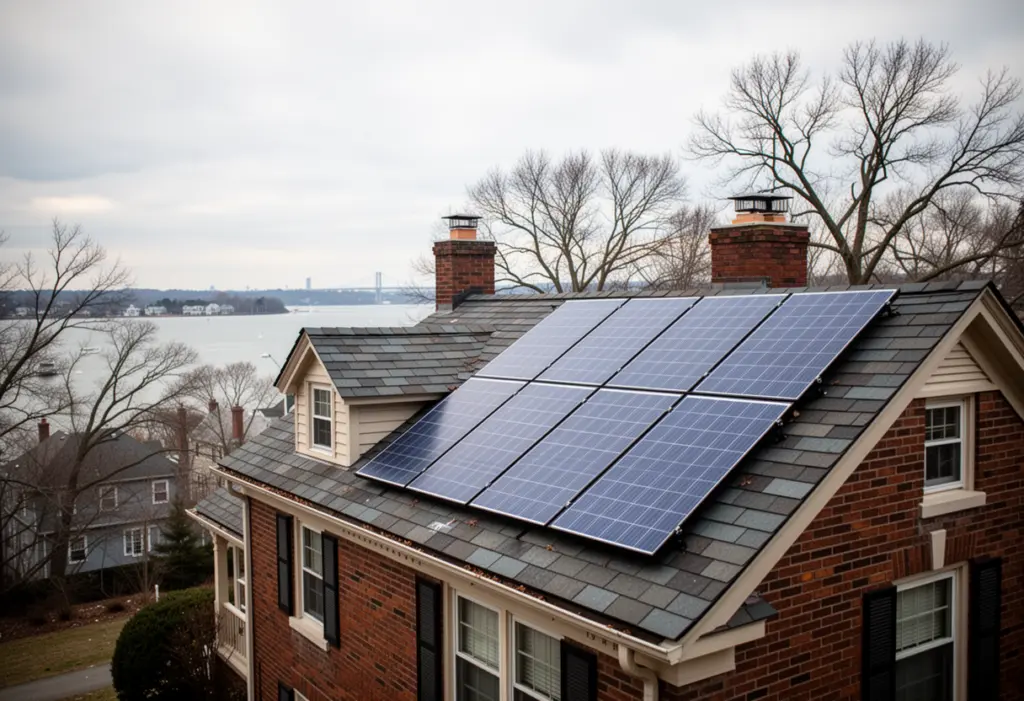
New Rochelle covers ZIP codes 10801, 10804 and 10805 in southern Westchester County, on Long Island Sound, in Con Edison territory. Ask what solar costs here and the honest answer starts with a different question: is the roof yours to decide about, and how far is it from salt water. Those two things separate New Rochelle quotes from one another far more than the module brand does.
One authority, which is a genuine saving
New Rochelle is a city, so a single municipal building department covers every address inside it. That is worth naming because most of the county around it is not like that: neighbouring parcels sit in villages inside towns, with two sets of officials and two fee schedules. Here you deal with the city, and you should still ask it three things before contract: whether it uses the New York State Unified Solar Permit for systems of 25 kW DC and under, what the current fee is, and whether your address falls inside a locally designated historic district. The last one changes the design, not just the paperwork.
The Sound writes part of the specification
Along Davenport Neck, around Echo Bay and on the low ground near the water, three coastal facts turn into line items:
- Mapped flood elevation. Where a parcel sits in a flood zone, the inverter, the disconnects and any battery have to be mounted above a set height. That removes the basement as a battery location, which is usually where one would otherwise go.
- Wind exposure. Closer to open water the uplift calculation is harsher, so attachments are spaced more tightly and there are more roof penetrations to flash properly. More attachments is more labour and more risk of a leak done badly.
- Salt air. Ask what the racking, the fasteners and the module frames are rated for in a coastal environment, and get the answer in the proposal rather than in conversation.
If the roof belongs to a corporation
A substantial share of housing in and around downtown is co-operative or condominium. In a co-op the roof is not yours: it belongs to the corporation, and putting an array on it is a board decision governed by the proprietary lease and the house rules, not a homeowner decision. In a condominium the roof is usually common element with the same result.
That is not a dead end, it is a different product. Community solar requires no roof, no permit, no interconnection application and no capital, and subscribers pay no Customer Benefit Contribution at all. For an apartment household in New Rochelle it is frequently the only version of solar actually available, and it should be compared honestly against a rooftop quote rather than treated as a consolation prize.
Pre-war roofs and small services
North of the parkways the housing stock is largely inter-war and earlier, which means slate and tile appear regularly, framing predates modern trusses, and 100 amp service is common. Each has a price. Slate needs an installer who can show finished work on slate rather than describe it. Older framing draws an engineer’s structural letter far more often than a 1990s roof does. And a 100 amp panel may not accept a solar breaker without an upgrade or a line-side connection.
Have the service rating and the busbar capacity verified at the property, not assumed from the age of the house, and have whatever follows written into the contract price. A service upgrade raised after signing is the single most common reason a New Rochelle quote turns out not to have been the price.
Con Edison bills you on size, not output
Systems interconnected on or after 1 January 2022 pay the Customer Benefit Contribution, worked out from DC system size. Con Edison’s 2026 residential rate is $1.29 per kW-month, and the supplier name printed on your own bill is what settles whether that is your rate. A 6 kW array therefore pays $7.74 a month, about $93 a year, and it pays that in a cloudy February exactly as it does in July. The rate is recalculated annually rather than locked at interconnection. Against that, Phase One net metering credits exports at the full retail rate for 20 years from interconnection, which is what makes a correctly sized array work here.
2026 incentives, and one detail your neighbours do not share
There is no federal residential credit for a 2026 purchase. Section 25D ended for expenditures made after 31 December 2025, with the expenditure treated as made when the original installation is completed. Treat any proposal still showing 30% federal as evidence about the company that wrote it.
What remains is state and local. The New York 25% credit capped at $5,000 on Form IT-255 applies to a principal residence and is limited by your actual New York tax liability, with unused credit carried forward for up to five years. NY-Sun would come off the price through the contractor, but as of September 2026 NYSERDA has no open NY-Sun block for homes in any utility territory; check NYSERDA’s NY-Sun dashboard for a new one. The state sales tax exemption applies to residential equipment. And RPTL 487 exempts the added value for 15 years, on a system constructed before 1 January 2030, where the city, Westchester County and the school district have each not opted out. That third check is real in New Rochelle: the school district here levies its own property tax, unlike Yonkers elsewhere in the county, whose fiscally dependent district is one of the state’s Big Five and raises no separate levy to check. Confirm all three in writing, and confirm them again close to installation, because opt-out laws and programme rules both change.
Frequently Asked Questions
Can I put solar on a co-op or condo in New Rochelle?
Not unilaterally. The roof is a common element owned by the corporation or association, so it is a board decision under the proprietary lease or bylaws. Community solar needs no roof and no board vote, and subscribers pay no Customer Benefit Contribution.
Does being near Long Island Sound change the installation?
Yes. Flood-zone parcels need inverters, disconnects and batteries mounted above a set elevation, wind exposure tightens the attachment spacing, and coastal-rated racking and fasteners should be specified in writing.
What does Con Edison charge solar customers each month?
The 2026 residential Customer Benefit Contribution is $1.29 per kW-month of DC size for systems interconnected on or after 1 January 2022. A 6 kW system pays about $7.74 a month, roughly $93 a year, regardless of production.
Do I still need to check the school district for the property tax exemption?
In New Rochelle, yes. RPTL 487 requires that the city, the county and the school district have each not opted out. The exception is the five fiscally dependent Big Five districts, including Yonkers, which levy no separate school property tax.
This article is general information, not tax, legal or financial advice. Incentive amounts, eligibility rules and deadlines change and depend on your utility, your tax situation and your property. Confirm current terms with NYSERDA, your utility and a qualified tax professional before making a decision.
NY Solar Incentives
Independent New York solar research. We summarise NYSERDA, NY-Sun and federal programme rules from published sources and state plainly when a figure is an estimate. We are not a government agency and do not sell equipment.
Run the arithmetic on your own system
Check the dated program table and your arrangement before counting an incentive. Standard residential NY-Sun blocks are closed; Long Island Affordable Solar has a conditional income-verification route. The NY credit depends on qualified costs and tax liability, while the NYC abatement reduces future property-tax bills. The estimator keeps those timings separate.