What Solar Costs in Kingston, NY
Kingston has some of the oldest housing stock on the mid-Hudson, and a review board that looks at your design before the building department does. Both are cost drivers before a single module is priced.
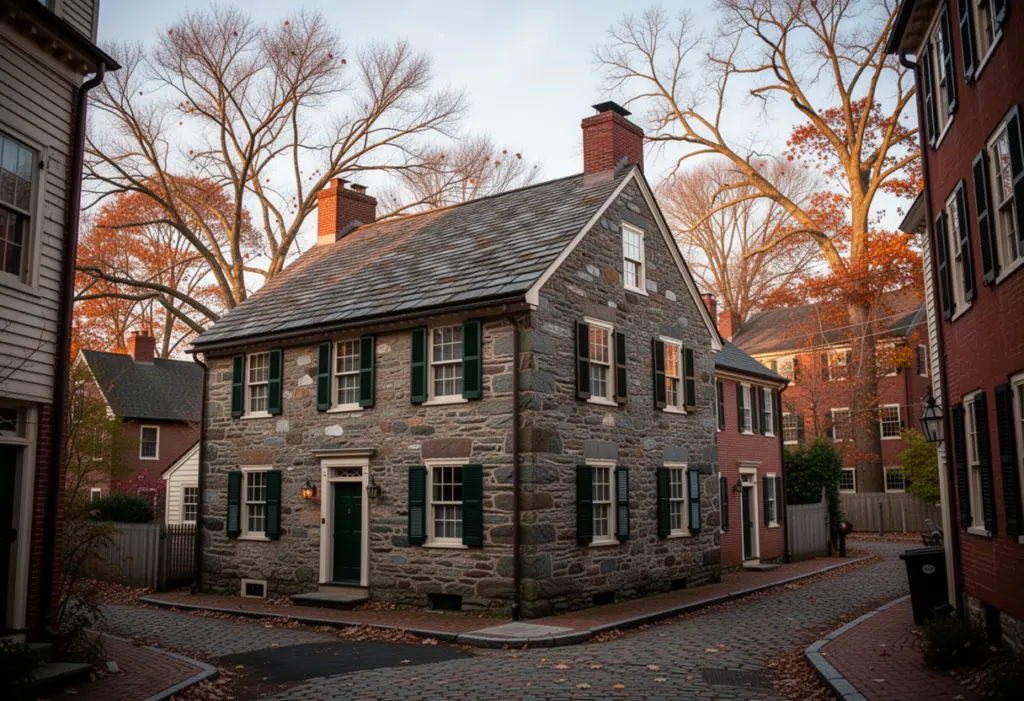
Kingston is a city in Ulster County, at the point where the Rondout Creek meets the Hudson River. ZIP code 12401. It was the first capital of New York State, and the practical consequence for a solar project is that the housing here is genuinely old. That, far more than the size of the array, is what drives cost in this city.
The review board decides the design before the permit does
Uptown Kingston contains the Stockade District, one of the most intact early streetscapes in the state, and other older quarters carry protected character as well. Where architectural or landmarks review applies, it sits ahead of the building permit. The design is judged before the building department ever sees it, and the outcome can restrict street-visible placement.
Establish whether your address falls inside a designated district before you sign anything, then design for approval rather than arguing after a refusal:
- A rear or secondary roof plane not visible from the public way. This resolves most applications on its own.
- All-black modules with black frames. Silver frames read as industrial equipment on a historic elevation.
- Flush mounting following the roof pitch. Tilted racking on a historic roof is the single thing most likely to be refused.
- Concealed conduit, run internally or painted where it has to be exposed.
Ask when the reviewing board meets. Monthly meetings are common, so a missed submission deadline costs four weeks, and the installation date on your proposal should allow for that.
Old housing is the line item nobody quotes up front
Three things turn up repeatedly on Kingston roofs, and each one has a price:
- Slate. It needs a mounting approach not every installer is equipped for. Ask what they have done on slate, and ask for photographs of the finished penetrations.
- Standing-seam metal. The best case in the whole city. Racking clamps to the seams with no penetrations at all, and the roof commonly outlasts the panels.
- A structural letter. Older framing draws an engineer’s letter far more often than a modern truss roof. Budget for it rather than discovering it after contract.
Then the service panel. Kingston’s older stock commonly carries 100 amp service, and a solar breaker may not fit without a panel upgrade or a line-side tap. Have the rating and the busbar capacity confirmed at the property, and have whatever follows written into the price before contract rather than raised after it.
Which authority, and how low the ground is
A Kingston mailing address does not prove you are in the city. The City of Kingston, the Town of Ulster and the Town of Hurley are separate authorities with their own building departments. Confirm which one covers your parcel before an installer files anything.
Along the Rondout and on the low ground near the water, ask whether your parcel sits in a mapped flood zone. Where it does, the inverter, the disconnects, the production meter and any battery usually have to be mounted above a specified elevation, so a basement battery is frequently the wrong answer even where it is the cheapest place to put one.
Central Hudson carries the highest solar charge in New York
Every system interconnected on or after 1 January 2022 pays a Customer Benefit Contribution, worked out from the DC size of the array rather than from its output. Central Hudson’s 2026 residential figure is $1.67 per kW-month, the highest residential rate charged by any utility in the state, which puts a 5 kW system at $8.35 a month, about $100 a year, and a 9 kW system at $15.03, about $180. The rate is set annually, so it is not locked in when you connect.
Parts of this region fall to NYSEG at $1.19 instead, where the same 9 kW array pays $10.71 a month, roughly $129 a year. That is about $52 a year of difference decided by nothing except the name printed on the bill, so read that name before accepting either figure. Running the other way, Phase One net metering credits your exports at the full retail rate and holds that structure for 20 years from interconnection.
2026 incentives
The 30% federal residential credit is gone. Section 25D was terminated for expenditures made after 31 December 2025, and an expenditure is treated as made when the original installation is completed. Any Kingston proposal still showing a 30% federal line is materially wrong.
What no longer remains for a home is NY-Sun. NYSERDA’s per-watt incentive was paid through the contractor as a reduction on the price and administered in megawatt blocks by region, and the residential blocks have closed: outside Con Edison and Long Island, which covers Central Hudson and NYSEG customers, the last standard residential block for Central Hudson and Orange & Rockland customers (Block 13, $0.15/W) closed on 4 August 2025; the last for NYSEG, RG&E and National Grid customers (Block 14, $0.15/W) closed on 17 December 2025, and the Affordable Solar block for income-qualified homes ran from 18 December 2025 to 9 March 2026. As of September 2026 NYSERDA has no open NY-Sun block for homes in any utility territory; check NYSERDA’s NY-Sun dashboard for a new one. If a Kingston proposal still shows a NY-Sun reduction, ask the installer which open block it comes from before you sign.
What remains is the state’s 25% credit capped at $5,000 on Form IT-255 at a principal residence, which reaches leases and power purchase agreements of ten years or more as well as purchases and is limited by your actual state tax liability, with any unused part carried forward for up to five years; the state sales tax exemption; and RPTL 487, a 15-year exemption on the added value where the city, Ulster County and your school district have each not opted out. Those three are separate answers. Take the live position on every programme from NYSERDA and the NY Department of Taxation and Finance rather than from the proposal in front of you.
Frequently Asked Questions
Does historic review apply to solar in Kingston?
In the Stockade District and other protected quarters it can, and it sits ahead of the building permit rather than after it. Establish whether your address is inside a designated district before signing, and design for approval: rear plane, all-black flush-mounted modules, concealed conduit.
Why does a Kingston quote cost more than one in a newer suburb?
Usually the roof and the panel. Slate needs a mounting approach not every installer has, older framing draws a structural engineer's letter more often, and 100 amp service is common enough that a panel upgrade or line-side tap should be priced up front.
Who issues my solar permit in Kingston?
It depends on the parcel, not the postal address. The City of Kingston, the Town of Ulster and the Town of Hurley are separate authorities with their own building departments. Confirm which covers you before an installer files anything.
What does Central Hudson charge a Kingston solar customer?
The Customer Benefit Contribution at $1.67 per kW-month of DC system size for 2026, the highest residential rate in New York. That is about $100 a year on 5 kW and $180 on 9 kW, charged on capacity regardless of production.
This article is general information, not tax, legal or financial advice. Incentive amounts, eligibility rules and deadlines change and depend on your utility, your tax situation and your property. Confirm current terms with NYSERDA, your utility and a qualified tax professional before making a decision.
NY Solar Incentives
Independent New York solar research. We summarise NYSERDA, NY-Sun and federal programme rules from published sources and state plainly when a figure is an estimate. We are not a government agency and do not sell equipment.
Run the arithmetic on your own system
Check the dated program table and your arrangement before counting an incentive. Standard residential NY-Sun blocks are closed; Long Island Affordable Solar has a conditional income-verification route. The NY credit depends on qualified costs and tax liability, while the NYC abatement reduces future property-tax bills. The estimator keeps those timings separate.