What Solar Panels Cost in Henrietta, NY
Henrietta sits in RG&E territory, and RG&E carries one of the highest residential capacity charges in New York — which changes the recurring side of the arithmetic.
On this page 7 sections
- 01The capacity charge is higher here than the statewide average implies
- 02Not everyone in Monroe County is on RG&E
- 03The trap in the housing stock: how many layers is that roof
- 04Permitting and the three property tax checks
- 05The rental question, and why it decides the tax credit
- 06What remains in 2026
- 07Frequently Asked Questions
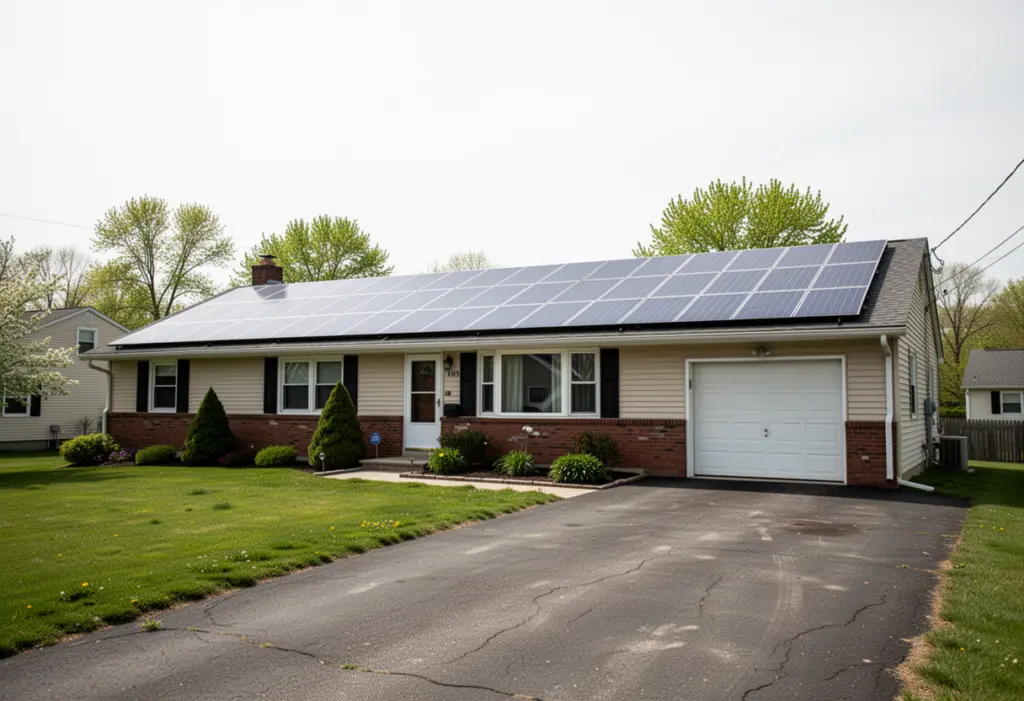
Henrietta is a Monroe County town south of Rochester, covering ZIP codes 14467 and 14586 along with part of 14623. Two things about solar here differ from the statewide picture: the recurring charge on your utility is near the top of the range, and the suburban housing stock has one specific trap in it.
The capacity charge is higher here than the statewide average implies
The Customer Benefit Contribution is billed monthly on the DC size of the array, not on what it produces, for systems interconnected on or after 1 January 2022. RG&E's 2026 residential rate is $1.31 per kW-month, which is the second highest of the seven New York utilities. On a 7 kW system that is $9.17 a month, or $110.04 a year.
To see what that costs you, run the same array under National Grid, whose 2026 residential rate is $0.97: the same 7 kW pays $6.79 a month, or $81.48 a year. That is $28.56 a year of difference on identical hardware producing identical kilowatt-hours, decided by nothing but which utility the roof sits under. Over the life of the system it is not a rounding error, and it is a reason to be sceptical of a payback calculation that uses a statewide figure. The rates are also recalculated annually rather than locked in at interconnection, so treat any twenty-year projection built on today's number as an estimate.
Not everyone in Monroe County is on RG&E
This is the check most homeowners here skip. RG&E does not serve all of Monroe County. The villages of Fairport, Spencerport and Churchville run their own municipal electric utilities, and a municipal electric customer is outside Public Service Commission jurisdiction entirely: no PSC net metering, no Customer Benefit Contribution and no state interconnection process. Terms are set by the utility and have to be asked for directly.
If you are moving within the county, or if the bill comes from a village electric department rather than RG&E, almost none of the standard sequence applies to you. Read the utility name printed on your own bill before you accept any interconnection timeline from an installer.
The trap in the housing stock: how many layers is that roof
Much of Henrietta is postwar and later suburban housing, which is good news for solar — long simple roof planes, straightforward racking runs, few dormers and chimneys competing for the good slope. Two things offset it.
Layered shingles. A house on its second or third roof covering has extra weight already on the framing and a shallower path to solid material for attachments. Ask directly how many layers are up there, because the answer changes the structural check, the flashing detail and possibly the price. A tear-off before installation is often the honest recommendation and is much cheaper than removing an array to do it later.
Service panels from the era. A 1960s or 1970s 100 amp service frequently cannot carry a solar breaker alongside an electric vehicle charger or a heat pump you may be planning. Establish that during the site visit rather than during installation week, when it becomes a change order.
Permitting and the three property tax checks
The Town of Henrietta building department is the authority for most addresses here; confirm it for yours, since a village inside a town issues its own permits where one exists. Most of New York uses the NYS Unified Solar Permit for systems of 25 kW DC and under, which standardises the residential application.
RPTL 487 gives a 15-year exemption on the added value of the system, and it requires three separate confirmations: the Town of Henrietta, Monroe County and the Rush-Henrietta Central School District must each not have opted out. They are three different bodies and they opt out by different instruments — a municipality or county by local law, a school district by resolution — so one answer does not give you the other two. The system must be constructed before 1 January 2030.
The rental question, and why it decides the tax credit
Parts of Henrietta carry a meaningful share of rented and two-family housing. That raises two questions a generic guide skips. First, whose meter does the array connect to, and does the person paying for it consume the production? Second, and more expensively: New York's solar energy system equipment credit requires the equipment to be installed and used at the taxpayer's principal residence in the state. A property you rent out does not qualify, whatever the installer's spreadsheet shows.
What remains in 2026
For an owner-occupier, the state credit is the anchor: 25% of qualified expenditure capped at $5,000 on Form IT-255, limited by your actual New York State tax liability with unused amounts carrying forward up to five years. The state sales tax exemption on residential solar equipment applies, with the local share exempted separately by county and city, so ask what tax appears on your contract and why. NY-Sun, which used to reduce the contract price through the contractor at a level set by region and megawatt block, takes nothing off it at present: the last standard Upstate residential block (Block 14, $0.15/W, NYSEG, RG&E and National Grid territories) closed on 17 December 2025, and as of September 2026 NYSERDA has no open NY-Sun block for homes in any utility territory; check NYSERDA's NY-Sun dashboard for a new one.
What does not apply is anything federal. Section 25D was terminated for expenditures made after 31 December 2025, an expenditure being treated as made when the original installation is completed, so a system finished in 2026 earns no federal credit. If a proposal for a Henrietta roof still shows 30% federal, treat the whole document as out of date and ask for it to be reissued. Confirm the live position at NYSERDA and the Department of Taxation and Finance before signing.
Frequently Asked Questions
Which utility serves Henrietta, NY?
Most of Henrietta is RG&E territory, but RG&E does not cover all of Monroe County. Fairport, Spencerport and Churchville run municipal electric utilities, so check the name printed on your own bill.
How much is the capacity charge on RG&E?
The 2026 residential Customer Benefit Contribution is $1.31 per kW-month, the second highest in the state. A 7 kW array pays $9.17 a month, or $110.04 a year, regardless of what it produces.
Does a second layer of shingles affect a solar quote?
Yes. Extra layers add weight and complicate attachment and flashing, which changes the structural check and possibly the price. Ask how many layers are on the roof before a design is finalised.
Can I claim the New York solar credit on a rental in Henrietta?
No. The Form IT-255 credit requires the equipment to be installed and used at the taxpayer's principal residence in New York State, so a property you rent out does not qualify.
This article is general information, not tax, legal or financial advice. Incentive amounts, eligibility rules and deadlines change and depend on your utility, your tax situation and your property. Confirm current terms with NYSERDA, your utility and a qualified tax professional before making a decision.
NY Solar Incentives
Independent New York solar research. We summarise NYSERDA, NY-Sun and federal programme rules from published sources and state plainly when a figure is an estimate. We are not a government agency and do not sell equipment.
Run the arithmetic on your own system
Check the dated program table and your arrangement before counting an incentive. Standard residential NY-Sun blocks are closed; Long Island Affordable Solar has a conditional income-verification route. The NY credit depends on qualified costs and tax liability, while the NYC abatement reduces future property-tax bills. The estimator keeps those timings separate.