Solar Panel Cost in Clifton Park, NY: Where the Cap Bites
Clifton Park houses are large and the arrays are large with them. That is exactly where New York's $5,000 credit cap stops scaling and the monthly charge does not.
On this page 7 sections
- 01The cap, and the exact point it bites
- 02The monthly figure that scales when the credit does not
- 03Local items that move a Clifton Park price
- 04Property tax: three checks, and the school district matters
- 05If the address is on a municipal system
- 062026 incentives, in the order they matter here
- 07Frequently Asked Questions
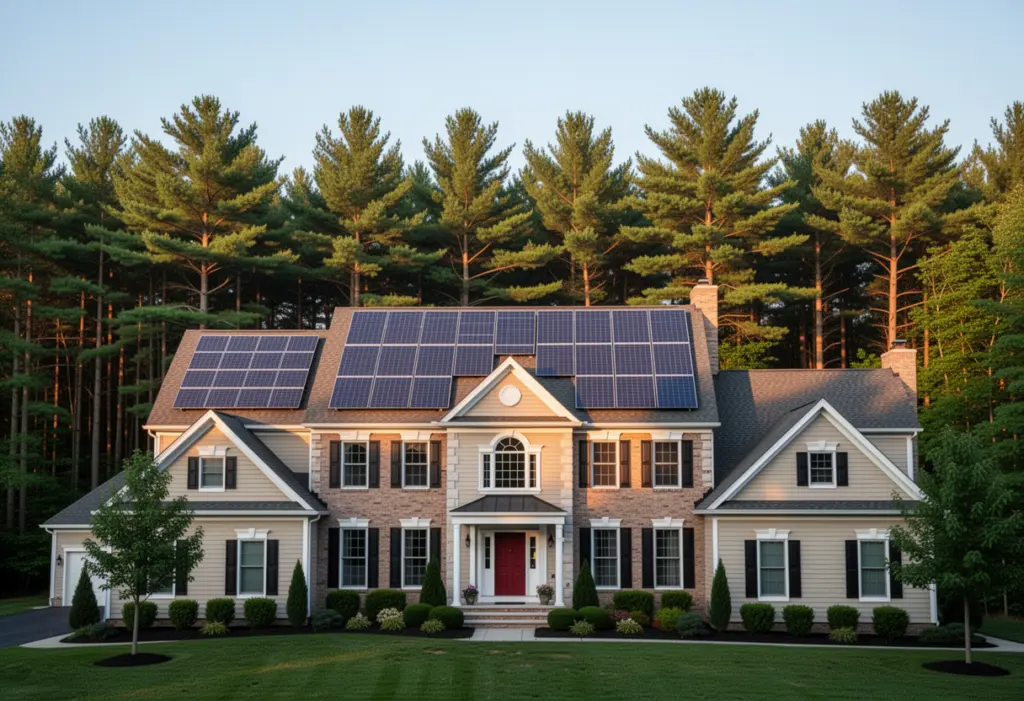
Clifton Park is a town of comparatively large, comparatively new houses, and that shapes the solar arithmetic in a way that generic New York advice misses. Bigger houses mean bigger loads, bigger roofs and bigger arrays — and above a certain system price, the state incentive stops growing while the monthly cost of capacity keeps going.
The cap, and the exact point it bites
New York’s solar credit is 25 percent of qualified expenditure, capped at $5,000, claimed on Form IT-255 for equipment at your principal residence in the state. Twenty-five percent reaches $5,000 at $20,000 of qualified expenditure. Above $20,000, the state credit does not grow at all. Every additional dollar of system price after that point is unsubsidised by the state, and on a 12 kW array in a town like this the price is comfortably past it.
Two consequences follow. First, the marginal kilowatt on a large array is more expensive in real terms than the first kilowatt, because no incentive scales with it. Second, the credit is limited by your actual New York State tax liability — it is not refundable — although unused amounts carry forward for up to five years. Ask your accountant what your liability actually is before you treat $5,000 as money in hand.
The monthly figure that scales when the credit does not
Clifton Park is National Grid territory. The Customer Benefit Contribution is billed on the DC size of the array every month, regardless of production, at $0.97 per kW-month for 2026. A 12 kW system pays $11.64 a month, roughly $140 a year. A 6 kW system pays half that. The charge applies to systems interconnected on or after 1 January 2022, and the rates are reset annually rather than held at the level in force when you connect.
So the incentive stops scaling at $20,000 of expenditure and the running charge does not stop scaling at all. That is the case for sizing carefully rather than filling the roof: build for the load you have, plus a heat pump or an electric vehicle if either is genuinely planned, and stop there. Phase One net metering credits exports at full retail rate for 20 years from interconnection, but banked credits you never consume are money spent on capacity you also pay to hold.
Local items that move a Clifton Park price
- Architectural review in a subdivision. Many neighbourhoods here have homeowner association covenants and an architectural review process. Ask for the association’s rules in writing before signing an installation contract, and ask the installer what the design would look like if a street-facing roof plane is refused. That is a production question as well as an aesthetic one.
- The permitting desk. There are no incorporated villages in the town, so the Town of Clifton Park building department is generally the authority, working from the state Unified Solar Permit for systems of 25 kW DC and under. Confirm the fee schedule rather than accepting the placeholder in a proposal.
- Newer roofs, older assumptions. Much of the housing stock is recent enough that shingle life and service capacity are not the constraint they are in older towns. That is a genuine cost advantage here, and it means a quote carrying a large allowance for electrical upgrades deserves a question.
- Pines and the southern horizon. Subdivisions carved out of woodland keep tall conifers on their boundaries, and conifers do not drop their needles in December. Insist on an on-site shading assessment with December and January production shown separately.
Property tax: three checks, and the school district matters
RPTL 487 exempts the added value of a solar system from real property tax for 15 years, but only where the taxing authorities have not opted out — and the opt-out is available separately to the town, to Saratoga County and to your school district. Most of Clifton Park sits in the Shenendehowa district, with other districts reaching into the town at its edges, so two houses a mile apart can get different answers on the school portion. Ask the assessor for the position of all three, and note that the system has to be constructed before 1 January 2030 to qualify at all.
If the address is on a municipal system
The Capital Region has municipal electric utilities — the Green Island Power Authority in Albany County is the nearest example. A municipal electric customer is outside Public Service Commission jurisdiction, which means no state net metering rules, no Customer Benefit Contribution and no state interconnection process. Terms are whatever the utility sets. Check the name on your own bill rather than assuming from the region.
2026 incentives, in the order they matter here
The state credit comes first because it is the one with a ceiling you will hit: 25 percent to a maximum of $5,000, principal residence only, carried forward up to five years against New York tax. A seasonal or rental property does not qualify. The sales tax exemption and RPTL 487 complete the list. NY-Sun, applied by the contractor as a price reduction when a megawatt block is open, is not on it: as of September 2026 NYSERDA has no open NY-Sun block for homes in any utility territory; check NYSERDA’s NY-Sun dashboard for a new one.
What is not on the list is the federal credit. Section 25D was terminated for expenditures made after 31 December 2025, with an expenditure treated as made when the original installation is completed — and for a newly built house the test is different again, turning on when the owner’s original use of the structure begins. In a town with active new construction that distinction is worth raising with your accountant. Incentive rules change; confirm the current position with NYSERDA and the Department of Taxation and Finance rather than with a sales document.
Frequently Asked Questions
At what system price does the New York state solar credit stop growing?
At $20,000 of qualified expenditure. The credit is 25% capped at $5,000, so 25% of $20,000 reaches the ceiling. Above that, additional system cost gets no additional state credit, which matters on the large arrays common in Clifton Park.
What does a 12 kW array cost per month in National Grid territory?
The 2026 Customer Benefit Contribution is $0.97 per kW-month of DC size, so a 12 kW system pays about $11.64 a month, roughly $140 a year, billed on capacity whether or not the panels produce.
Can my homeowner association stop me installing solar?
Many Clifton Park neighbourhoods have covenants and an architectural review process. Get the association's written rules before you sign an installation contract, and ask the installer how the design and production estimate change if a street-facing roof plane is refused.
Is the property tax exemption automatic in Clifton Park?
No. RPTL 487 gives a 15-year exemption on the added value only where the town, the county and the school district have each not opted out — three separate checks. Most of the town is in the Shenendehowa district, but others reach in at the edges.
This article is general information, not tax, legal or financial advice. Incentive amounts, eligibility rules and deadlines change and depend on your utility, your tax situation and your property. Confirm current terms with NYSERDA, your utility and a qualified tax professional before making a decision.
NY Solar Incentives
Independent New York solar research. We summarise NYSERDA, NY-Sun and federal programme rules from published sources and state plainly when a figure is an estimate. We are not a government agency and do not sell equipment.
Run the arithmetic on your own system
Check the dated program table and your arrangement before counting an incentive. Standard residential NY-Sun blocks are closed; Long Island Affordable Solar has a conditional income-verification route. The NY credit depends on qualified costs and tax liability, while the NYC abatement reduces future property-tax bills. The estimator keeps those timings separate.