Solar Panel Cost in Cheektowaga, NY: Pricing a Ranch Roof
Cheektowaga roofs are mostly modest post-war ones, which keeps the array small and the price moderate. Three change orders are what usually spoil it.
On this page 9 sections
- 01Change order one: the service panel
- 02Change order two: the roof itself
- 03Change order three: the permit desk was the wrong one
- 04What the array costs to keep
- 05Lake Erie, and the specification that follows from it
- 06Comparing quotes without being led
- 07Where a municipal utility changes the answer
- 082026 incentives for a Cheektowaga household
- 09Frequently Asked Questions
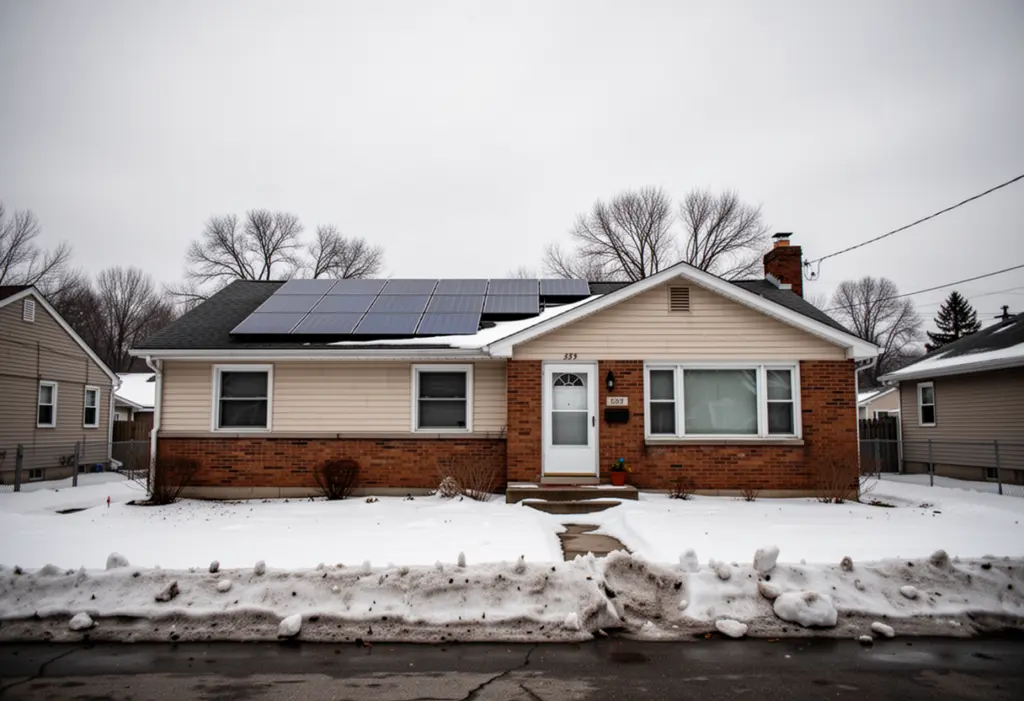
Cheektowaga prices well for solar for an unglamorous reason: much of the town is modest post-war housing on simple roofs, so the arrays are small, the labour is predictable and the electrical runs are short. A smaller array costs less to buy and less to keep. What turns a good Cheektowaga price into a bad one is almost always a change order, and there are three that recur.
Change order one: the service panel
Ranches and Cape Cods built in the 1950s and 1960s frequently came with 100 amp service, and many still have it. A solar breaker has to land somewhere, and where the busbar has no room the options are a panel upgrade or a line-side tap. Both are real money and both are avoidable as a surprise: ask what the service is rated at, ask whether the busbar has capacity, and require the answer in the proposal rather than at installation. An installer who has not opened the panel before quoting has not finished quoting.
Change order two: the roof itself
Ask how many years of shingle life a roofer would give the covering. Under roughly ten, re-roof first. Removing an array and reinstalling it later is one of the few costs in residential solar that is entirely self-inflicted, and it is charged at full labour rates both ways. On a smaller roof there is a second issue: plumbing vents, a chimney and a small dormer eat into a single usable plane quickly, so the module count that fits may be lower than a satellite tool suggested. That changes the array size, and the array size changes the price of everything downstream.
Change order three: the permit desk was the wrong one
Most of the town permits through the Town of Cheektowaga, but not all of it. The Village of Sloan sits inside the town, and the Village of Depew straddles the Cheektowaga and Lancaster town line, and a village address permits through the village. With ZIP codes in the town including 14225, 14227, 14206 and 14215, the mailing address is not a reliable guide. Ask which authority the application goes to and whether the fee shown is that authority’s fee.
What the array costs to keep
Cheektowaga is served by National Grid, whose Customer Benefit Contribution for 2026 is $0.97 per kW-month of DC system size — the lowest residential rate in the state. On a 6.5 kW array, the size a typical smaller roof here supports, that is $6.31 a month, about $76 a year. It is charged on capacity rather than production, applies to systems interconnected on or after 1 January 2022, and is recalculated annually rather than being fixed when you connect.
That figure is worth putting beside the alternative. The same 6.5 kW array under Central Hudson’s 2026 residential rate of $1.67 would pay about $10.86 a month. Western New York is the cheap end of that spread, and it is one of the few solar costs that is decided entirely by where the roof is.
Lake Erie, and the specification that follows from it
Lake-effect snow off Lake Erie is a design input rather than a curiosity. Two questions belong in every quote here: what snow load is the racking specified for, and does the array need snow guards where it sheds onto a door, a path or a driveway. A shallow-pitched ranch roof holds snow longer than a steep one, so ask what the production model assumes about winter cover as well. December and January production should be shown as their own figures, not folded into an annual total.
Comparing quotes without being led
- Divide gross price before incentives by DC watts. Dollars per watt is the only comparable number.
- Make the exclusion lists match before comparing anything — permit, interconnection filing, monitoring, service upgrade, roof work, tree work.
- Ask for the cash price beside the financed price. A loan at about one percent normally carries a dealer fee built back into the system price, so the low rate is bought rather than given.
- Ignore the monthly payment as a comparison. It is a financing artefact and can be made to look like anything.
Where a municipal utility changes the answer
Erie County contains villages that run their own electric utilities — Akron and Springville among them. A municipal electric customer is outside Public Service Commission jurisdiction, so there is no state net metering, no Customer Benefit Contribution and no state interconnection process, and terms have to be asked for directly. Confirm the utility from your own bill rather than from the county you live in.
2026 incentives for a Cheektowaga household
The federal residential credit is not part of this arithmetic any more: section 25D was terminated for expenditures made after 31 December 2025, treating an expenditure as made when the original installation is completed. Any 2026 proposal still showing 30 percent federal is wrong on its face.
The incentive most often left unclaimed in a town with Cheektowaga’s income profile was Affordable Solar, NYSERDA’s incentive for households below 80 percent of area median income. It is applied by the contractor through NY-Sun rather than claimed on a tax return, which means the customer frequently had to raise it — an installer who has not asked cannot apply it. Its Upstate track ran from 18 December 2025 to 9 March 2026 and is closed. As of September 2026 NYSERDA has no open NY-Sun block for homes in any utility territory; check NYSERDA’s NY-Sun dashboard for a new one. If one opens, ask directly whether you qualify and require the answer in writing. What remains are the 25 percent state credit capped at $5,000 on Form IT-255 for a principal residence, the state sales tax exemption, and RPTL 487‘s 15-year property tax exemption where the town or village, the county and the school district have each not opted out. Programme rules move, so check NYSERDA’s current pages and the Tax Department before you rely on any of it.
Frequently Asked Questions
Why are solar systems often cheaper in Cheektowaga than in bigger houses nearby?
Much of the town is modest post-war housing with simple roofs and shorter electrical runs, so arrays tend to be smaller. A smaller array costs less to buy and less to keep, since the monthly capacity charge is billed per DC kilowatt.
Do I permit through the town or a village?
It depends on the address. The Village of Sloan sits inside the Town of Cheektowaga and the Village of Depew straddles the Cheektowaga and Lancaster line, and a village address permits through the village. The ZIP code is not a reliable guide.
What does National Grid charge monthly for a 6.5 kW system?
The 2026 Customer Benefit Contribution is $0.97 per kW-month of DC size, so about $6.31 a month or roughly $76 a year on 6.5 kW. It is billed on capacity regardless of production and recalculated each year.
Can I still get the Affordable Solar incentive?
Not at the moment. It is a NYSERDA incentive for households under 80% of area median income, applied by the contractor through NY-Sun rather than claimed on your taxes, and its Upstate track ran from 18 December 2025 to 9 March 2026. As of September 2026 NYSERDA has no open NY-Sun block for homes in any utility territory; check NYSERDA’s NY-Sun dashboard for a new one. If one opens, ask the installer directly whether you qualify and have the answer put in writing.
This article is general information, not tax, legal or financial advice. Incentive amounts, eligibility rules and deadlines change and depend on your utility, your tax situation and your property. Confirm current terms with NYSERDA, your utility and a qualified tax professional before making a decision.
NY Solar Incentives
Independent New York solar research. We summarise NYSERDA, NY-Sun and federal programme rules from published sources and state plainly when a figure is an estimate. We are not a government agency and do not sell equipment.
Run the arithmetic on your own system
Check the dated program table and your arrangement before counting an incentive. Standard residential NY-Sun blocks are closed; Long Island Affordable Solar has a conditional income-verification route. The NY credit depends on qualified costs and tax liability, while the NYC abatement reduces future property-tax bills. The estimator keeps those timings separate.