Solar Loan vs Cash in New York: Which Is Actually Cheaper
Cash is almost always cheaper in total dollars. A loan is not cheaper — it buys you the use of money you keep. The gap widened in 2026, and the state credit cap decides part of it.
On this page 9 sections
- 01What changed, and why it hits the cash buyer hardest
- 02The fee that decides the comparison
- 03Put arbitrary figures on it so the arithmetic is visible
- 04Whether you can use the credit at all
- 05Where the loan genuinely wins
- 06The cost neither column shows
- 07How to compare two quotes honestly
- 08The 2026 incentive picture for a buyer
- 09Frequently Asked Questions
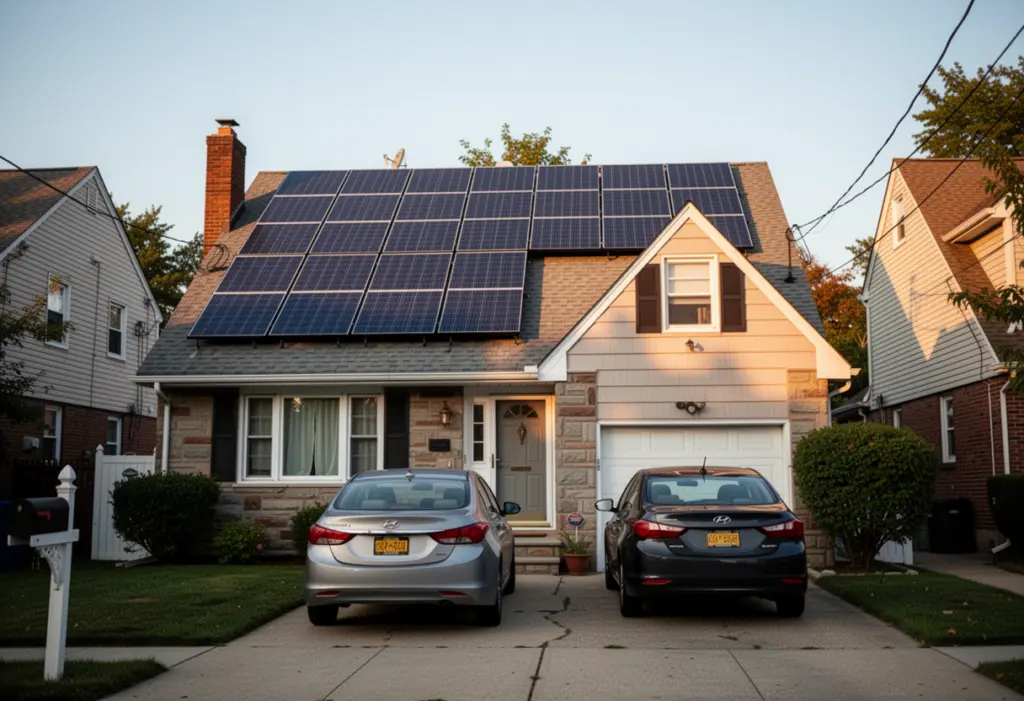
Paying cash is almost always cheaper in total dollars, and any comparison that concludes otherwise is usually hiding a fee. A loan is not cheaper; it buys you the use of money you would otherwise have handed over on day one. The real question is how much that costs, and in 2026 the answer changed for both sides at once.
What changed, and why it hits the cash buyer hardest
Until the end of 2025 the cash purchase carried a large federal offset. Section 25D is now terminated for expenditures made after 31 December 2025, with an expenditure treated as made when the original installation is completed, so a 2026 buyer receives nothing federally whether they pay cash or borrow. Any proposal you are handed this year showing a 30 percent federal line is materially wrong, and that is worth saying out loud to whoever produced it.
The credit that survived is the business-side one, and it belongs to whoever owns the equipment. That is why third-party offers can still price an incentive into a monthly figure that a buyer never sees, and it is the reason the tax arithmetic in 2026 leans toward a lease, a power purchase agreement or a community solar subscription in a way it did not before. It does not automatically make those the better deal — it means the comparison has to be redone rather than inherited from an older article.
The fee that decides the comparison
Solar loans quoted well below the cost of unsecured credit are financed by a fee added into the system price. It is not usually itemised, and it is not usually called a fee. Ask one installer for the cash price and the financed price of the same array on the same day, and the difference between the two is the number the whole decision turns on.
Put arbitrary figures on it so the arithmetic is visible
None of the following are market rates and you should substitute your own two quotes. Suppose the cash price is $24,000, and the same system financed comes to $28,800 — a difference of $4,800, or 20 percent. Before any interest is charged, the borrower has already agreed to pay $4,800 more for identical hardware.
Now run the state credit through both. IT-255 gives 25 percent of qualified expenditure capped at $5,000. On $24,000 that is $6,000, capped to $5,000. On $28,800 it is $7,200, still capped to $5,000. Above roughly $20,000 of qualified expenditure the cap binds, so the extra $4,800 buys no additional state credit at all. The fee is carried entirely by the household, and the borrower still pays interest on it for the life of the loan.
Whether you can use the credit at all
The credit is not refundable and is limited by your actual New York State tax liability, with a carryforward of up to five years. A retired couple with modest state liability and a large system may take several years to absorb $5,000, or may never absorb all of it. That timing question belongs in the comparison for both cash and loan buyers, and it belongs with a tax preparer rather than with a salesperson.
Where the loan genuinely wins
- You keep the cash. If the alternative use of $24,000 earns more than the loan costs after the fee, borrowing is rational. Compare against what your money actually does, not against zero.
- You do not have the cash. A financed array that reduces a bill can beat no array at all, provided the fee is visible and accepted rather than concealed.
- Programme financing. NYSERDA routes financing through Energy Finance Solutions, including an On-Bill Recovery Loan repaid through the utility bill and a Smart Energy Loan. Those are worth pricing against a dealer product rather than assuming the installer offers the only option.
The cost neither column shows
The Customer Benefit Contribution is charged on the DC size of the array regardless of production and regardless of how it was paid for. A 10 kW system in Orange & Rockland territory pays 10 × $1.00, or $10 a month and about $120 a year at the 2026 residential rate. Rates are reset annually and are not locked in at interconnection, so a 25-year savings model that treats it as fixed is guessing. Community solar subscribers pay no Customer Benefit Contribution at all, which is a live consideration if the roof is marginal.
How to compare two quotes honestly
Reduce both to cost per watt of DC capacity on the gross price before any incentive, then list what each includes: roof work, a service upgrade if the house is on 100 amp service, tree work, permit fees, monitoring, and the warranty terms behind each. A cheaper quote that excludes a needed service upgrade is not cheaper. Ask for the December and January production estimate separately from the annual total, because that is where an optimistic model shows first.
The 2026 incentive picture for a buyer
What remains for someone buying the equipment outright in New York is the 25 percent IT-255 credit capped at $5,000 at a principal residence, the sales tax exemption on residential solar equipment, and the 15-year RPTL 487 exemption on the added assessed value, claimed by filing form RP-487 with your assessor, where three separate opt-out checks come back clean. The contractor-applied NY-Sun price reduction and its Affordable Solar incentive for households under 80 percent of area median income are not on that list at present: as of September 2026 NYSERDA has no open NY-Sun block for homes in any utility territory; check NYSERDA’s NY-Sun dashboard for a new one. Every one of these can change; check the current position with NYSERDA and with the Department of Taxation and Finance rather than with the vendor.
Frequently Asked Questions
Is paying cash for solar cheaper in New York?
In total dollars, almost always. A financed price generally includes a fee that buys down the interest rate, and that fee is paid by the household with interest on top. A loan is worth it when the cash has a better alternative use.
Does the state tax credit cover the financing fee?
No. The IT-255 credit is 25% of qualified expenditure capped at $5,000, so above roughly $20,000 of expenditure the cap binds and additional financed cost earns nothing more from the state.
Is there still a 30% federal credit if I pay cash?
No. Section 25D was terminated for expenditures made after 31 December 2025, with an expenditure treated as made when the original installation is completed. A 2026 proposal showing a 30% federal line is materially wrong.
What should I compare between two quotes?
Cost per watt of DC capacity on the gross price before incentives, plus exactly what each includes: roof work, service upgrade, tree work, permits, monitoring and warranty terms. Ask for December and January production separately from the annual total.
This article is general information, not tax, legal or financial advice. Incentive amounts, eligibility rules and deadlines change and depend on your utility, your tax situation and your property. Confirm current terms with NYSERDA, your utility and a qualified tax professional before making a decision.
NY Solar Incentives
Independent New York solar research. We summarise NYSERDA, NY-Sun and federal programme rules from published sources and state plainly when a figure is an estimate. We are not a government agency and do not sell equipment.
Run the arithmetic on your own system
Check the dated program table and your arrangement before counting an incentive. Standard residential NY-Sun blocks are closed; Long Island Affordable Solar has a conditional income-verification route. The NY credit depends on qualified costs and tax liability, while the NYC abatement reduces future property-tax bills. The estimator keeps those timings separate.