Solar Incentives in Warren County, NY
Warren County runs from suburban Glens Falls into the Adirondack Park, and the two ends face genuinely different processes.
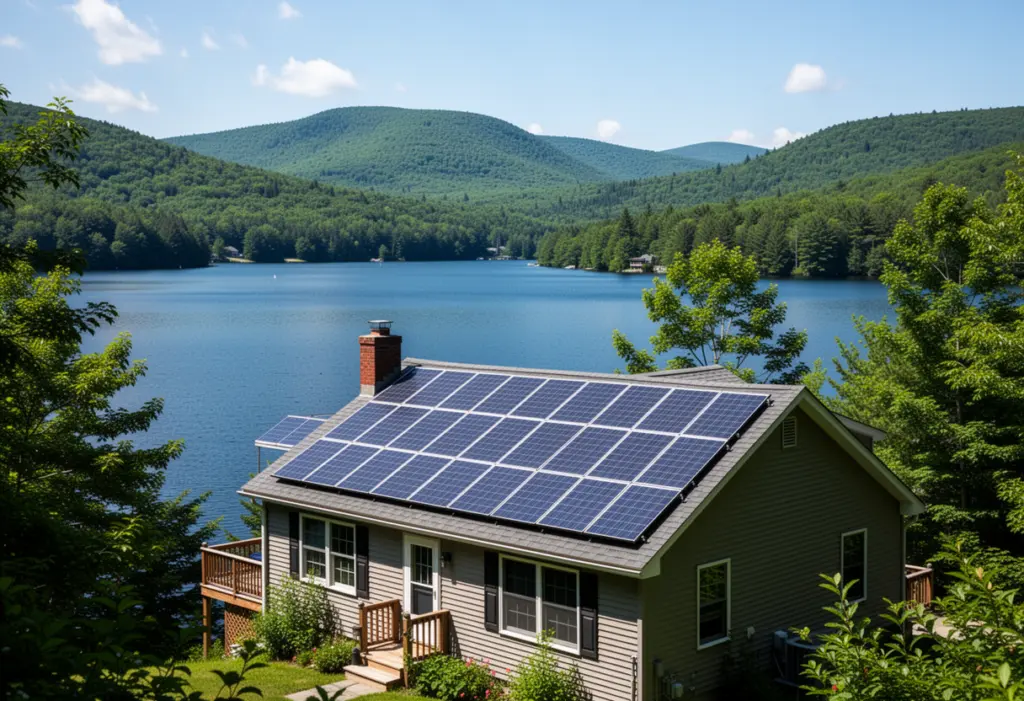
Warren County runs from Glens Falls and Queensbury north into the Adirondacks — Lake George, Bolton Landing, Warrensburg, Chestertown, North Creek. ZIP codes here begin 128. The two ends of the county are different enough that a quote written for one is not a quote for the other.
The southern end: conventional suburban work
Queensbury and Glens Falls are ordinary pitched-roof suburban installations. Newer development means roofs with life left, simpler planes so fire-access clearances eat less usable area, fewer structural questions, and larger electrical services that handle solar plus an EV charger without an upgrade.
The trade is landscaping: trees planted decades ago are substantial now, so an on-site shading assessment still matters.
The northern end: inside the Adirondack Park
North of the Glens Falls suburbs the county lies inside the Park, where private land sits under a land-use framework administered by the Adirondack Park Agency alongside town rules. Whether that touches a particular project depends on land classification and what is proposed — a rooftop array on an existing house is a very different question from a ground mount involving clearing and excavation.
Ask before design. Which authority reviews this, does Park classification affect it, and how long does it add? Several Park communities also carry their own local review, and around Lake George shoreline rules can apply.
Second homes and the credit
Warren County has a great many seasonal properties, and New York’s 25% credit on Form IT-255 is for equipment installed and used at your principal residence. A lake camp that is not your principal residence does not qualify. It is worth establishing before a proposal is built around a credit you cannot claim.
Seasonal occupancy also changes sizing. A house used heavily in summer and lightly in winter matches solar production unusually well, but twelve months of actual usage is essential — a design from a July bill oversizes badly and one from a February bill undersizes.
Snow
Design loads rise as you go north in this county. Ask what load the racking is specified for at your address, who verified the roof can carry it, whether snow guards are needed where the array discharges, and what snow-cover assumption is in the production estimate.
National Grid
The Customer Benefit Contribution is $0.97 per kW-month of DC system size for 2026, the lowest of the major New York utilities — about $7.76 a month on an 8 kW system, roughly $93 a year. Billed on capacity regardless of production and recalculated annually. Confirm your utility from your own bill; service in the Adirondacks is not uniform.
Land and ground mounts
Outside the built-up south, properties frequently have space, and a ground mount removes the roof-age question, lets orientation and tilt be chosen and allows safe ground-level snow clearing. Inside the Park it is also the option most likely to attract review, so raise it early rather than late.
2026 incentives
The 30% federal residential credit has ended — section 25D was terminated for expenditures made after 31 December 2025, with an expenditure treated as made when the original installation is completed.
Still available for a principal residence: New York’s 25% credit capped at $5,000 on Form IT-255; the sales tax exemption, which in Warren County covers the local sales tax as well as the 4% state tax, except in the city of Glens Falls, which still charges 1½% local sales tax (Publication 718-S); and RPTL 487’s 15-year property tax exemption where your town, the county and your school district have not opted out. The exemption needs a system built before 1 January 2030 and form RP-487 filed with your assessor by the taxable status date (March 1 in most towns; your assessor confirms yours).
Not available for homes now: NY-Sun. As of September 2026 NYSERDA has no open NY-Sun block for homes in any utility territory. In its Upstate region the last standard residential block (Block 14, $0.15/W), for NYSEG, RG&E and National Grid territory, closed on 17 December 2025, and the Affordable Solar block for lower-income households closed on 9 March 2026. Check NYSERDA’s NY-Sun dashboard for a new one before counting on it.
Frequently Asked Questions
Is solar different in the north and south of Warren County?
Yes. Queensbury and Glens Falls are conventional suburban installations, while the northern half lies inside the Adirondack Park, where a land-use framework administered by the Park Agency sits alongside town rules and can affect what is proposed.
Can I claim the New York solar credit on a Lake George camp?
Only if it is your principal residence. Form IT-255 covers equipment installed and used at your principal residence in New York State, so a seasonal camp does not qualify — worth establishing before a proposal is built around it.
Does a ground mount need extra review inside the Park?
It is the option most likely to attract it, because it involves clearing and excavation rather than work on an existing roof. Raise it early with whoever reviews your address rather than after a design exists.
How should a seasonal house be sized for solar?
Against twelve months of actual usage. Heavy summer occupancy matches production well, but a design built from a July bill oversizes badly and one from a February bill undersizes.
This article is general information, not tax, legal or financial advice. Incentive amounts, eligibility rules and deadlines change and depend on your utility, your tax situation and your property. Confirm current terms with NYSERDA, your utility and a qualified tax professional before making a decision.
NY Solar Incentives
Independent New York solar research. We summarise NYSERDA, NY-Sun and federal programme rules from published sources and state plainly when a figure is an estimate. We are not a government agency and do not sell equipment.
Run the arithmetic on your own system
Check the dated program table and your arrangement before counting an incentive. Standard residential NY-Sun blocks are closed; Long Island Affordable Solar has a conditional income-verification route. The NY credit depends on qualified costs and tax liability, while the NYC abatement reduces future property-tax bills. The estimator keeps those timings separate.