Solar Incentives in Schoharie County, NY
Schoharie County knows about flooding, and that changes where solar equipment can be mounted. It is the local question nobody expects.
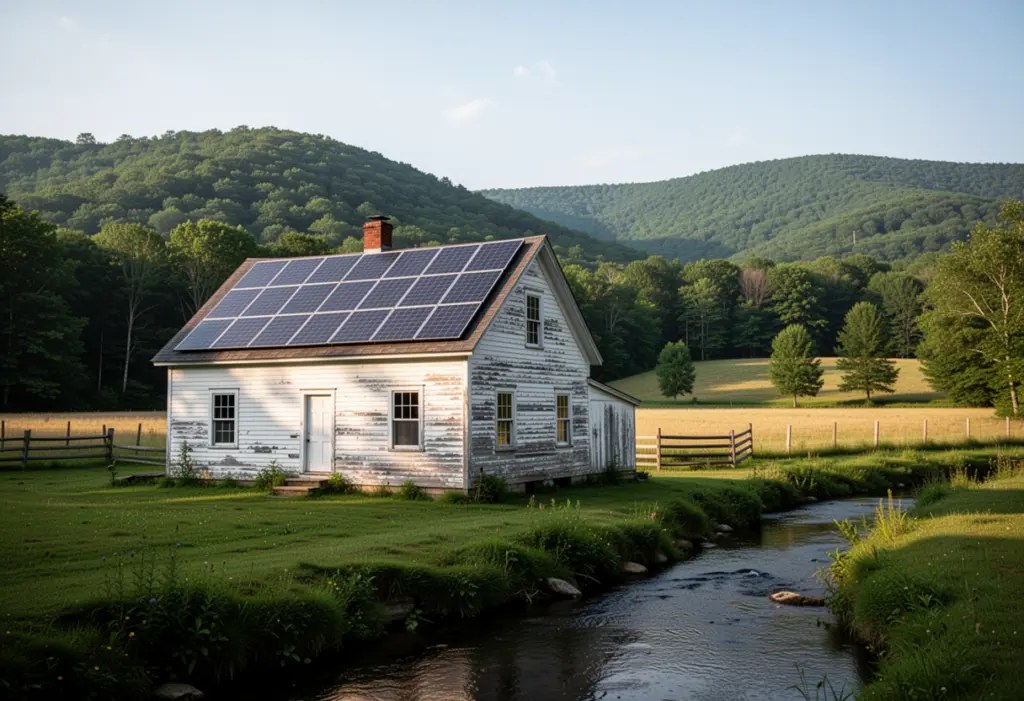
Schoharie County sits west of Albany in the hills between the Mohawk and the Catskills — Cobleskill, Middleburgh, Schoharie, Richmondville, Sharon Springs. ZIP codes here begin 121 and 120. It is farming country in a valley that has flooded badly within living memory, and that is a genuinely local consideration for a solar project.
Flood zones change where equipment goes
Parts of the Schoharie valley sit in mapped flood zones, and this county’s experience of flooding is recent enough that people take it seriously.
For solar it affects one specific thing: where the inverter, disconnects and any battery are mounted. Equipment at ground level in a flood-prone building is a design question rather than a detail, and the answer may be a higher mounting position, a different wall, or a different location entirely.
Raise it explicitly if your property is affected. An installer who works in this valley will have a considered answer; one who does not may mount to habit.
Valley shading
Wooded hills on both sides mean the southern horizon matters, and the low December sun is what makes an obstruction decisive. Insist on an on-site shading assessment and ask what the model assumes about December and January rather than only the annual figure.
Where the roof will not work, most properties here have land for a ground mount — which lets the array go where the sun is, removes the roof-age question and allows ground-level maintenance. On a flood-prone property, siting a ground mount also needs thought about the ground itself.
Rural circuits
Long feeders serving few customers are where interconnection applications hit limits. Ask whether hosting capacity was checked for your circuit before designing, and settle in writing when the application will be filed — before installation — and what happens to your deposit if a study or upgrade is required.
Confirm which utility serves you from your own bill; this county sits near a service boundary and is not uniformly served by one company.
Farmland
A project to offset a farm’s own consumption sits on the business side of the tax code, where the investment tax credit and depreciation did not follow the residential credit into repeal at the end of 2025 — a live question for your accountant with your own figures. Get interval data rather than bill totals.
Leasing ground to a developer is a separate, decades-long decision whose terms on decommissioning security, rent escalation, access routes, drainage and tile, the option period and agricultural assessment matter far more than the headline rent. Use your own attorney.
Roofs, snow and sizing
Roof age is the usual residential gate: under roughly ten years of shingle life left means re-roof first. Snow load is real; ask what the racking is specified for and what snow assumption is in the production estimate. And get twelve months of usage before accepting a design.
2026 incentives
The 30% federal residential credit has ended — section 25D was terminated for expenditures made after 31 December 2025, with an expenditure treated as made when the original installation is completed.
Still available: New York’s 25% credit capped at $5,000 on Form IT-255, non-refundable but carried forward five years and reaching leases and PPAs of ten years or more as well as purchases; the state sales tax exemption, which covers the 4% state tax only: Schoharie County still charges its own 4% local sales tax on residential solar (Publication 718-S, Part 1); and RPTL 487’s 15-year property tax exemption where your town or village, the county and your school district have not opted out. The exemption needs a system built before 1 January 2030 and form RP-487 filed with your assessor by the taxable status date (March 1 in most towns; your assessor confirms yours).
Not available for homes now: NY-Sun. As of September 2026 NYSERDA has no open NY-Sun block for homes in any utility territory. In its Upstate region the last standard residential block (Block 14, $0.15/W), for NYSEG, RG&E and National Grid territory, closed on 17 December 2025, and the Affordable Solar block for lower-income households closed on 9 March 2026. Check NYSERDA’s NY-Sun dashboard for a new one before counting on it.
Frequently Asked Questions
Does a flood zone affect a solar installation?
It affects where the inverter, disconnects and any battery may be mounted, which is a design question rather than a detail on flood-prone Schoharie valley properties. Raise it explicitly — an installer who works in the valley will have a considered answer.
Is shading a problem in the Schoharie valley?
Wooded hills on both sides mean the southern horizon matters, and the low December sun makes an obstruction decisive in the month it is least affordable. An on-site shading assessment is essential.
Which utility serves Schoharie County?
The county sits near a service boundary and is not uniformly served by one company. Read the name printed on your own bill rather than accepting an installer's assumption.
Can a Schoharie County farm claim a federal solar credit?
A project to offset the farm's own consumption sits on the business side of the tax code, where the investment tax credit and depreciation did not follow the residential credit into repeal. It is a live question for your accountant with your own figures.
This article is general information, not tax, legal or financial advice. Incentive amounts, eligibility rules and deadlines change and depend on your utility, your tax situation and your property. Confirm current terms with NYSERDA, your utility and a qualified tax professional before making a decision.
NY Solar Incentives
Independent New York solar research. We summarise NYSERDA, NY-Sun and federal programme rules from published sources and state plainly when a figure is an estimate. We are not a government agency and do not sell equipment.
Run the arithmetic on your own system
Check the dated program table and your arrangement before counting an incentive. Standard residential NY-Sun blocks are closed; Long Island Affordable Solar has a conditional income-verification route. The NY credit depends on qualified costs and tax liability, while the NYC abatement reduces future property-tax bills. The estimator keeps those timings separate.