Solar Incentives in Hamilton County, NY
Hamilton County is the least populated county east of the Mississippi and lies wholly inside the Adirondack Park. Both facts change the answer.
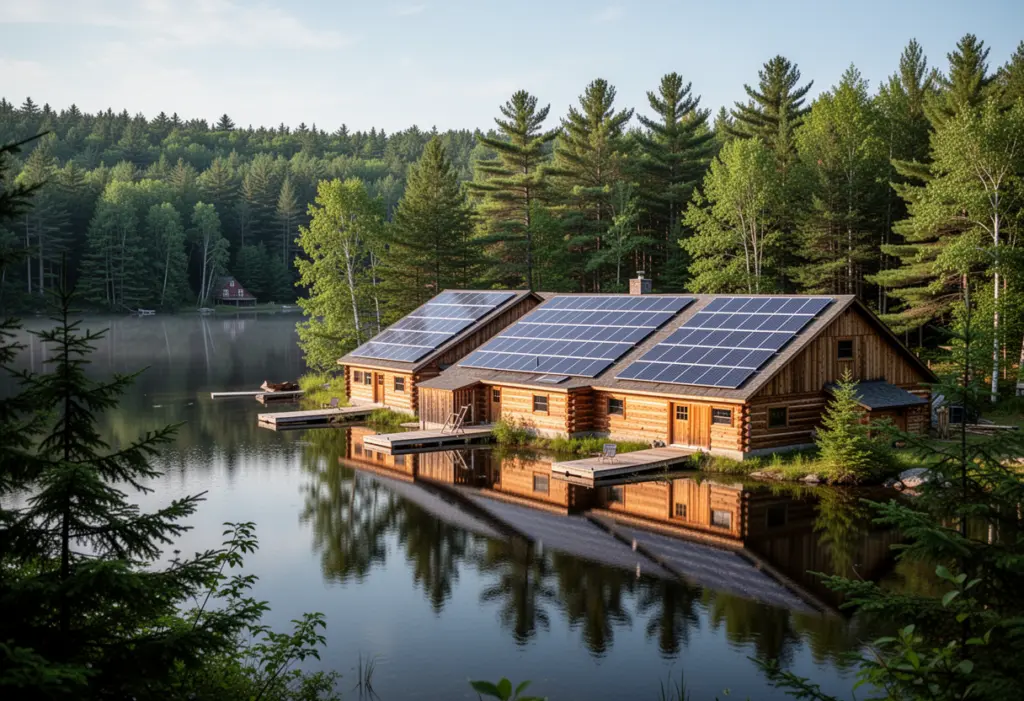
Hamilton County covers the central Adirondacks — Lake Pleasant, Speculator, Indian Lake, Long Lake, Inlet, Wells. ZIP codes here begin 121 and 128. It is the least populated county east of the Mississippi and it lies entirely inside the Adirondack Park, which makes it the most distinctive solar market in New York.
Everything here is inside the Park
Private land in Hamilton County sits under a land-use framework administered by the Adirondack Park Agency alongside town rules. Whether it touches a given project depends on land classification and what is proposed — a rooftop array on an existing camp is a different question from a ground mount involving clearing and excavation.
Unlike counties that are partly in the Park, there is no outside here. Ask before design: which authority reviews this, does classification affect it, and what does it add? An installer who works in the Park regularly answers immediately; one who does not may not know the question exists.
Most buildings here are seasonal, and that decides the credit
New York’s 25% credit on Form IT-255 is for equipment installed and used at your principal residence in New York State. A camp that is not your principal residence does not qualify.
In a county where a large share of buildings are seasonal, that is the single most important thing to establish before anyone builds a proposal around a credit you cannot claim. Ask the question early and get the answer from your accountant rather than from a sales sheet.
Seasonal use also changes sizing entirely. A camp used heavily in summer and barely in winter has a consumption profile nothing like a year-round house, and a template will get it badly wrong in one direction or the other. Twelve months of actual usage, or an honest account of the occupancy pattern, is essential.
Forest, and the southern horizon
This is dense forest with mountains. The southern horizon is frequently trees, a ridge, or both, and the low December sun makes that decisive. An on-site shading assessment is not optional here — and where the answer is that the roof will not work, it is a real answer rather than a negotiating position.
A ground mount can solve it where there is a clearing, but in the Park a ground mount is also the option most likely to attract review. Raise both together rather than sequentially.
Off-grid is a genuine question here
In a county this remote, some properties are far from a line, and the cost of extending service can exceed the cost of a standalone system. That is a different discipline from grid-tied solar — it is a battery-first design with generator backup, sized for the worst week rather than the annual average, and none of the net-metering arrangements described elsewhere on this site apply to it.
If that is your situation, say so at the first conversation. An installer who mainly fits grid-tied rooftop systems is not necessarily the right firm for it.
Utility, snow and cold
Confirm which utility serves you from your own bill; service here is not uniform. Design snow loads are high — ask what the racking is specified for, who verified the roof, whether snow guards are needed, and what snow-cover assumption is in the production estimate. Cold itself is mildly helpful to output; short winter days are not.
2026 incentives
The 30% federal residential credit is gone — section 25D was terminated for expenditures made after 31 December 2025, with an expenditure treated as made when the original installation is completed.
Still available for a principal residence: New York’s 25% credit capped at $5,000 on Form IT-255; the state sales tax exemption; and RPTL 487’s 15-year property tax exemption, claimed on form RP-487 filed with your assessor by the taxable status date, where your town, the county and your school district have not opted out. NY-Sun and its Affordable Solar track are not: as of September 2026 NYSERDA has no open NY-Sun block for homes in any utility territory; check NYSERDA’s NY-Sun dashboard for a new one.
Frequently Asked Questions
Does the Adirondack Park affect every solar project in Hamilton County?
The county lies entirely inside the Park, so there is no outside. Private land sits under a land-use framework administered by the Park Agency alongside town rules, and whether it touches your project depends on classification and what is proposed.
Can I claim the New York solar credit on an Adirondack camp?
Only if it is your principal residence. Form IT-255 covers equipment installed and used at your principal residence in New York State, which matters greatly in a county where a large share of buildings are seasonal.
Is off-grid solar realistic in Hamilton County?
For remote properties where extending a line costs more than a standalone system, yes — but it is a different discipline: battery-first, generator-backed, sized for the worst week rather than the annual average, and none of the net-metering arrangements apply.
How should a seasonal camp be sized for solar?
Against actual usage or an honest account of the occupancy pattern. A camp used heavily in summer and barely in winter has a profile nothing like a year-round house, and a template will get it badly wrong.
This article is general information, not tax, legal or financial advice. Incentive amounts, eligibility rules and deadlines change and depend on your utility, your tax situation and your property. Confirm current terms with NYSERDA, your utility and a qualified tax professional before making a decision.
NY Solar Incentives
Independent New York solar research. We summarise NYSERDA, NY-Sun and federal programme rules from published sources and state plainly when a figure is an estimate. We are not a government agency and do not sell equipment.
Run the arithmetic on your own system
Check the dated program table and your arrangement before counting an incentive. Standard residential NY-Sun blocks are closed; Long Island Affordable Solar has a conditional income-verification route. The NY credit depends on qualified costs and tax liability, while the NYC abatement reduces future property-tax bills. The estimator keeps those timings separate.