Solar Incentives in Monroe County, NY
Monroe County covers Rochester and its towns, sits in RG&E territory, and carries one of the state's higher solar charges. Here is the full picture.
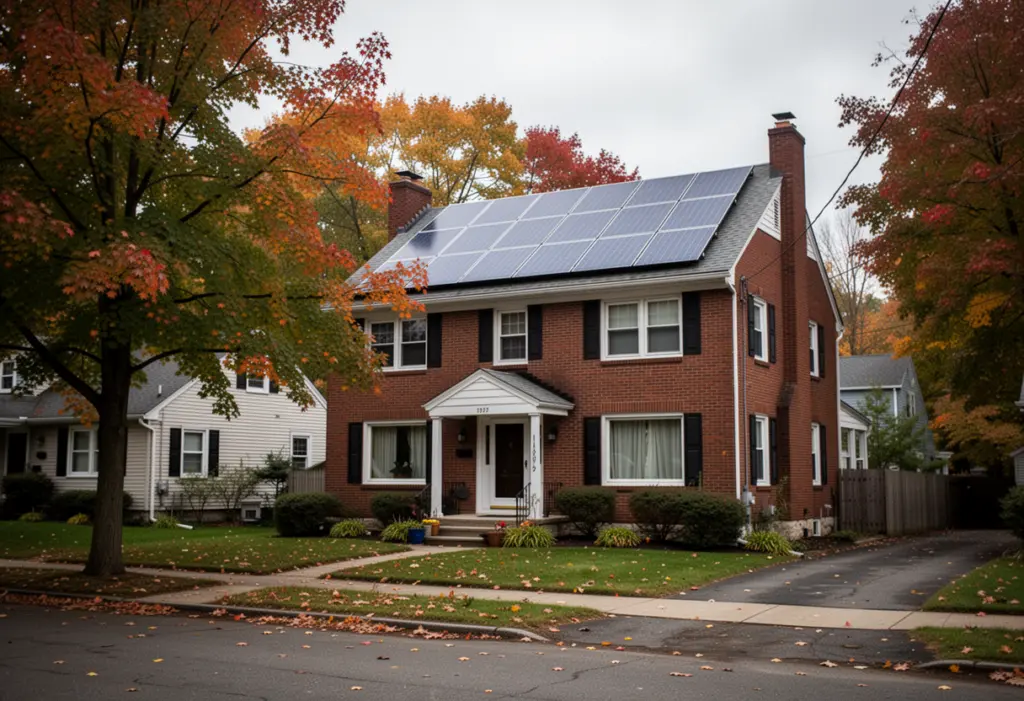
Monroe County is Rochester plus the ring of towns around it — Greece, Irondequoit, Henrietta, Penfield, Webster, Pittsford, Brighton, Chili, Gates and the rest. ZIP codes here begin 144 and 146. It is one of the most affordable large housing markets in the state, and one of the cloudier ones, and both of those facts shape the solar conversation.
What is claimable in 2026
The federal 30% credit is gone. Section 25D was terminated for expenditures made after 31 December 2025, with an expenditure treated as made when the original installation is completed. A Monroe County system finished in December 2025 still qualifies even where RG&E granted permission to operate later. A purchase today does not.
New York’s 25% credit, capped at $5,000, on Form IT-255 for your principal residence. Non-refundable but carried forward for up to five years — which matters if your tax liability is modest, as it often is in this market.
NY-Sun is not open for homes. It was paid through the contractor as a price reduction, with the amount depending on size and region and stepping down as capacity blocks filled. In NYSERDA’s Upstate region the last standard residential block, open only in NYSEG, RG&E and National Grid territory, closed on 17 December 2025, and the Upstate Affordable Solar block closed on 9 March 2026. As of September 2026 NYSERDA has no open NY-Sun block for homes in any utility territory; check NYSERDA’s NY-Sun dashboard for a new one.
Affordable Solar, NYSERDA’s incentive for households with income under 80% of the area or state median income (whichever is higher), is closed upstate too.
The state sales tax exemption on residential solar equipment, with local shares exempted separately where the locality has elected to.
RPTL 487, the 15-year property tax exemption on the added value — where your municipality has not opted out. The RPTL 487 exemption is not automatic: file form RP-487 with your assessor by the taxable status date (March 1 in most towns; January 2 in Nassau towns; May 1 or June 1 in Westchester towns; set by charter in cities; usually January 1 in villages), and the system must be built before January 1, 2030 (RP-487 instructions). In Monroe County that is decided separately by your town, the county and your school district.
RG&E and the second-highest CBC in the state
Monroe County is RG&E territory. Beyond running the interconnection process and granting permission to operate, that sets your Customer Benefit Contribution: a monthly charge on the DC size of your system, for anyone interconnecting on or after 1 January 2022.
RG&E’s final 2026 residential rate is $1.31 per kW-month, second only to Central Hudson.
- A 6 kW system: $7.86 a month, about $94 a year.
- An 8 kW system: $10.48 a month, about $126 a year.
- A 10 kW system: $13.10 a month, about $157 a year.
It is billed on capacity regardless of production and recalculated annually rather than fixed at interconnection. Put it in your arithmetic; almost no proposal will.
Which town you are in decides more than you would expect
Monroe County’s towns each run their own building department, and the permit and inspection step varies between them in a way the utility step does not. Greece, Irondequoit, Henrietta, Penfield, Webster, Pittsford, Brighton, Chili and Gates all have their own processes and their own turnarounds.
Ask your installer which authority is issuing your permit and what it is currently running at. An installer who works mainly in Henrietta may have no idea what Pittsford’s queue looks like.
The same fragmentation applies to RPTL 487. Each town, the county and each school district decides for its own levy, so “is solar exempt from property tax in Monroe County” has no single answer — it has one answer per address.
Rochester’s grey winter
Monroe County is genuinely one of the cloudier parts of New York, with a deep November-to-February trough and a low sun angle. What makes solar work anyway is net metering: exports are credited at the full retail rate and the March-to-September surplus banks as a credit balance that pays the winter bills.
The practical consequence is that sizing has to be honest. A Monroe County system needs to run a genuine annual surplus in summer, or the credit balance runs out in January — the month it is most needed. Get twelve months of RG&E usage before accepting any design, and ask what the production estimate assumed about shading. Rochester’s older neighbourhoods carry mature street trees, and a proposal that ignores them will overstate output.
Roof age, which is the usual constraint
Monroe County housing is old by national standards. If your shingles have under about ten years of life left, replace the roof before installing — removing and reinstalling an array later costs considerably more than mounting on a bare roof. Snow load here is moderate for upstate but racking still has to be specified for it.
The alternative worth knowing
Community solar operates in RG&E territory, needs no roof and no up-front cost, and its subscribers are exempt from the Customer Benefit Contribution altogether. For a shaded lot, a rented home or a roof that needs replacing first, it is a genuine answer rather than a consolation.
Frequently Asked Questions
What is the RG&E solar charge in Monroe County?
The 2026 residential Customer Benefit Contribution is $1.31 per kW-month of DC system size, the second-highest in New York. An 8 kW system pays about $10.48 a month, roughly $126 a year, billed on capacity regardless of production.
Is solar exempt from property tax in Monroe County?
It depends on your address. RPTL 487 provides a 15-year exemption on the added value, but municipalities may opt out and your town, the county and your school district each decide for their own levy. There is one answer per address, not one for the county.
Is Rochester too cloudy for solar to be worth it?
The winters are grey, but net metering banks the March-to-September surplus as a credit that carries into winter, so the annual total is what matters. What it requires is honest sizing against a full year of consumption and a real shading assessment.
Who issues a solar permit in Monroe County?
Your town. Greece, Irondequoit, Henrietta, Penfield, Webster, Pittsford, Brighton, Chili and Gates each run their own building department with their own turnaround. The utility step is identical across all of them.
This article is general information, not tax, legal or financial advice. Incentive amounts, eligibility rules and deadlines change and depend on your utility, your tax situation and your property. Confirm current terms with NYSERDA, your utility and a qualified tax professional before making a decision.
NY Solar Incentives
Independent New York solar research. We summarise NYSERDA, NY-Sun and federal programme rules from published sources and state plainly when a figure is an estimate. We are not a government agency and do not sell equipment.
Run the arithmetic on your own system
Check the dated program table and your arrangement before counting an incentive. Standard residential NY-Sun blocks are closed; Long Island Affordable Solar has a conditional income-verification route. The NY credit depends on qualified costs and tax liability, while the NYC abatement reduces future property-tax bills. The estimator keeps those timings separate.