Using a HELOC to Pay for Solar in New York
A home equity line separates two decisions a dealer-financed solar loan bundles together: what the system costs, and who lends you the money. That separation is the reason to consider it and also where the risk sits.
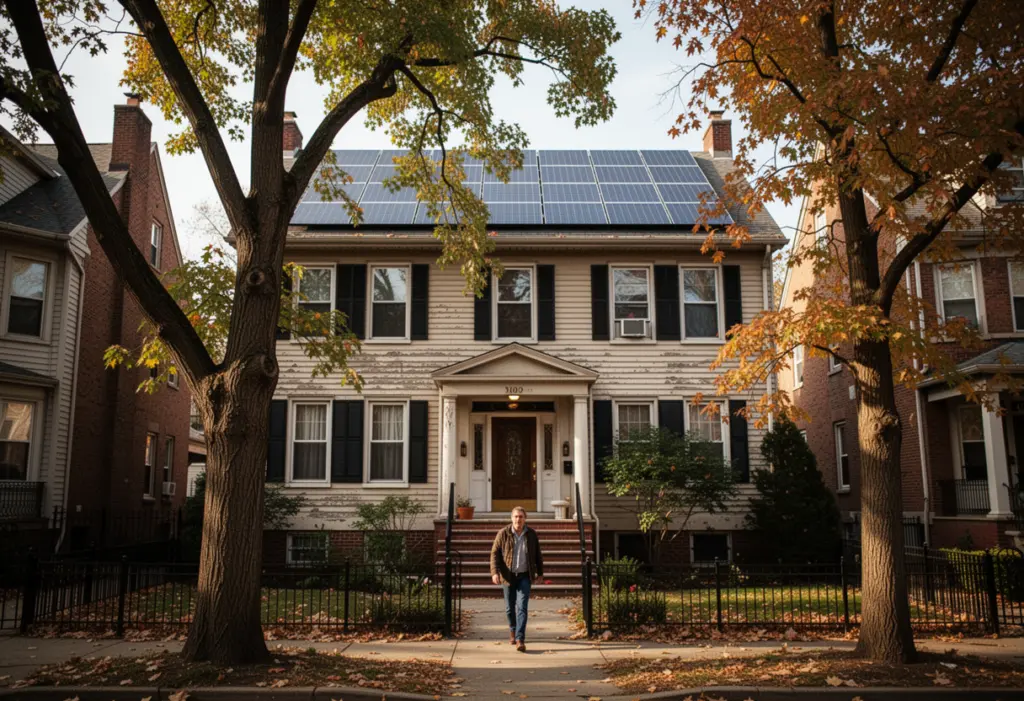
A home equity line of credit separates two decisions that a contractor-arranged solar loan bundles together: what the system costs, and who lends you the money. That separation is the entire argument for using one. It is also where the risk sits, because a line of credit is secured by your house rather than by the panels.
Why separating them matters
A contractor-arranged loan at an unusually low rate is normally paid for by a fee the contractor pays the lender and recovers inside the system price. Arriving with your own money removes that mechanism entirely. Ask for the cash price of the system in writing, then ask what the same system costs on the promoted financing. The difference is what that financing costs, and it is frequently larger than the interest you would pay on equity borrowing over the same period.
What a line of credit actually is
- Usually a variable rate. A line of credit moves with an index. A fixed-rate home equity loan does not. Against an asset expected to run twenty years or more, that difference is not cosmetic, and it is worth pricing both.
- A draw period, then a repayment period. Interest-only payments during the draw period end, and the payment steps up when repayment begins. Ask for the payment in both phases before you draw a dollar.
- Costs to open. Appraisal, title work, recording and sometimes an annual fee. Ask for the total to open it and the total to close it early.
- It is a lien on the home. A solar loan generally carries a fixture filing. Home equity borrowing is a mortgage. Say that to yourself plainly before signing, because the collateral is different in kind.
What it does not change
The New York solar energy system equipment credit follows ownership, not the source of the funds. If you buy the equipment for your principal residence in New York you claim 25 percent on Form IT-255, capped at $5,000, whether you paid cash, used a contractor-arranged loan, or drew on a line of credit.
Run that credit against your actual tax position rather than the headline. It is not refundable, it is limited by your New York liability, and unused amounts carry forward up to five years. On an $18,000 qualified expenditure the credit is $4,500, comfortably under the cap, but a household whose New York liability runs around $900 a year needs five tax years to absorb it: the year of the claim plus four of the five carryforward years. That is a cash-flow fact worth knowing before you set a repayment schedule around it.
The Customer Benefit Contribution is likewise indifferent to financing. It is charged monthly on DC system size for systems interconnected on or after 1 January 2022. At the 2026 residential rates a 7 kW array is $6.79 a month on National Grid at $0.97 per kW-month, $8.33 on NYSEG at $1.19 and $9.17 on RG&E at $1.31. Small numbers, but they are charged on capacity whether or not the array produces, so an array oversized merely because credit was available costs you twice.
Interest deductibility is a question for your accountant
Whether interest on home equity borrowing is deductible depends on how the proceeds are used and on rules this site cannot settle for your situation. Solar is often described loosely as a home improvement, but the test and the documentation are specific and the answer is personal. Ask your accountant before you count a deduction into the comparison, and do not accept that answer from whoever is selling the system.
The New York alternatives worth pricing against it
NYSERDA offers financing through Energy Finance Solutions: the On-Bill Recovery Loan, repaid through your utility bill, and the Smart Energy Loan. Both are worth a quote alongside a line of credit, because neither is a dealer-fee product either. Price all three against the cash price of the same system rather than against one another’s monthly payments, which is how a longer term gets mistaken for a cheaper deal.
Settle the incentives before you borrow
Borrow against the price you will actually pay. As of September 2026 NYSERDA has no open NY-Sun block for homes in any utility territory; check NYSERDA’s NY-Sun dashboard for a new one. When a block is open, NY-Sun is applied by the contractor as a reduction on the invoice, so it shrinks the amount you draw rather than arriving afterwards. The Affordable Solar incentive for income-qualified households has closed as well: it ran from 30 May to 15 October 2025 in Con Edison territory and from 18 December 2025 to 9 March 2026 in the rest of the state outside Long Island. The state sales tax exemption removes the state share on residential solar equipment, with localities electing separately on their own share. RPTL 487 exempts the added value from property tax for fifteen years where the county, the municipality and the school district have each not opted out, and it requires construction before 1 January 2030 — three separate checks, one call each. And the 30 percent federal residential credit is gone: section 25D ended for expenditures made after 31 December 2025, with an expenditure treated as made when the original installation is completed, so nothing federal arrives later to pay down the balance. Confirm the current position at tax.ny.gov and nyserda.ny.gov before you draw.
Frequently Asked Questions
Does using a HELOC change the New York solar credit?
No. The credit follows ownership of the equipment, not the source of the funds, so a purchase for your principal residence qualifies at 25% up to $5,000 on Form IT-255 however you paid for it.
Is a HELOC cheaper than a contractor's solar loan?
It depends on the cash price. Compare the cash price plus equity interest against the financed price plus its interest, because a low advertised rate is often paid for inside a higher system price.
Can I deduct the interest on money borrowed for solar?
That depends on how the proceeds are used and on your own tax position. Ask your accountant before counting a deduction into the comparison, and do not take that answer from a salesperson.
Should I borrow more and install a larger array?
Only if the load justifies it. The Customer Benefit Contribution is charged on DC capacity every month regardless of production, and net metering credits you never consume are credits you paid for twice.
This article is general information, not tax, legal or financial advice. Incentive amounts, eligibility rules and deadlines change and depend on your utility, your tax situation and your property. Confirm current terms with NYSERDA, your utility and a qualified tax professional before making a decision.
NY Solar Incentives
Independent New York solar research. We summarise NYSERDA, NY-Sun and federal programme rules from published sources and state plainly when a figure is an estimate. We are not a government agency and do not sell equipment.
Run the arithmetic on your own system
Check the dated program table and your arrangement before counting an incentive. Standard residential NY-Sun blocks are closed; Long Island Affordable Solar has a conditional income-verification route. The NY credit depends on qualified costs and tax liability, while the NYC abatement reduces future property-tax bills. The estimator keeps those timings separate.