Comparing Three Solar Quotes: What to Normalise First
Three quotes arrive and the totals differ by thousands. Four adjustments make them comparable, and one of them explains most of the gap.
On this page 8 sections
- 011. Convert everything to dollars per DC watt
- 022. Compare production, then interrogate it
- 033. Find out whether NY-Sun is still in the price
- 044. Take the finance fee out
- 05The incentive lines to check
- 06The line that appears in none of them
- 07What to hold constant across all three
- 08Frequently Asked Questions
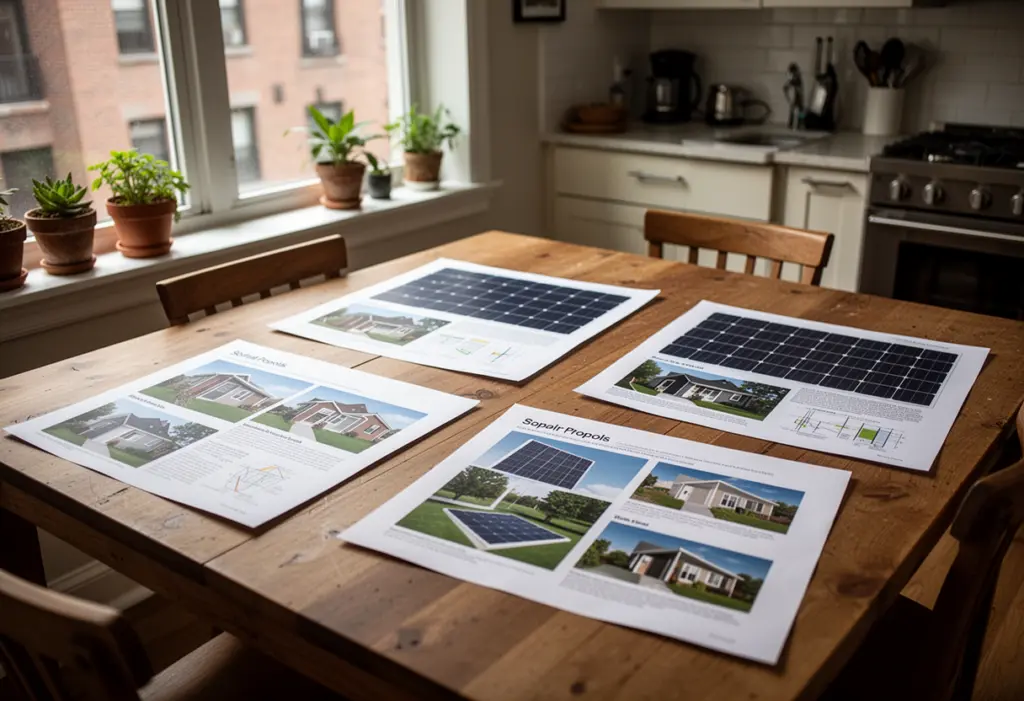
Three solar quotes arrive and the totals differ by thousands. Very little of that gap is what it appears to be, because the three documents are not measuring the same thing. Before comparing a single number, normalise four of them: system size in DC watts, annual production in kilowatt-hours, whether the price still assumes a NY-Sun deduction, and whether the price carries a finance fee. After that the comparison is real, and it is usually far closer than it looked.
1. Convert everything to dollars per DC watt
Divide the price by the system size in DC watts. Two figures purely to show the arithmetic, chosen for the sum and not as any indication of what solar costs today: a 24,000 dollar quote for an 8 kW system and a 30,000 dollar quote for a 10 kW system are the same price per watt; one is simply a larger system. Check which size the quote states, because DC module capacity and AC inverter capacity are different numbers and dividing by the wrong one flatters or penalises a quote by a tenth or more. If a quote does not state DC watts, ask for it in writing before going any further.
2. Compare production, then interrogate it
Every quote carries an annual production estimate in kilowatt-hours. If two quotes propose a similar array on the same roof and one claims materially more production, that difference is an assumption rather than equipment.
- What shading data was used, and was anyone actually on the roof?
- What tilt and azimuth does it assume, and does that match the roof?
- What does it assume about snow?
- What are the December and January monthly figures, rather than the annual total?
Those winter months are where a desk estimate and an on-site assessment diverge most in New York. Read the estimate as the installer’s claim about your roof, and claims can be asked about.
3. Find out whether NY-Sun is still in the price
This has been the most common apples-to-oranges error in New York, and it is entirely invisible on the page. NY-Sun was paid through the contractor as a reduction in the price rather than claimed by you on a form, so one quote could show a gross price with the incentive listed underneath, and another a lower price with the incentive already deducted and never mentioned. As of September 2026 NYSERDA has no open NY-Sun block for homes in any utility territory; check NYSERDA’s NY-Sun dashboard for a new one. A 2026 quote that still subtracts NY-Sun looks cheaper by exactly an incentive that is not on offer.
Ask each installer the same sentence: does this price assume any NY-Sun incentive, and if so, which open block and what per-watt figure are you applying. Blocks close as capacity fills, so an answer that names a block can be checked on the dashboard the same day. A figure quoted two months ago is not necessarily the figure today.
4. Take the finance fee out
A quote offering a strikingly low loan rate is normally carrying a dealer fee inside the system price. That is not a scandal, it is how the product is built, but it means the cash price and the financed price are not the same price and comparing them directly is meaningless. Ask each installer for both, as two separate figures. If they come back identical, ask again. Then compare cash to cash, and treat the finance separately as what it is: a loan with a rate, a term and a total interest cost you can add up yourself.
The incentive lines to check
Any 2026 quote showing a 30 percent federal credit for you as the buyer is materially wrong, and you should say so out loud. Section 25D was terminated for expenditures made after 31 December 2025, and an expenditure is treated as made when the original installation is completed. A quote still carrying that line is either out of date or quietly describing a third-party owned system where the benefit belongs to the owner rather than to you.
New York State’s credit is 25 percent of qualified expenditure, capped at 5,000 dollars, claimed on Form IT-255 for a principal residence in New York and limited by your actual state tax liability. Notice what the cap does to a comparison: 25 percent reaches 5,000 dollars at 20,000 dollars of expenditure, so a 26,000 dollar system and a 33,000 dollar system produce exactly the same 5,000 dollar credit. Above that level the state credit does not narrow the gap between two quotes at all. It is the same subtraction from both.
The line that appears in none of them
None of the three quotes is likely to show the Customer Benefit Contribution, a monthly charge on the DC size of the array rather than on production, applying to systems interconnected on or after 1 January 2022. For 2026 the residential rates are 0.97 dollars per kW-month on National Grid, 1.00 on Orange & Rockland, 1.13 on LIPA and PSEG Long Island, 1.19 on NYSEG, 1.29 on Con Edison, 1.31 on RG&E and 1.67 on Central Hudson.
A 9 kW array on NYSEG is 10.71 dollars a month, roughly 129 a year. The same array on Central Hudson is 15.03, roughly 180. It matters most when the three quotes propose different sizes, because the larger array carries the larger charge for as long as you own it, and the rates are recalculated annually rather than locked in at interconnection.
What to hold constant across all three
- The four warranties, listed separately: module, inverter, workmanship and any production guarantee.
- Who pulls the electrical and building permits, and in whose name.
- Who submits the interconnection application to the utility.
- What is excluded: service panel upgrade, tree work, roof repair, structural work.
- What happens if you sell the house before the system is paid for.
One last thing. Do not let three quotes collapse into a negotiation over a discount that expires this evening. A price that exists only today is a sales technique, not a price. Every incentive named here is administered by NYSERDA, by the New York State Department of Taxation and Finance or by your utility, on their own timetable, and none of them ends because a salesperson is leaving your kitchen.
Frequently Asked Questions
What is the single most misleading difference between two solar quotes?
Whether the price still subtracts a NY-Sun incentive. As of September 2026 NYSERDA has no open NY-Sun block for homes in any utility territory, so a quote showing a net price after NY-Sun looks cheaper by exactly an incentive that is not on offer. Ask which open block it relies on and check NYSERDA's NY-Sun dashboard.
How do I compare quotes for different system sizes?
Divide the price by the system size in DC watts to get dollars per watt, and check that the quote states DC and not AC capacity. Then compare annual production estimates, and remember the larger array also carries a larger monthly capacity charge for as long as you own it.
Why is a low-rate solar loan not a cheaper deal?
A strikingly low rate normally carries a dealer fee inside the system price, so the cash price and the financed price are different prices. Ask for both as separate figures, compare cash to cash, and price the loan separately by its rate, term and total interest.
Does the New York State credit make an expensive quote worth it?
No. The credit is 25% capped at $5,000, and 25% reaches $5,000 at $20,000 of expenditure. Above that, a $26,000 system and a $33,000 system both produce a $5,000 credit, so it subtracts the same amount from each and does not close the gap.
This article is general information, not tax, legal or financial advice. Incentive amounts, eligibility rules and deadlines change and depend on your utility, your tax situation and your property. Confirm current terms with NYSERDA, your utility and a qualified tax professional before making a decision.
NY Solar Incentives
Independent New York solar research. We summarise NYSERDA, NY-Sun and federal programme rules from published sources and state plainly when a figure is an estimate. We are not a government agency and do not sell equipment.
Run the arithmetic on your own system
Check the dated program table and your arrangement before counting an incentive. Standard residential NY-Sun blocks are closed; Long Island Affordable Solar has a conditional income-verification route. The NY credit depends on qualified costs and tax liability, while the NYC abatement reduces future property-tax bills. The estimator keeps those timings separate.