Solar Panel Cost in Pittsford, NY
Pittsford has large houses and a protected canal village. One scales the cost up and the other decides where the panels can go.
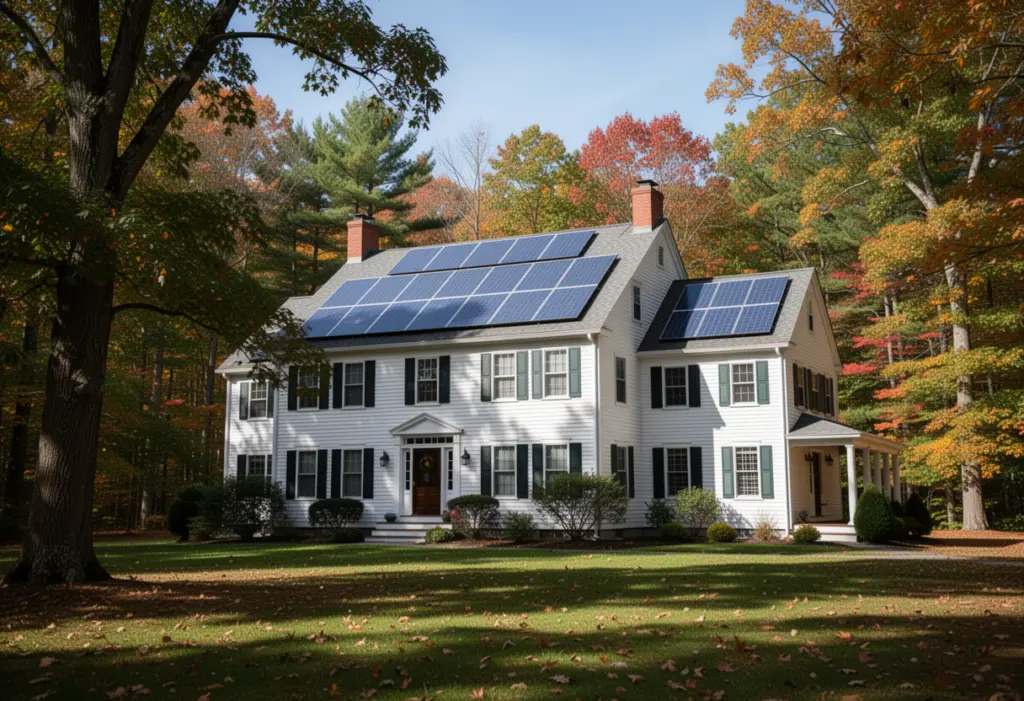
Pittsford is a town and village in Monroe County, south-east of Rochester on the Erie Canal. ZIP code 14534. Three things drive the cost of a system here.
Larger systems, and the cap that binds
Consumption here runs above the county average, so arrays do too, and two costs scale with that.
The Customer Benefit Contribution is charged on DC system size. At RG&E’s 2026 residential rate of $1.31 per kW-month:
- A 10 kW system: $13.10 a month, about $157 a year.
- A 14 kW system: $18.34 a month, about $220 a year.
- An 18 kW system: $23.58 a month, about $283 a year.
And New York’s credit is capped at $5,000 regardless of system size. On a large Pittsford array the cap binds, so the credit covers a smaller proportion of the total than it would on a modest system — worth knowing when a proposal quotes 25% as though it applied to the whole cost.
Village review decides placement
The Village of Pittsford and the Town of Pittsford are separate authorities with their own building departments. The village’s canal-side streets carry significant historic character, and architectural review may apply — a municipal step ahead of the building permit that can restrict street-visible placement.
Design for approval rather than arguing after refusal: a rear or secondary roof plane not visible from the public way, all-black modules with black frames, flush mounting following the roof plane, and concealed conduit. Ask when the board meets — boards frequently meet monthly, so a missed submission deadline costs four weeks.
Note the cost consequence of that timing: a project held in review past a year boundary can lose an incentive that was open when it was quoted.
Trees, and what they cost you
Pittsford’s lots are generously treed, and the low December sun makes an obstruction decisive in the month the credit balance is being drawn down. Insist on an on-site shading assessment and ask what the model says about December and January.
On a shaded roof, per-panel electronics — microinverters or DC optimisers — earn their cost by containing a loss to the affected panel rather than a whole string.
If tree removal is proposed, treat it as your decision. It carries real cost, may need a permit, and permanently changes a property where mature trees are part of the value.
Land, and the ground-mount alternative
Outside the village many properties have space, and a ground mount is often the option a review board is most comfortable with — it does not touch the building at all. It also lets orientation and tilt be chosen, removes the roof-age question, and puts snow clearing at ground level. Ask for it to be quoted alongside the roof option.
Roofs
Roof age is the usual gate: under roughly ten years of shingle life left means re-roof first. Slate and standing-seam metal both appear on older Pittsford housing — slate needs a mounting approach not every installer is equipped for, while standing seam is the best case, since racking clamps to the seams with no penetrations at all.
2026 incentives
The 30% federal residential credit has ended — section 25D was terminated for expenditures made after 31 December 2025, with an expenditure treated as made when the original installation is completed. On a large system the loss is a large absolute number, and any proposal still showing it is materially wrong.
Still available for a principal residence: New York’s 25% credit capped at $5,000 on Form IT-255, which also reaches leases and PPAs of ten years or more; the state sales tax exemption; and RPTL 487’s 15-year property tax exemption where the town or village, Monroe County and your school district have not opted out, if you file form RP-487 with the assessor by the taxable status date. NY-Sun is not on that list: as of September 2026 NYSERDA has no open NY-Sun block for homes in any utility territory; check NYSERDA’s NY-Sun dashboard for a new one.
Frequently Asked Questions
Is the New York credit worth less on a large Pittsford system?
Proportionally, yes. It is 25% of qualified expenditure but capped at $5,000 regardless of size, so on a large array the cap binds and the credit covers a smaller share than a proposal quoting 25% might suggest.
Does village review apply to solar in Pittsford?
In the village's historic canal-side streets it can, ahead of the building permit and capable of restricting street-visible placement. The Village and Town of Pittsford are separate authorities, so establish which covers your address.
What does RG&E charge on a large Pittsford array?
The Customer Benefit Contribution at $1.31 per kW-month of DC system size for 2026 — about $157 a year on 10 kW, $220 on 14 kW and $283 on 18 kW, billed on capacity regardless of production.
Is a ground mount easier to get approved?
Often, outside the village. It does not touch the building at all, which review boards are frequently more comfortable with, and it lets orientation and tilt be chosen while removing the roof-age question.
This article is general information, not tax, legal or financial advice. Incentive amounts, eligibility rules and deadlines change and depend on your utility, your tax situation and your property. Confirm current terms with NYSERDA, your utility and a qualified tax professional before making a decision.
NY Solar Incentives
Independent New York solar research. We summarise NYSERDA, NY-Sun and federal programme rules from published sources and state plainly when a figure is an estimate. We are not a government agency and do not sell equipment.
Run the arithmetic on your own system
Check the dated program table and your arrangement before counting an incentive. Standard residential NY-Sun blocks are closed; Long Island Affordable Solar has a conditional income-verification route. The NY credit depends on qualified costs and tax liability, while the NYC abatement reduces future property-tax bills. The estimator keeps those timings separate.