Solar Panel Installation in Lancaster, NY
Lancaster contains two villages with their own building departments, and housing that ranges over a century. Both decide the project.
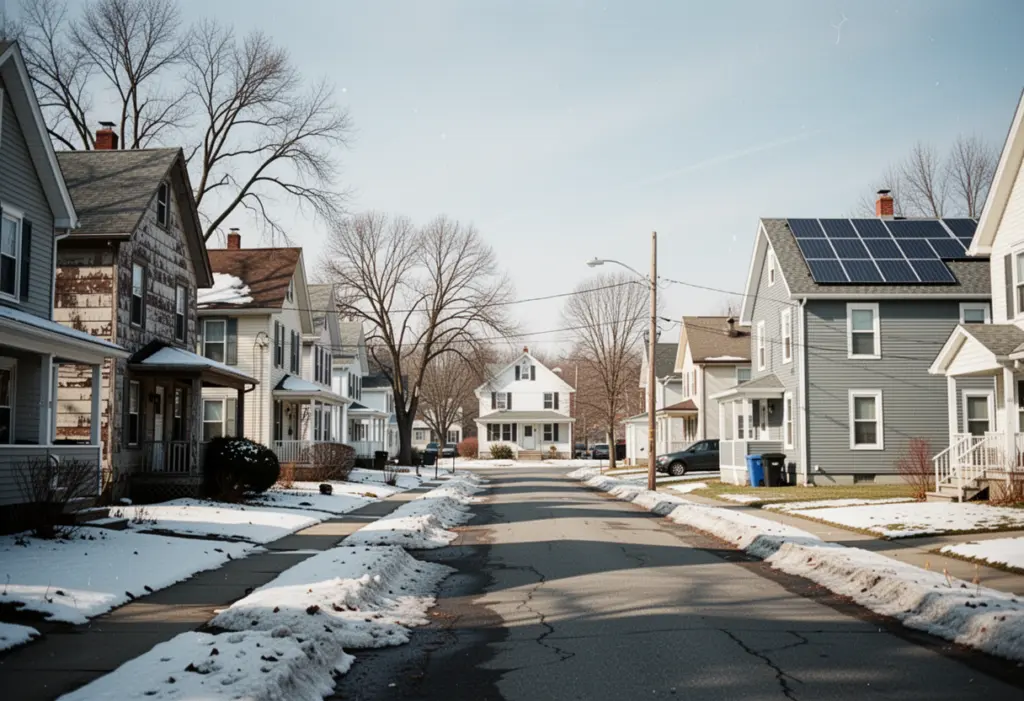
Lancaster is a town in Erie County, east of Buffalo. ZIP codes 14086 and 14043. Two practical things distinguish it: three permitting authorities, and a housing stock that spans more than a century.
Three authorities
The Town of Lancaster, the Village of Lancaster and the Village of Depew each have their own building department, and the villages sit inside the town. Establish which covers your address before an installer files anything — turnarounds and fee schedules differ, and a permit lodged with the wrong department is time lost.
The older village streets may also carry historic character where review applies ahead of the building permit. Where it does, design for approval: a rear or secondary roof plane, all-black modules with black frames, flush mounting following the roof plane, concealed conduit.
Housing age decides the checks
Lancaster’s housing ranges from nineteenth century village stock to recent subdivision building, and the questions differ sharply between them.
Older village housing. Roof age is the gate — under roughly ten years of shingle life left means re-roof first. Structural letters are needed more often on older wood frame, and 100 amp service is common, where fitting a solar breaker can require a panel upgrade or a line-side tap. Slate and standing-seam metal appear here too; standing seam is the best case, since racking clamps to the seams with no penetrations at all.
Newer subdivision housing. Engineered trusses carry an array without difficulty, 200 amp service usually has busbar room, and larger simple roof planes fit more modules. Covenants or an association may apply instead — a private agreement separate from the town permit, so read yours and apply early if approval is needed.
Ask an installer which category your property falls into and what follows from it. If your quote differs from a neighbour’s for the same size, the reason is usually here.
Snow
Erie County lake-effect snow is significant. Ask what ground snow load the racking, attachments and roof structure are specified for, whether snow guards are needed where the array discharges over a door, a walkway or a driveway, and what snow-cover assumption is in the production estimate — a model built on a downstate profile overstates the winter here.
Heavy snow does not justify tilting a roof array steeply to shed faster: that raises wind load, complicates mounting, and usually costs more production across the year than the snow it clears.
Shading
The established streets carry mature canopy while the newer subdivisions are open. The low December sun is what makes an obstruction decisive, so insist on an on-site assessment and ask what the model says about December and January rather than only the annual total.
National Grid
The Customer Benefit Contribution is $0.97 per kW-month of DC system size for 2026, the lowest residential rate of New York’s seven investor-owned utilities — about $6.79 a month on a 7 kW system, roughly $81 a year, or $9.70 on 10 kW, about $116.
Billed on capacity regardless of production and recalculated annually. Phase One net metering credits exports at the full retail rate and holds for 20 years from interconnection. Confirm your utility from your own bill.
2026 incentives
The 30% federal residential credit is gone — section 25D was terminated for expenditures made after 31 December 2025, with an expenditure treated as made when the original installation is completed.
Still available for a principal residence: New York’s 25% credit capped at $5,000 on Form IT-255, reaching leases and PPAs of ten years or more as well as purchases; the state sales tax exemption; and RPTL 487’s 15-year property tax exemption where your town or village, Erie County and your school district have not opted out, if you file form RP-487 with the assessor by the taxable status date. NY-Sun and its Affordable Solar blocks for lower-income households are not on that list: as of September 2026 NYSERDA has no open NY-Sun block for homes in any utility territory; check NYSERDA’s NY-Sun dashboard for a new one.
Frequently Asked Questions
Who issues a solar permit in Lancaster?
The Town of Lancaster, the Village of Lancaster and the Village of Depew each have their own building department, and the villages sit inside the town. Establish which covers your address before anything is filed.
Does housing age change what I should ask?
Substantially. Older village housing raises roof age, structural letters and 100 amp service; newer subdivision housing usually clears all three but may carry covenants or an association rule instead, which is separate from the town permit.
How should the array be designed for Erie County snow?
Ask what ground snow load the racking, attachments and roof structure are specified for, and for snow guards where the array discharges over a door, walkway or driveway. Tilting a roof array steeply to shed faster generally costs more than it saves.
What does National Grid charge a Lancaster solar customer?
The Customer Benefit Contribution at $0.97 per kW-month of DC system size for 2026, the lowest residential rate in New York — about $81 a year on a 7 kW system and $116 on 10 kW.
This article is general information, not tax, legal or financial advice. Incentive amounts, eligibility rules and deadlines change and depend on your utility, your tax situation and your property. Confirm current terms with NYSERDA, your utility and a qualified tax professional before making a decision.
NY Solar Incentives
Independent New York solar research. We summarise NYSERDA, NY-Sun and federal programme rules from published sources and state plainly when a figure is an estimate. We are not a government agency and do not sell equipment.
Run the arithmetic on your own system
Check the dated program table and your arrangement before counting an incentive. Standard residential NY-Sun blocks are closed; Long Island Affordable Solar has a conditional income-verification route. The NY credit depends on qualified costs and tax liability, while the NYC abatement reduces future property-tax bills. The estimator keeps those timings separate.