Solar Panel Installation in Batavia, NY
Batavia sits on flat open country between Buffalo and Rochester, with National Grid's solar charge, the lowest of the major New York utilities, and room to put an array on the ground.
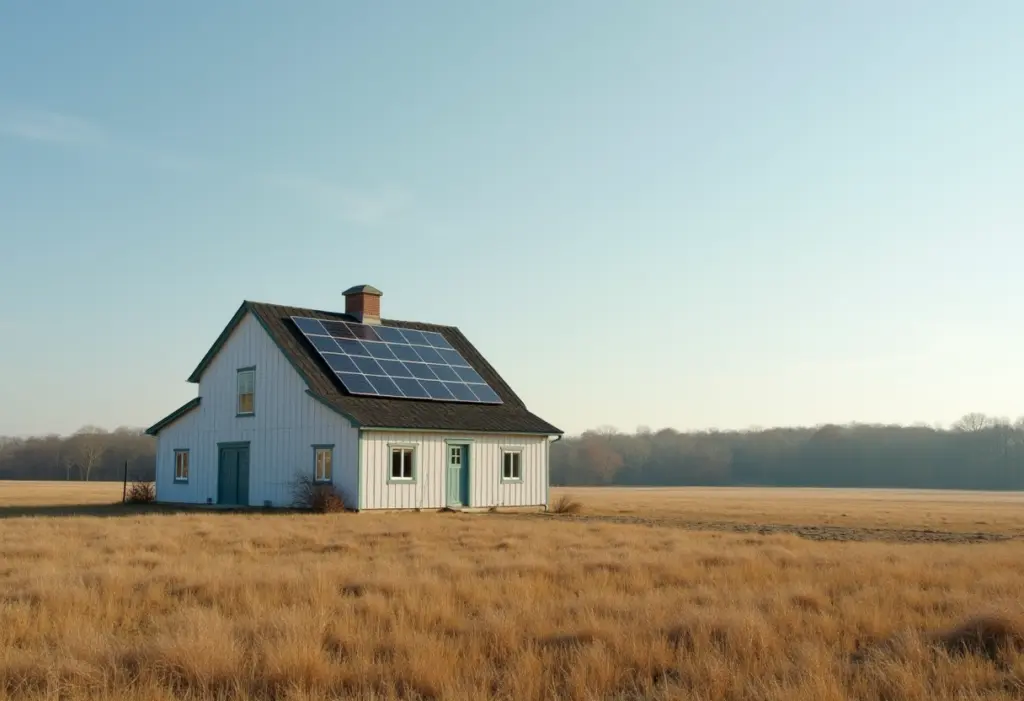
Batavia is a small city in Genesee County, midway between Buffalo and Rochester on flat open country. ZIP code 14020. Two things make it a straightforward place to install solar, and one thing complicates it.
Flat, open, and unshaded
Genesee County is agricultural plain. There is no ridge to the south, and outside the older city streets there is comparatively little mature canopy — so the southern horizon on many properties here is simply open sky.
That matters more than it sounds. Shading is the single most common reason an upstate roof produces less than modelled, and it is the reason production estimates in hilly or wooded parts of the state need a site visit to be trusted. Here the estimate and the outcome are more likely to agree.
Still ask for an on-site assessment on the older city streets, where mature street trees do exist and the low December sun makes them decisive.
Land, and the ground-mount option
Outside the city, properties frequently have real acreage. A ground mount here is not a fallback:
- Orientation and tilt are chosen rather than inherited from a roof.
- The roof-age question disappears — no re-roof first, no removal and reinstallation later.
- Maintenance and snow clearing happen at ground level.
- Size is limited by consumption and land rather than by usable roof area.
Ask early about setbacks, site plan review, and foundation depth below the frost line — the last is a genuine cost item in western New York and belongs in the quote. And ask about clearance beneath the lowest row: an array set too low is buried by drifted snow for weeks.
Snow is the complication
Genesee County catches lake-effect snow from Lake Erie and Lake Ontario both. Ask what ground snow load the racking and attachments are specified for, whether snow guards are needed where a roof array discharges over a door or a walkway, and what snow-cover assumption is in the production estimate.
Note what snow does not justify: tilting a roof array steeply to shed faster. That raises wind load, complicates mounting and usually costs more across the year than the snow it clears. On a ground mount, tilt is a free choice — which is another point in its favour here.
National Grid: the lowest solar charge of the major New York utilities
The Customer Benefit Contribution — a monthly charge on the DC size of the system for anyone interconnecting on or after 1 January 2022 — is $0.97 per kW-month for 2026 on National Grid’s residential rate, the lowest of the seven investor-owned utilities.
- An 8 kW system: $7.76 a month, about $93 a year.
- A 14 kW ground mount: $13.58 a month, about $163 a year.
Billed on capacity regardless of production and recalculated annually. Confirm your utility from your own bill — several villages in western New York run their own municipal electric utilities, where state net metering and this charge may not apply; ask your municipal utility for its own rules.
2026 incentives
The 30% federal residential credit is gone — section 25D was terminated for expenditures made after 31 December 2025, with an expenditure treated as made when the original installation is completed.
Still available for a principal residence: New York’s 25% credit capped at $5,000 on Form IT-255, reaching leases and PPAs of ten years or more as well as purchases; the state sales tax exemption; and RPTL 487’s 15-year property tax exemption where the city or town, Genesee County and your school district have not opted out, if you file form RP-487 with the assessor by the taxable status date. NY-Sun and its Affordable Solar blocks for lower-income households are not on that list: as of September 2026 NYSERDA has no open NY-Sun block for homes in any utility territory; check NYSERDA’s NY-Sun dashboard for a new one.
On a farm property the residential credit is the wrong provision for the business share of the load — that belongs with your accountant before you sign.
Frequently Asked Questions
Is Batavia good for solar?
The terrain is. Genesee County is flat agricultural plain with no ridge to the south and little mature canopy outside the older city streets, so shading — the most common reason an upstate roof underperforms its model — is much less often a factor.
Is a ground mount better than a roof here?
Frequently, outside the city. It lets orientation and tilt be chosen, removes the roof-age question, allows ground-level snow clearing, and is sized by consumption and land rather than by usable roof area.
How much snow does a Batavia system have to handle?
Genesee County catches lake-effect snow from both Lake Erie and Lake Ontario. Ask what ground snow load the racking is specified for, what snow-cover assumption is in the estimate, and for a ground mount how much clearance sits beneath the lowest row.
What does National Grid charge a Batavia solar customer?
The Customer Benefit Contribution at $0.97 per kW-month of DC system size for 2026, the lowest residential rate in the state — about $93 a year on an 8 kW system and $163 on a 14 kW ground mount.
This article is general information, not tax, legal or financial advice. Incentive amounts, eligibility rules and deadlines change and depend on your utility, your tax situation and your property. Confirm current terms with NYSERDA, your utility and a qualified tax professional before making a decision.
NY Solar Incentives
Independent New York solar research. We summarise NYSERDA, NY-Sun and federal programme rules from published sources and state plainly when a figure is an estimate. We are not a government agency and do not sell equipment.
Run the arithmetic on your own system
Check the dated program table and your arrangement before counting an incentive. Standard residential NY-Sun blocks are closed; Long Island Affordable Solar has a conditional income-verification route. The NY credit depends on qualified costs and tax liability, while the NYC abatement reduces future property-tax bills. The estimator keeps those timings separate.