Solar Panel Cost in Irondequoit, New York
Irondequoit is older and more wooded than Rochester's newer suburbs, which makes roof age and shading the two deciding questions.
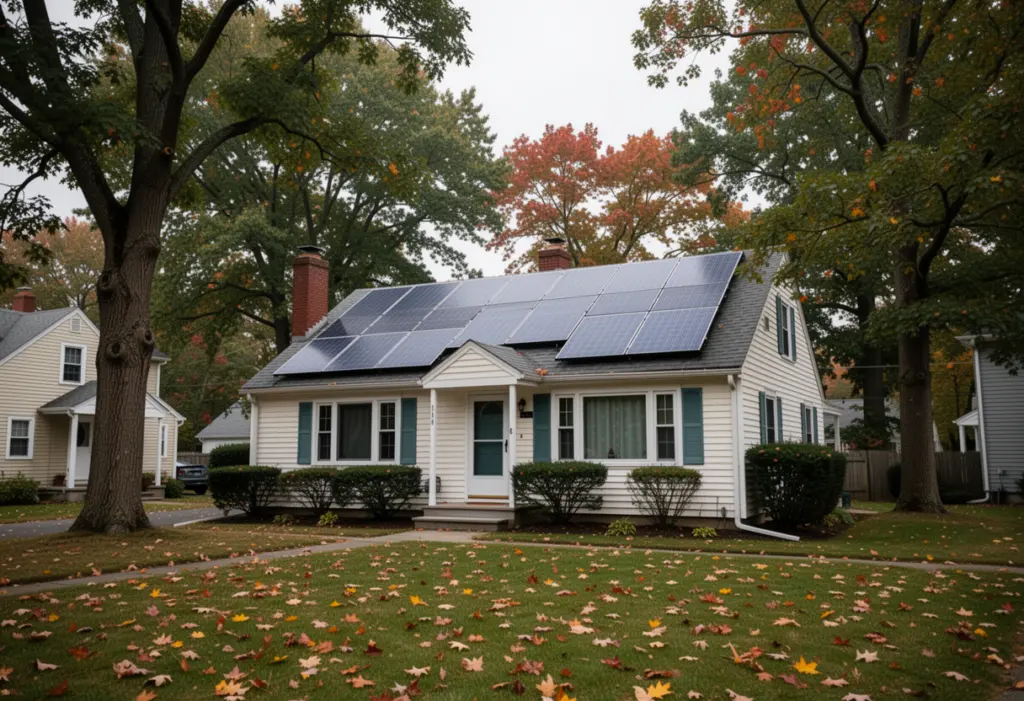
Irondequoit sits between Rochester and Lake Ontario, one of the county’s older inner suburbs. ZIP codes here begin 146 and 145. Two things decide most projects here, and neither is the weather.
Roof age
Irondequoit grew earlier than Webster or Penfield, and much of its housing dates from the 1940s to the 1960s. Solar modules last decades; asphalt shingles do not.
If your shingles have under roughly ten years of life left, replace the roof before installing. Removing and reinstalling an array later costs considerably more than mounting on a bare roof, and a leak under an array is a far more expensive problem than one on open shingles.
Get the roof assessed by someone who is not selling you panels. It is the most useful independent opinion in the process.
Mature trees
Streets planted seventy years ago now carry substantial canopy, and the low December sun is what makes that matter. An obstruction irrelevant in July removes hours of production in the month the credit balance is being drawn down — and in Rochester’s grey winter the balance is already working hard.
Insist on an on-site shading assessment rather than a satellite estimate, and ask specifically what the model assumes about December and January.
If tree removal is proposed, treat it as a decision rather than an assumption folded into the production estimate. It has real cost and a permanent effect on the property.
Post-war roof shapes
Capes and small colonials frequently have limited usable area and cut-up planes. Usable roof area rather than consumption often caps the array, and fire-access clearances take proportionally more of a small roof. Ask what is limiting the system and how much capacity went to clearances.
An array split across planes needs module-level electronics so the orientations do not drag on each other.
The RG&E charge
RG&E’s 2026 residential Customer Benefit Contribution is $1.31 per kW-month of DC system size, the second highest in New York. A 6 kW system pays about $7.86 a month, roughly $94 a year; an 8 kW system about $126.
Billed on capacity regardless of production and recalculated annually. Put it in your arithmetic; the proposal will not.
Snow
Proximity to the lake means real snow. Ask what load the racking is specified for, whether snow guards are needed where the array discharges over a door or a drive, and what snow-cover assumption is in the production estimate.
2026 incentives
The 30% federal residential credit is gone — section 25D was terminated for expenditures made after 31 December 2025, with an expenditure treated as made when the original installation is completed.
Still available: New York’s 25% credit capped at $5,000 on Form IT-255, non-refundable but carried forward five years and reaching leases and PPAs of ten years or more as well as purchases; the state sales tax exemption; and RPTL 487’s 15-year property tax exemption where the town, Monroe County and your school district have not opted out. The RPTL 487 exemption is not automatic: file form RP-487 with your assessor by the taxable status date (March 1 in most towns; January 2 in Nassau towns; May 1 or June 1 in Westchester towns; set by charter in cities; usually January 1 in villages), and the system must be built before January 1, 2030 (RP-487 instructions).
NY-Sun is not on that list. The last standard Upstate residential block (Block 14, $0.15/W, NYSEG, RG&E and National Grid territories) closed on 17 December 2025 and the Upstate Affordable Solar track for lower-income households on 9 March 2026; as of September 2026 NYSERDA has no open NY-Sun block for homes in any utility territory. Check NYSERDA’s NY-Sun dashboard for a new one.
Where the trees or the roof rule it out, community solar operates in RG&E territory, needs no roof or up-front cost, and its subscribers pay no Customer Benefit Contribution at all.
Frequently Asked Questions
What decides whether solar works in Irondequoit?
Roof age and tree cover. Much of the housing dates from the 1940s to the 1960s, so shingles with under roughly ten years left mean re-roofing first, and streets planted seventy years ago now carry canopy that removes December production.
Should I remove trees for solar in Irondequoit?
It is a decision with real cost and a permanent effect on the property, and it should be presented to you as a choice rather than quietly assumed into an installer's production estimate.
What does RG&E charge an Irondequoit solar customer?
The Customer Benefit Contribution at $1.31 per kW-month of DC system size for 2026, the second highest in New York — about $94 a year on a 6 kW system and $126 on 8 kW.
What if the trees or the roof rule solar out?
Community solar operates in RG&E territory, needs no roof, no equipment and no up-front cost, and its subscribers pay no Customer Benefit Contribution at all.
This article is general information, not tax, legal or financial advice. Incentive amounts, eligibility rules and deadlines change and depend on your utility, your tax situation and your property. Confirm current terms with NYSERDA, your utility and a qualified tax professional before making a decision.
NY Solar Incentives
Independent New York solar research. We summarise NYSERDA, NY-Sun and federal programme rules from published sources and state plainly when a figure is an estimate. We are not a government agency and do not sell equipment.
Run the arithmetic on your own system
Check the dated program table and your arrangement before counting an incentive. Standard residential NY-Sun blocks are closed; Long Island Affordable Solar has a conditional income-verification route. The NY credit depends on qualified costs and tax liability, while the NYC abatement reduces future property-tax bills. The estimator keeps those timings separate.