Solar Panel Cost in Hamburg, New York
Hamburg sits on the Lake Erie shore in the Southtowns, where snow and wind both matter to a racking specification.
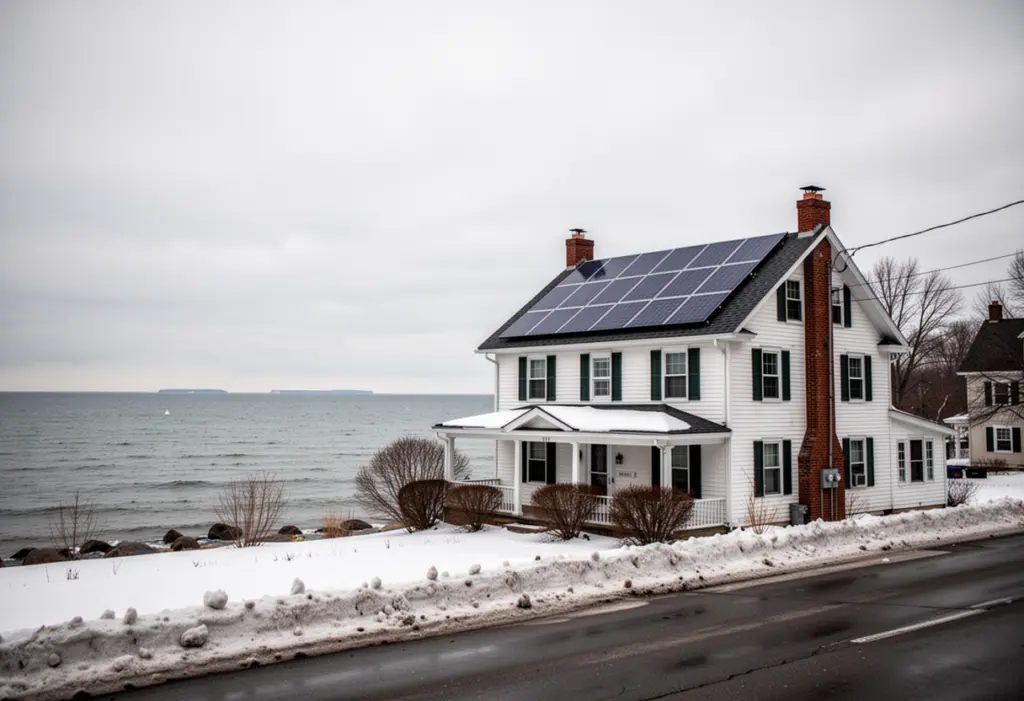
Hamburg covers the Lake Erie shore and the country behind it south of Buffalo — the village, Blasdell, Water Valley and the farmland east of the Thruway. ZIP codes here begin 140 and 141. Two lake-driven factors shape the engineering here.
Snow and wind together
The Southtowns take heavy lake-effect snow, and the shore is exposed. That makes both loads live questions rather than one:
- What snow load is the racking specified for, and who verified the roof can carry it?
- What wind load, particularly on properties near the shore where exposure is real?
- Where does the snow discharge, and are snow guards included?
- What snow-cover assumption is in the production estimate? A model without one overstates the annual figure.
Ask for both load figures. An installer who gives one and not the other has not thought about the shore.
Mixed housing, mixed answers
Hamburg spans older village housing, post-war suburban development and newer building further out. That matters because roof age is the usual gate: under roughly ten years of shingle life left means re-roof first, since removing and reinstalling an array later costs considerably more than mounting on a bare roof.
The newer eastern parts of the town generally have roofs with life left, simpler planes and larger electrical services. The village is a different conversation.
Land east of the Thruway
Away from the built-up shore, properties have space, and a ground mount becomes realistic: orientation and tilt chosen freely, roof age irrelevant, shading solved by siting, and safe ground-level snow clearing — which in this snow belt is a real advantage. Ask for it alongside the roof option, and ask about setbacks and foundation depth below the frost line.
What sets the number
System size, decided by annual consumption rather than roof area. Get twelve months of National Grid usage before accepting a design.
National Grid
The Customer Benefit Contribution is $0.97 per kW-month of DC system size for 2026, the lowest of the major New York utilities — about $7.76 a month on an 8 kW system, roughly $93 a year. Billed on capacity regardless of production and recalculated annually. Phase One net metering credits exports at the full retail rate and holds for 20 years.
2026 incentives
The 30% federal residential credit is gone — section 25D was terminated for expenditures made after 31 December 2025, with an expenditure treated as made when the original installation is completed.
Still available: New York’s 25% credit capped at $5,000 on Form IT-255, non-refundable but carried forward five years and reaching leases and PPAs of ten years or more as well as purchases; the state sales tax exemption; and RPTL 487’s 15-year property tax exemption, claimed on form RP-487 filed with your assessor by the taxable status date, where the town or village, Erie County and your school district have not opted out. NY-Sun and its Affordable Solar track are not: as of September 2026 NYSERDA has no open NY-Sun block for homes in any utility territory; check NYSERDA’s NY-Sun dashboard for a new one.
Five questions worth asking here
- What snow load AND what wind load is the racking specified for?
- How much shingle life does my roof have left, assessed by someone not selling panels?
- Can a ground mount be quoted alongside the roof option?
- What DC size is proposed, and therefore my monthly CBC at $0.97 per kW?
- Does the net-cost figure contain any federal credit? It should not.
The first question is the one that separates a Southtowns quote from a template. An installer who gives a snow figure and no wind figure has not looked at where the house actually sits.
Frequently Asked Questions
Does the Lake Erie shore affect a solar installation?
Yes, in two ways at once. The Southtowns take heavy lake-effect snow and the shore is exposed to wind, so racking must be specified for both loads. Ask for both figures — an installer who gives one and not the other has not thought about the shore.
Is a ground mount practical in Hamburg?
East of the Thruway, where properties have space, often yes. It lets orientation and tilt be chosen, removes the roof-age question, and allows safe ground-level snow clearing — a real advantage in this snow belt.
What does National Grid charge a Hamburg solar customer?
The Customer Benefit Contribution at $0.97 per kW-month of DC system size for 2026, the lowest of the major New York utilities — about $93 a year on an 8 kW system.
Does Hamburg's housing stock affect the answer?
It does. The town spans older village housing, post-war suburbs and newer building further out. The newer parts generally have roofs with life left and larger electrical services; the village is a different conversation.
This article is general information, not tax, legal or financial advice. Incentive amounts, eligibility rules and deadlines change and depend on your utility, your tax situation and your property. Confirm current terms with NYSERDA, your utility and a qualified tax professional before making a decision.
NY Solar Incentives
Independent New York solar research. We summarise NYSERDA, NY-Sun and federal programme rules from published sources and state plainly when a figure is an estimate. We are not a government agency and do not sell equipment.
Run the arithmetic on your own system
Check the dated program table and your arrangement before counting an incentive. Standard residential NY-Sun blocks are closed; Long Island Affordable Solar has a conditional income-verification route. The NY credit depends on qualified costs and tax liability, while the NYC abatement reduces future property-tax bills. The estimator keeps those timings separate.