Solar Incentives in Franklin County, NY
Franklin County runs from Adirondack lake villages to the Canadian border farmland. The two ends face different processes entirely.
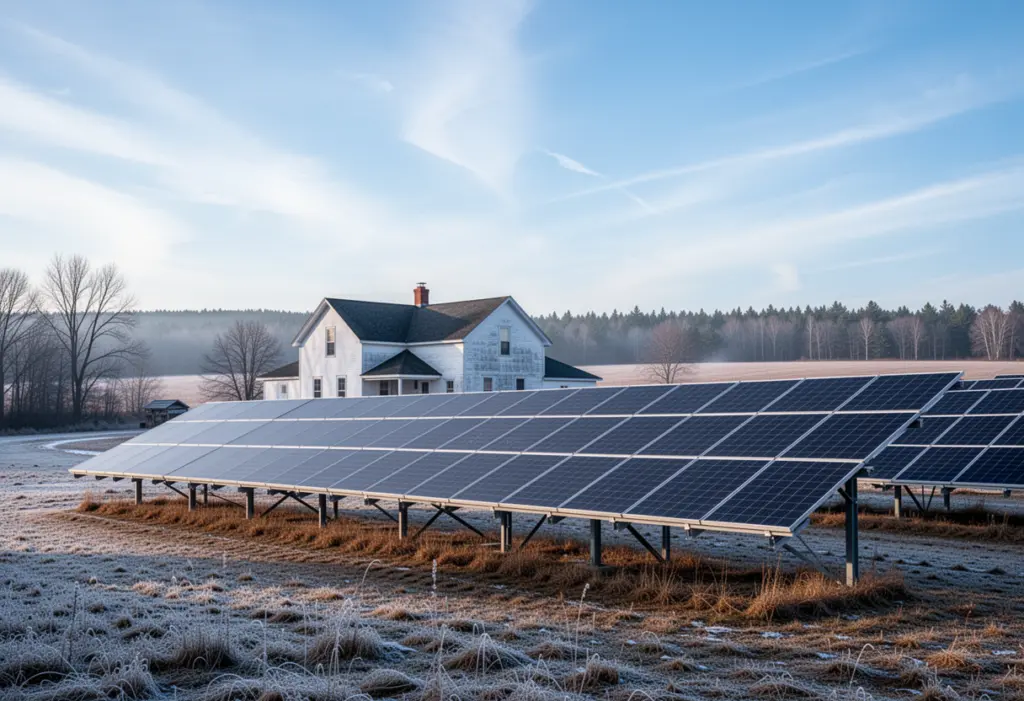
Franklin County runs from Saranac Lake and Tupper Lake in the Adirondacks north to Malone and the farmland along the Canadian border. ZIP codes here begin 129 and 12983. The two ends of the county are different enough that a quote written for one does not describe the other.
The southern end: inside the Adirondack Park
Saranac Lake, Tupper Lake and the surrounding towns lie inside the Park, where private land sits under a land-use framework administered by the Adirondack Park Agency alongside town rules. Whether that touches a particular project depends on land classification and what is proposed — a rooftop array on an existing house is a very different question from a ground mount involving clearing and excavation.
Ask before you design. Which authority reviews this, does Park classification affect it, and what does it add to the schedule? Several Park villages also carry their own review, and historic character matters in parts of Saranac Lake.
Mountain terrain also means the southern horizon can be a ridge, so an on-site shading assessment is essential rather than optional.
The northern end: open farmland
North of the Park the county opens into farmland, and the picture inverts. Clear southern horizons are common, ground mounts are straightforward, and the constraints are the ones that come with being rural rather than being wooded.
A ground mount here removes the roof-age question, lets orientation and tilt be chosen and allows safe ground-level snow clearing — which matters in a county this cold. Ask what foundation is proposed and to what depth: the frost line is deep in the far north and it is a real part of the cost.
Long rural circuits
Feeders serving very few customers over long distances are exactly where an interconnection application comes back requiring a study or a distribution upgrade. Ask whether hosting capacity was checked for your circuit before designing, and settle in writing when the application will be filed — before installation — and what happens to your deposit if an upgrade is required.
Confirm which utility serves you from your own bill; service in the North Country is not uniform, and some communities are served by municipal utilities, where state net metering, the Customer Benefit Contribution and the state interconnection process may not apply; ask your municipal utility for its own metering and interconnection rules.
Cold, snow and sizing
Cold is mildly helpful — modules are more efficient at lower temperatures — but the winter days are short and the low sun makes a deep November-to-February trough that the summer credit balance has to cover. Design snow loads are high: ask what the racking is specified for, who verified the roof, whether snow guards are needed, and what snow-cover assumption is in the production estimate.
Get twelve months of usage before accepting a design. Electric supplementary heat is common, and a seasonal camp has a profile nothing like a year-round house.
2026 incentives
The 30% federal residential credit is gone — section 25D was terminated for expenditures made after 31 December 2025, with an expenditure treated as made when the original installation is completed.
Still available, and unaffected by whether your utility is investor-owned or municipal because these are state programmes: New York’s 25% credit capped at $5,000 on Form IT-255 — for your principal residence, so a camp does not qualify; the state sales tax exemption, which covers the 4% state tax only: Franklin County still charges its own 4% local sales tax on residential solar (Publication 718-S, Part 1); and RPTL 487’s 15-year property tax exemption where your town or village, the county and your school district have not opted out. The exemption needs a system built before 1 January 2030 and form RP-487 filed with your assessor by the taxable status date (March 1 in most towns; your assessor confirms yours).
Not available for homes now: NY-Sun. As of September 2026 NYSERDA has no open NY-Sun block for homes in any utility territory. In its Upstate region the last standard residential block (Block 14, $0.15/W), for NYSEG, RG&E and National Grid territory, closed on 17 December 2025, and the Affordable Solar block for lower-income households closed on 9 March 2026. Check NYSERDA’s NY-Sun dashboard for a new one before counting on it.
Frequently Asked Questions
Does the Adirondack Park affect solar in Franklin County?
In the southern half, where Saranac Lake, Tupper Lake and the surrounding towns lie inside the Park, private land sits under a land-use framework administered by the Park Agency alongside town rules. Ask before design, particularly for a ground mount involving clearing.
Is the north of Franklin County better for solar?
In one respect, yes. North of the Park the county opens into farmland with clear southern horizons, which makes ground mounts straightforward — the constraints there are rural interconnection and cold rather than shading.
Do state solar incentives apply on a municipal utility?
Yes. New York's 25% credit, the state sales tax exemption and RPTL 487 are state programmes, so the utility does not change them. NY-Sun, NYSERDA's incentive, has no open block for homes in any utility territory as of September 2026. It is the metering and interconnection rules that can differ, so ask your municipal utility for its own metering and interconnection rules.
Does cold weather hurt solar in the North Country?
No — modules are more efficient at lower temperatures. What limits winter output is short days and a low sun angle, producing a deep November-to-February trough that the summer credit balance has to cover.
This article is general information, not tax, legal or financial advice. Incentive amounts, eligibility rules and deadlines change and depend on your utility, your tax situation and your property. Confirm current terms with NYSERDA, your utility and a qualified tax professional before making a decision.
NY Solar Incentives
Independent New York solar research. We summarise NYSERDA, NY-Sun and federal programme rules from published sources and state plainly when a figure is an estimate. We are not a government agency and do not sell equipment.
Run the arithmetic on your own system
Check the dated program table and your arrangement before counting an incentive. Standard residential NY-Sun blocks are closed; Long Island Affordable Solar has a conditional income-verification route. The NY credit depends on qualified costs and tax liability, while the NYC abatement reduces future property-tax bills. The estimator keeps those timings separate.