Solar for a Rental Property Owner in New York
A landlord's solar project succeeds or fails on one question asked before design: which meter does the system offset?
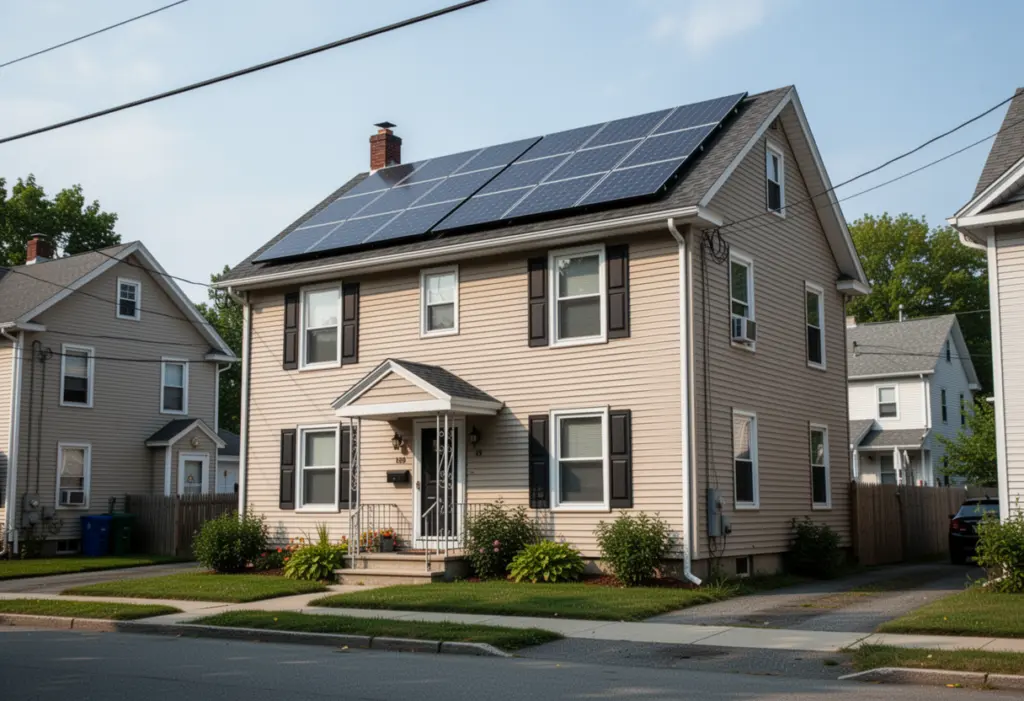
Solar on a property you rent out is a different proposition from solar on the house you live in, and most of the difference comes down to one question that has to be settled before anyone designs anything.
Which meter does the system offset?
A system offsets the meter it is connected behind. Only that meter.
So the position depends entirely on how the property is metered:
- Tenant pays their own electricity on their own meter. A system behind that meter reduces the tenant’s bill, not yours. You paid for it; they benefit. This is the split-incentive problem and it is why most landlord solar projects stall.
- You pay for everything and it is included in the rent. The system offsets an account you actually pay, and it can be sized against the whole property’s consumption. This is by far the strongest case.
- There is a separate house meter for common areas — hallway lighting, the boiler, a shared laundry, exterior lighting. You pay that one, so a system sized against it is aligned even where tenants hold their own meters. Smaller than the roof could hold, but it is the version that gets built.
Get the answer from the bills, not from memory. Then size against twelve months of actual usage on that specific meter.
Your tax position is not the residential one
New York’s 25% credit on Form IT-255 is for solar energy system equipment installed and used at the taxpayer’s principal residence. A property you rent out is not that.
A landlord’s system is a business asset, and the business side of the tax code — including depreciation and the investment tax credit — did not follow the residential credit into repeal at the end of 2025. That asymmetry is worth knowing: as of 2026 a landlord’s tax position on solar can be more favourable than a homeowner’s, which is the reverse of what most people assume.
It is a question for your accountant with your own figures, and it is worth actually asking rather than assuming there is nothing there.
If you occupy one unit of a two-family and rent the other, there is a genuine apportionment question between the residential and rental parts. Again: your accountant, before you sign.
The practical constraints
- Roof age. Under roughly ten years of shingle life left means re-roof first — and on a rental that is a decision about the building’s capital plan rather than a preference.
- The Customer Benefit Contribution applies on the account the system is connected to, at your utility’s rate — from $0.97 per kW-month on National Grid to $1.67 on Central Hudson for 2026.
- Selling the property. A system owned outright transfers with the building. A leased or financed system means an agreement and possibly a UCC filing that a buyer’s attorney will find. Keep the paperwork somewhere you can produce it.
- Insurance. Tell your insurer. The cost to rebuild now includes the array, and a limit set before the panels existed may be short.
If none of it works
Tell your tenants about community solar. It costs you nothing, requires nothing of the building, and the credit lands on their own utility account — which is a genuinely useful thing to offer a tenant in a market where you cannot make the roof work.
What to establish before signing
- Which meter will this system be connected behind, in writing?
- What annual consumption on that meter is the design sized against?
- What does my accountant say about depreciation and the business credit for this property?
- What does the roof have left, assessed by someone not selling panels?
- Does the net-cost figure contain a residential federal credit? It should not — section 25D ended for expenditures made after 31 December 2025.
Frequently Asked Questions
Does solar on a rental reduce my tenant's bill or mine?
Whichever meter the system is connected behind. If tenants hold their own meters, a system behind a tenant's meter reduces their bill and not yours — which is why most landlord projects target the common-area house meter instead.
Can a landlord claim New York's 25% solar credit?
No. Form IT-255 is for equipment installed and used at your principal residence. A rented property is a business asset, and the applicable treatment — depreciation and the business investment tax credit — is a question for your accountant.
Is a landlord's tax position better than a homeowner's in 2026?
In many cases yes, which is the reverse of what most people assume. The residential credit ended for expenditures made after 31 December 2025 while the business-side treatment did not follow it. Ask your accountant rather than assuming there is nothing there.
What can I offer tenants if the roof will not work?
Community solar. It costs the building nothing, requires no installation, and the credit lands on the tenant's own utility account — a genuinely useful thing to be able to point them at.
This article is general information, not tax, legal or financial advice. Incentive amounts, eligibility rules and deadlines change and depend on your utility, your tax situation and your property. Confirm current terms with NYSERDA, your utility and a qualified tax professional before making a decision.
NY Solar Incentives
Independent New York solar research. We summarise NYSERDA, NY-Sun and federal programme rules from published sources and state plainly when a figure is an estimate. We are not a government agency and do not sell equipment.
Run the arithmetic on your own system
Check the dated program table and your arrangement before counting an incentive. Standard residential NY-Sun blocks are closed; Long Island Affordable Solar has a conditional income-verification route. The NY credit depends on qualified costs and tax liability, while the NYC abatement reduces future property-tax bills. The estimator keeps those timings separate.