Solar Incentives in Greene County, NY
Greene County sits on a utility boundary between the state's highest solar charge and its lowest. Read your bill before anything else.
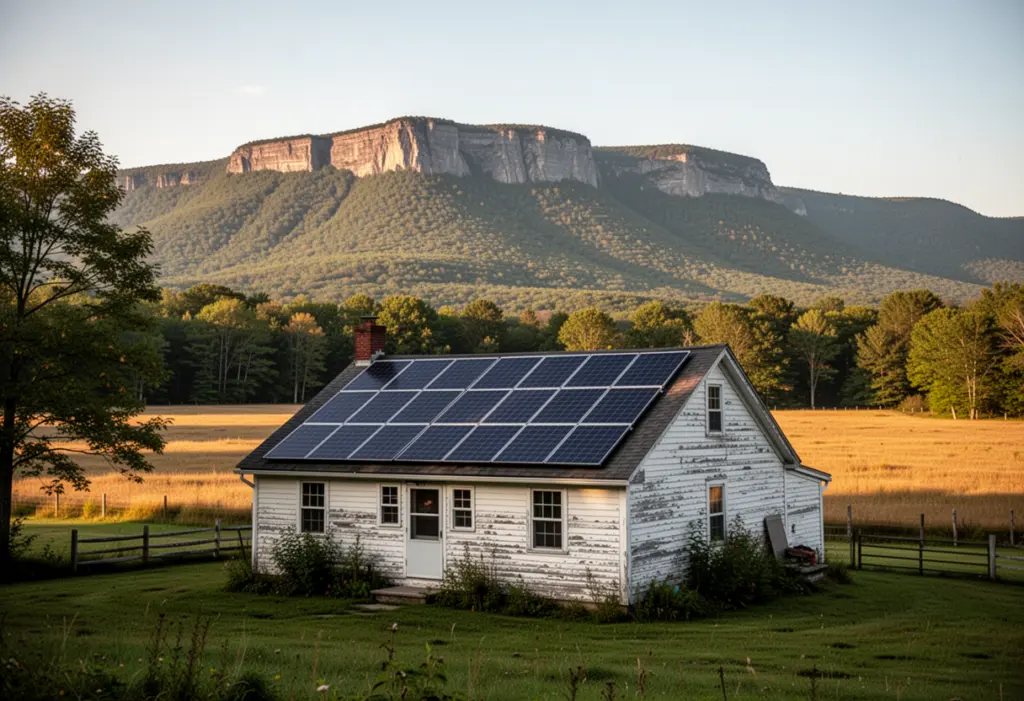
Greene County runs from the Hudson west into the Catskills — Catskill, Coxsackie, Athens, Cairo, Windham, Hunter, Tannersville, Greenville. ZIP codes here begin 124 and 121. The first thing to establish here is not technical at all.
Which utility is on your bill
Greene sits near a service boundary and is not uniformly served by one company. That matters more here than in most counties because of which two companies they are:
- Central Hudson — 2026 residential Customer Benefit Contribution of $1.67 per kW-month, the highest in New York. An 8 kW system pays about $160 a year.
- National Grid — $0.97 per kW-month, the lowest. The same system pays about $93 a year.
That is a difference of roughly $67 a year on identical hardware, decided only by which side of a boundary the house sits on, every year the system runs. Read the name printed on your own bill rather than accepting an installer’s assumption — particularly one who works mostly on the other side of the line.
Both charges apply to systems interconnected on or after 1 January 2022, are billed on DC system size regardless of production, and are recalculated annually rather than fixed.
Catskill terrain
The western half of the county rises steeply into the mountains, and shading is frequently the deciding variable there rather than one factor among several. The low winter sun means a ridge or a stand of hardwoods to the south removes hours of December production that a summer assessment would never reveal.
Insist on an on-site shading assessment and ask what the model assumes about winter specifically. Where a roof will not work, many Greene County properties have land for a ground mount, which lets the array go where the sun is.
Along the Hudson — Catskill, Coxsackie, Athens — the ground is gentler and the constraint is more often the housing stock than the horizon.
Historic villages
Catskill, Athens and Coxsackie carry historic character, and architectural review may apply. That review is a municipal step ahead of the building permit and can restrict street-visible placement. Establish whether your property is affected before signing rather than after.
Older housing also means roof age is frequently the gate: under roughly ten years of shingle life left means re-roof first, because removing and reinstalling an array later costs considerably more than mounting on a bare roof.
Rural circuits
Long feeders serving few customers are where interconnection applications hit hosting-capacity limits. Ask whether the installer checked hosting capacity for your circuit before designing, and settle in writing what happens to your deposit if a study or distribution upgrade is required.
2026 incentives
The 30% federal residential credit is gone. Section 25D was terminated for expenditures made after 31 December 2025, with an expenditure treated as made when the original installation is completed.
Still available: New York’s 25% credit capped at $5,000 on Form IT-255, which reaches leases and PPAs of ten years or more as well as purchases; the state sales tax exemption; and RPTL 487’s 15-year property tax exemption where your town or village, the county and your school district have not opted out. The RPTL 487 exemption is not automatic: file form RP-487 with your assessor by the taxable status date (March 1 in most towns; January 2 in Nassau towns; May 1 or June 1 in Westchester towns; set by charter in cities; usually January 1 in villages), and the system must be built before January 1, 2030 (RP-487 instructions).
NY-Sun is not on that list. As of September 2026 NYSERDA has no open NY-Sun block for homes in any utility territory; check NYSERDA’s NY-Sun dashboard for a new one. The last standard upstate residential block for Central Hudson and Orange & Rockland customers (Block 13, $0.15/W) closed on 4 August 2025; the last for NYSEG, RG&E and National Grid customers (Block 14, $0.15/W) closed on 17 December 2025, and the upstate Affordable Solar block for income-qualified households closed on 9 March 2026.
Frequently Asked Questions
Which utility serves Greene County for solar?
The county sits near a boundary between Central Hudson and National Grid, and the two carry the highest and lowest solar charges in New York — about $160 against $93 a year on an 8 kW system. Read the name printed on your own bill.
Is Catskill terrain a problem for solar?
In the western half of the county it frequently is. Steep ground and mature hardwoods mean the low winter sun is blocked in December even where summer output looks fine. An on-site shading assessment is essential, and a ground mount is often the answer.
Does historic review affect solar in Greene County villages?
It can. Catskill, Athens and Coxsackie carry historic character and architectural review may apply, ahead of the building permit, restricting street-visible placement. Establish whether your property is affected before signing.
Should I ask about hosting capacity in Greene County?
Yes. Long rural feeders are where interconnection applications hit limits and come back needing a study or a distribution upgrade. Ask whether it was checked for your circuit before design, and settle what happens to your deposit if an upgrade is required.
This article is general information, not tax, legal or financial advice. Incentive amounts, eligibility rules and deadlines change and depend on your utility, your tax situation and your property. Confirm current terms with NYSERDA, your utility and a qualified tax professional before making a decision.
NY Solar Incentives
Independent New York solar research. We summarise NYSERDA, NY-Sun and federal programme rules from published sources and state plainly when a figure is an estimate. We are not a government agency and do not sell equipment.
Run the arithmetic on your own system
Check the dated program table and your arrangement before counting an incentive. Standard residential NY-Sun blocks are closed; Long Island Affordable Solar has a conditional income-verification route. The NY credit depends on qualified costs and tax liability, while the NYC abatement reduces future property-tax bills. The estimator keeps those timings separate.