Solar Panel Installation in Saratoga Springs, NY
Saratoga Springs splits between a protected historic core and newer suburban development. The sequence differs sharply between them.
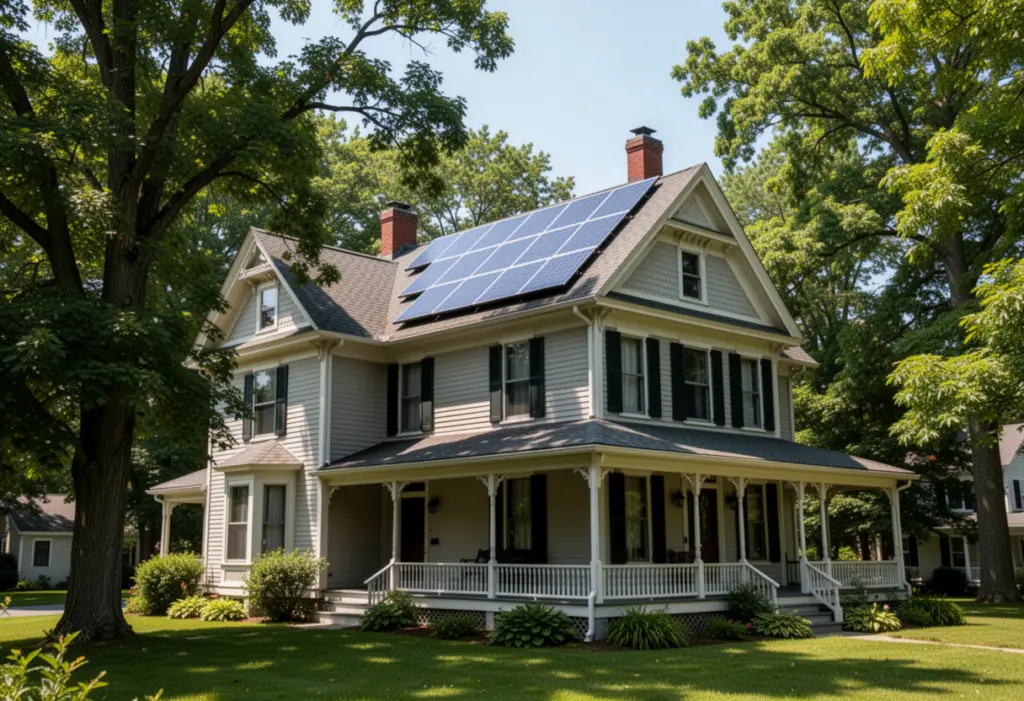
Saratoga Springs has one of the most carefully protected historic cores in upstate New York, surrounded by newer residential development. Which side of that line your house sits on changes almost everything about a solar project. ZIP code 12866.
In the historic core
Architectural review applies, it comes before the building permit, and it can restrict street-visible placement. Establish whether your property is affected before you take quotes, not after you sign.
What gets approved is fairly predictable:
- A rear or secondary roof plane not visible from the public way.
- All-black modules with black frames — silver frames read as industrial equipment.
- Flush mounting following the roof plane. Tilted racking on a pitched Victorian roof is the most likely thing to be refused.
- Concealed conduit.
- An explicit note that the mounting is reversible and the historic fabric is unchanged beneath.
Review boards frequently meet monthly, so a missed submission deadline costs a month. Ask when the board meets.
Outside it
Conventional pitched-roof work, and Saratoga’s newer development is unusually favourable: roofs have life left, planes are simpler so fire-access clearances eat less usable area, structural letters are needed less often, and 200-amp services handle solar plus an EV charger without an upgrade.
The trade is landscaping. Trees planted thirty years ago are substantial now, so an on-site shading assessment still matters.
The sequence
- Twelve months of National Grid usage, an on-site shading assessment, roof condition and structure.
- Architectural review, where it applies.
- Interconnection application to National Grid, before installation.
- City building permit.
- Installation, then electrical inspection.
- Certificate to National Grid, meter exchange, permission to operate. The system may not run before PTO.
The National Grid numbers
Phase One net metering credits exports at the full retail rate and holds for 20 years from interconnection. The Customer Benefit Contribution is $0.97 per kW-month of DC system size for 2026 — the lowest in the state, about $7.76 a month on an 8 kW system. Billed on capacity regardless of production and recalculated annually.
Snow
Capital District snow load is moderate for upstate. Racking must be specified for it, and snow guards matter where an array discharges over a porch, a door or a driveway — a real consideration on the deep-porched houses common here. Ask what snow assumption is in the production estimate.
2026 incentives
The 30% federal residential credit has ended — section 25D was terminated for expenditures made after 31 December 2025, with an expenditure treated as made when the original installation is completed. Note the interaction with review: a project a board held past the end of 2025 lost that credit.
Still available: New York’s 25% credit capped at $5,000 on Form IT-255; the state sales tax exemption; and RPTL 487’s 15-year property tax exemption where the city, Saratoga County and your school district have not opted out. The RPTL 487 exemption is not automatic: file form RP-487 with your assessor by the taxable status date (March 1 in most towns; January 2 in Nassau towns; May 1 or June 1 in Westchester towns; set by charter in cities; usually January 1 in villages), and the system must be built before January 1, 2030 (RP-487 instructions).
Not available now: NY-Sun. NYSERDA’s Upstate residential NY-Sun block 14 closed on 17 December 2025. As of September 2026 NYSERDA has no open NY-Sun block for homes in any utility territory; check NYSERDA’s NY-Sun dashboard for a new one. If a quote still subtracts a NY-Sun incentive, ask which open block it relies on.
Five questions worth asking here
- Is my property inside the historic district, and when does the review board meet?
- What DC size is proposed, and therefore what is my monthly CBC at $0.97 per kW?
- What snow load is the racking specified for, and where does snow discharge?
- How much shingle life does my roof have left, assessed by someone not selling panels?
- Does the net-cost figure contain any federal credit? It should not.
The first question is the one that moves a schedule. A board that meets monthly turns a missed deadline into four weeks, and a project pushed across a year boundary can lose an incentive that was open when it was quoted.
Frequently Asked Questions
Does Saratoga Springs allow solar panels on historic houses?
Generally yes, with architectural review that comes before the building permit and can restrict street-visible placement. A rear or secondary plane, all-black modules, flush mounting and concealed conduit is what gets approved.
How long does architectural review add?
Boards frequently meet monthly, so a missed submission deadline costs a month. Ask when the board meets and what the deadline is, and build it into the schedule rather than discovering it.
Are newer Saratoga County houses better for solar?
Generally yes. Post-1980 development has roofs with life left, simpler planes so fire-access clearances eat less usable area, fewer structural questions, and 200-amp services that handle solar plus an EV charger without an upgrade.
What does National Grid charge a Saratoga Springs solar customer?
The Customer Benefit Contribution at $0.97 per kW-month of DC system size for 2026, the lowest of the major New York utilities — about $7.76 a month on an 8 kW system.
This article is general information, not tax, legal or financial advice. Incentive amounts, eligibility rules and deadlines change and depend on your utility, your tax situation and your property. Confirm current terms with NYSERDA, your utility and a qualified tax professional before making a decision.
NY Solar Incentives
Independent New York solar research. We summarise NYSERDA, NY-Sun and federal programme rules from published sources and state plainly when a figure is an estimate. We are not a government agency and do not sell equipment.
Run the arithmetic on your own system
Check the dated program table and your arrangement before counting an incentive. Standard residential NY-Sun blocks are closed; Long Island Affordable Solar has a conditional income-verification route. The NY credit depends on qualified costs and tax liability, while the NYC abatement reduces future property-tax bills. The estimator keeps those timings separate.