Are Bifacial Solar Panels Worth It in New York?
Bifacial panels need light reaching their back face. Flush-mounted on a pitched roof, almost none does. Here is where they actually earn their price.
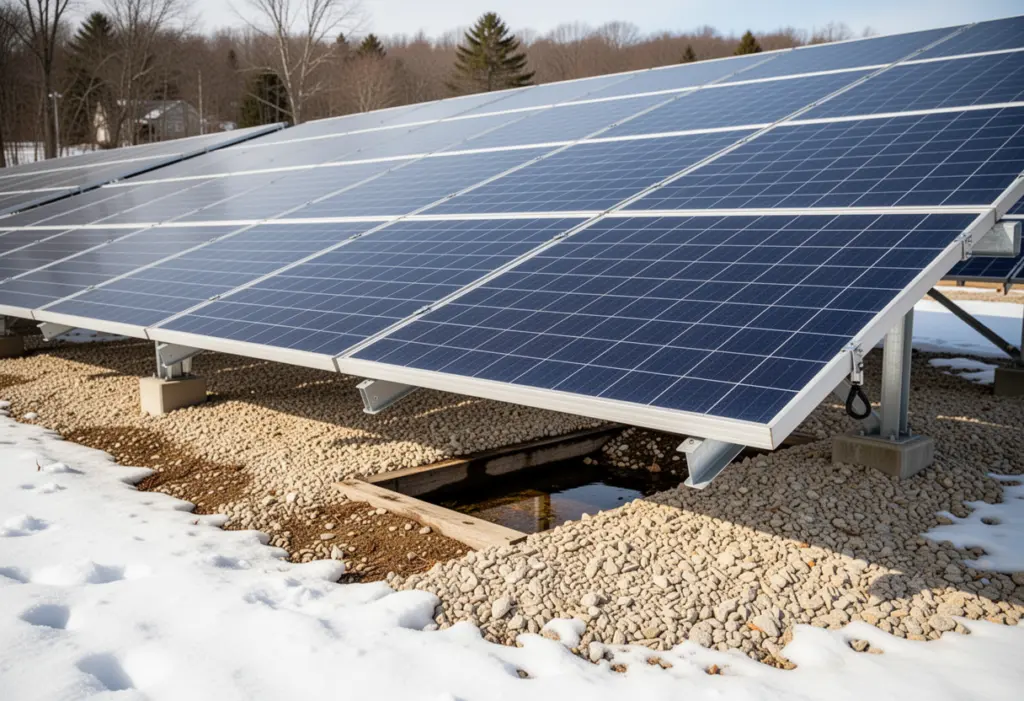
Bifacial modules generate from the rear face as well as the front, capturing light reflected off whatever is beneath them. It is a genuine technology and it is frequently sold into situations where it does nothing at all.
The condition that has to be met
The rear face needs light. That requires two things: a gap behind the panel for light to reach it, and a surface below that reflects rather than absorbs.
Flush-mounted on a pitched asphalt roof — the standard New York residential installation — neither condition is met. The panel sits a few inches off dark shingles. Almost nothing reaches the back. The bifacial gain in that configuration rounds to negligible, and paying a premium for it is paying for a capability the installation cannot use.
If an installer proposes bifacial modules for a flush-mounted shingle roof, ask them to quantify the expected rear-side gain for that specific installation. The question usually ends the conversation.
Where they genuinely pay in New York
Ground mounts. This is the real case, and there are plenty of them upstate. A ground-mounted array is elevated with open space beneath, and what is under it can be chosen — pale gravel reflects far more than dark grass. Rear-side gain here is real and worth paying for.
Snow, which is the New York twist. Snow is one of the most reflective surfaces there is. A ground-mounted bifacial array over snow-covered ground picks up meaningful rear-side generation in exactly the months when production is scarcest. Upstate, in Erie, Onondaga, Oneida and Jefferson counties, that is not a marginal effect.
Tilted flat-roof arrays over a light-coloured membrane. A white TPO roof is a good reflector and a tilted array has a gap beneath it. Modest gain, but a real one.
Carports, pergolas and elevated structures, where the underside is open by design.
What bifacial does not fix
It does not compensate for shading. A shaded array is a shaded array, and the rear face is shaded too. If shading is your constraint — which in the Hudson Valley, Westchester and the Southern Tier it usually is — the answer is siting, module-level electronics or a different location, not a different module.
It does not compensate for a poor orientation either.
The practical questions
- Is there a gap behind the panels in this design? If it is flush-mounted, the answer is effectively no.
- What is the surface below, and how reflective is it? Dark shingles, dark grass and dark gravel are all poor.
- What rear-side gain does the production estimate actually assume? If the model does not separate it, it is not modelling it.
- What is the price premium over an equivalent monofacial module? Compare that against the modelled gain, not against the technology’s reputation.
The honest summary
For a typical New York pitched-roof installation, bifacial modules are not worth a premium. For a ground mount — particularly one upstate where snow cover is reliable and the ground beneath can be made reflective — they are one of the few equipment upgrades that genuinely produces more electricity rather than just sounding better.
The technology is not the question. The mounting is.
Frequently Asked Questions
Do bifacial panels work on a normal roof?
Barely. Flush-mounted a few inches above dark shingles, almost no light reaches the rear face, so the bifacial gain rounds to negligible. Ask any installer proposing them for a pitched shingle roof to quantify the expected rear-side gain for that specific installation.
Where are bifacial panels worth it in New York?
Ground mounts above all, especially upstate where snow cover is a highly reflective surface during the months production is scarcest. Also tilted arrays over a light-coloured flat roof membrane, and carports or pergolas where the underside is open by design.
Does snow help bifacial solar panels?
Yes, on an elevated array. Snow is one of the most reflective surfaces there is, so a ground-mounted bifacial array over snow-covered ground picks up meaningful rear-side generation in exactly the months when output is lowest.
Will bifacial panels help with shading?
No. A shaded array is shaded on both faces. If shading is your constraint the answer is siting, module-level electronics or a different location — not a different module.
This article is general information, not tax, legal or financial advice. Incentive amounts, eligibility rules and deadlines change and depend on your utility, your tax situation and your property. Confirm current terms with NYSERDA, your utility and a qualified tax professional before making a decision.
NY Solar Incentives
Independent New York solar research. We summarise NYSERDA, NY-Sun and federal programme rules from published sources and state plainly when a figure is an estimate. We are not a government agency and do not sell equipment.
Run the arithmetic on your own system
Check the dated program table and your arrangement before counting an incentive. Standard residential NY-Sun blocks are closed; Long Island Affordable Solar has a conditional income-verification route. The NY credit depends on qualified costs and tax liability, while the NYC abatement reduces future property-tax bills. The estimator keeps those timings separate.