Solar for a Two-Family House in New York
Two-family houses are everywhere in New York and almost every solar proposal for one gets the meter question wrong. Settle it first.
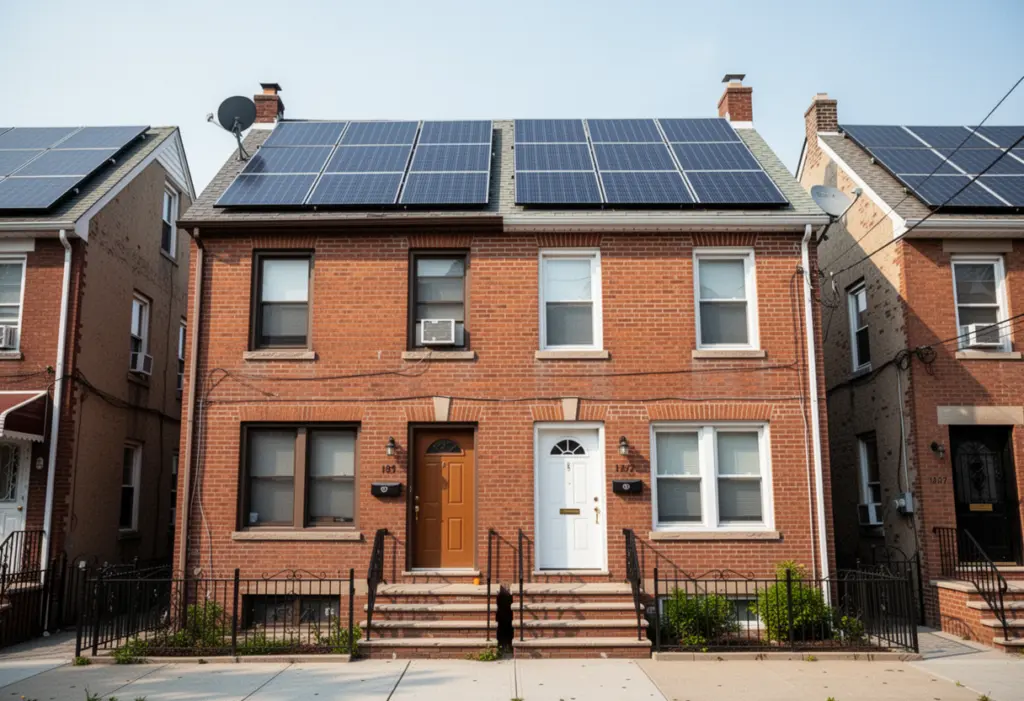
Two-family houses are a large share of the housing stock across the outer boroughs, Yonkers, Mount Vernon, New Rochelle and much of the older upstate cities. They are also where solar proposals most often go wrong, and the reason is always the same: the meters.
The one question that decides everything
A solar system offsets the meter it is connected behind. Only that meter.
Everything else follows. So before any design work, establish:
- How many meters serve the property?
- Who pays each one — you, or a tenant?
- Which meter serves what? In many two-families there is a third, small “house” meter for hallway lighting, the boiler and common areas.
Get the answers from the bills, not from memory or from an installer’s assumption.
The three common situations
You live in one unit and pay for it; your tenant pays their own. A system connected behind your meter offsets your consumption only. Your tenant’s bill is unchanged, and the panels above their apartment do nothing for them. The system is therefore sized against one household’s usage, not the building’s, and it is usually smaller than the roof could hold.
You pay for everything and electricity is included in the rent. The building is effectively one customer. A system can be sized against total consumption, which is the most favourable version of this — the roof and the load are matched.
You are an absentee owner and both units are tenanted with their own meters. An owner-side system offsets only the house meter, which is usually a small load. The economics are correspondingly small. This is the case that most often does not justify a rooftop system, and where community solar or nothing is the honest answer.
Why not just connect it to both?
Because a system sits behind one meter, physically. Splitting one array’s output between two separate accounts is not a wiring decision — it is a tariff arrangement, and it is not the ordinary residential net-metering setup. If someone proposes something along those lines, ask exactly what arrangement they mean, which utility programme it uses, and to see it in writing before you sign.
The tax credit follows the taxpayer
New York’s 25% credit, capped at $5,000 on Form IT-255, is for solar energy system equipment installed and used at the taxpayer’s principal residence in New York State. On an owner-occupied two-family that is a real question about apportionment between the residential part and the rental part, and it is one for your accountant with your own figures — not something to take from a sales proposal.
If you do not live in the building at all, the residential credit is not the relevant provision and the rental-property treatment is a different conversation entirely. Again: your accountant, before you sign.
The Customer Benefit Contribution
Charged monthly on the DC size of the system, on the account it is connected to, for anyone interconnecting on or after 1 January 2022. 2026 residential rates run from $0.97 per kW-month on National Grid to $1.67 on Central Hudson, with Con Edison at $1.29 and PSEG Long Island at $1.13. On a modest two-family system that is roughly $60 to $130 a year.
What to establish before you sign
- Which meter will this system be connected behind, in writing?
- What annual consumption on that meter is the design sized against?
- If it is my own unit’s meter, does the roof space exceed what that usage justifies — and if so, what happens to the surplus?
- What does my accountant say about the credit, given how I occupy the building?
- Does the net-cost figure contain a federal credit? It should not — section 25D ended for expenditures made after 31 December 2025.
A proposal that cannot answer the first two is not a proposal for your building.
Frequently Asked Questions
Does solar on a two-family house help both units?
Only if both are on the meter the system is connected behind. Where each unit has its own meter, a system behind the owner's meter offsets the owner's consumption alone and does nothing for the tenant's bill, even if the panels sit above their apartment.
Can one solar system serve two separate meters?
Not as an ordinary residential net-metering setup — the system sits behind one meter physically. If someone proposes an arrangement that splits output between accounts, ask which utility programme it uses and get it in writing before signing.
Can I claim the New York solar credit on a two-family house I live in?
The credit is for equipment installed and used at your principal residence, so on an owner-occupied two-family there is a real apportionment question between the residential and rental parts. That is one for your accountant with your own figures.
Is solar worth it on a two-family I do not live in?
Often not, if both units are tenanted with their own meters — an owner-side system then offsets only the small house meter serving hallways and common areas. Community solar, or nothing, is frequently the honest answer.
This article is general information, not tax, legal or financial advice. Incentive amounts, eligibility rules and deadlines change and depend on your utility, your tax situation and your property. Confirm current terms with NYSERDA, your utility and a qualified tax professional before making a decision.
NY Solar Incentives
Independent New York solar research. We summarise NYSERDA, NY-Sun and federal programme rules from published sources and state plainly when a figure is an estimate. We are not a government agency and do not sell equipment.
Run the arithmetic on your own system
Check the dated program table and your arrangement before counting an incentive. Standard residential NY-Sun blocks are closed; Long Island Affordable Solar has a conditional income-verification route. The NY credit depends on qualified costs and tax liability, while the NYC abatement reduces future property-tax bills. The estimator keeps those timings separate.