Do You Need a Battery With Solar in New York?
In a net-metered state a battery does not save you much — the grid already banks your surplus. It buys you something else, and that is the honest case for it.
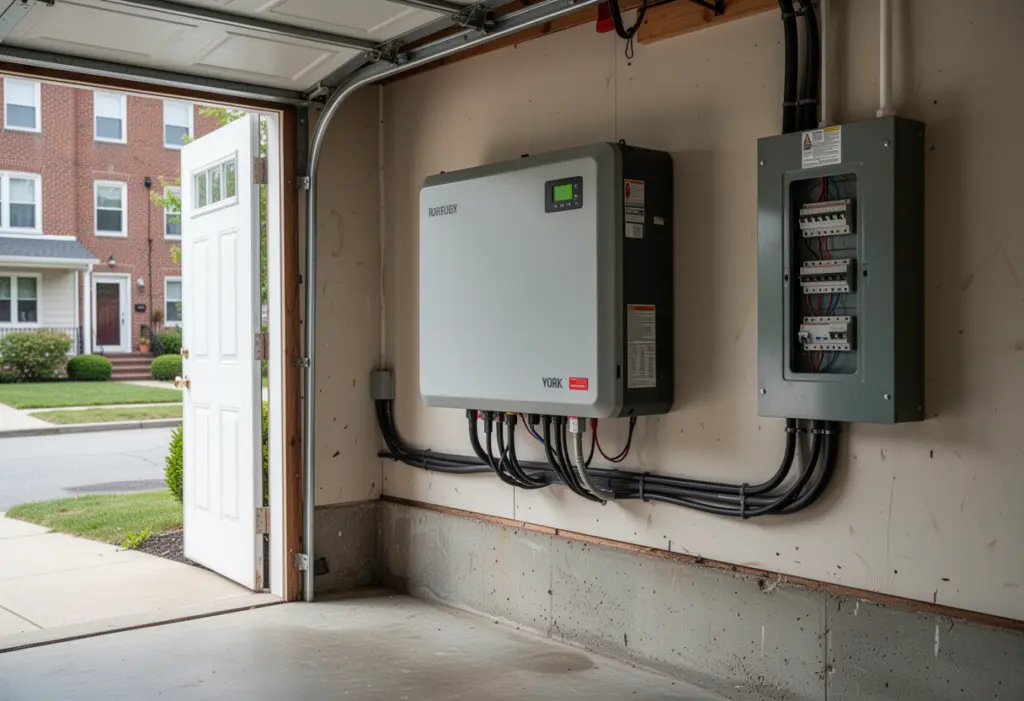
The short answer for most New York households is no, and the reason is net metering. Understanding why makes the cases where a battery is worth buying much clearer.
Why a battery saves less than people expect here
In states with time-of-use pricing and no full-retail net metering, a battery earns its keep by storing cheap midday solar and displacing expensive evening grid power. That arbitrage is the entire financial argument for home storage.
New York’s Phase One net metering removes it. Every kilowatt-hour you export is credited at the full retail rate, and you draw it back later at that same rate. The grid is already acting as your battery, at a hundred per cent round-trip efficiency, for free, with unlimited capacity. A physical battery cannot beat that — it can only lose a few per cent to conversion losses on the way through.
So if a salesperson tells you a battery will increase your solar savings in New York, ask them to show the arithmetic. On a standard residential net-metered account there usually is not any.
What a battery actually buys you
Power when the grid is down. That is the honest case, and it is a real one.
This surprises people: a grid-tied solar system without a battery shuts off in a power cut. It has to. Anti-islanding protection stops the inverter feeding a line that utility crews may be working on. So the array on your roof produces nothing during an outage, in bright sunshine, unless there is storage and the right switchgear to island the house.
If you have watched your neighbours’ solar sit dead through a storm outage and wondered why, that is why.
Who should actually consider one
- Households on long rural feeders — much of NYSEG’s and National Grid’s upstate territory — where outages are longer and more frequent than in a dense suburb.
- Anyone with a medical dependency on power: oxygen concentrators, refrigerated medication, powered mobility equipment. This is not a financial decision.
- Properties on a well. No power means no water, which changes an outage from an inconvenience into an evacuation.
- Homes with a sump pump where failure means a flooded basement.
- Storm-exposed areas — coastal Long Island, and anywhere with heavy tree cover over the lines.
Capacity and power are different numbers
This is the specification most often confused, and it decides what the battery can actually do.
Capacity (kWh) is how much energy is stored — how long it lasts.
Power output (kW) is how much it can deliver at once — how much it can run simultaneously.
A battery with generous capacity but modest power output will run lights, a fridge and a router for a long time, and will not start a well pump or a central air conditioner. If backing up a specific appliance is the reason you are buying, the power figure is the one to check, not the headline capacity.
Whole-house or critical loads
Most New York installations back up a critical loads panel: a sub-panel carrying the circuits that matter — fridge, some lighting, the boiler controls, a few outlets, the sump pump. It is far cheaper than whole-house backup and it covers what actually matters in an outage.
Whole-house backup needs a much larger battery and much more power output, and in an older house it frequently needs electrical work beyond the battery itself. Ask for both to be quoted so you can see the difference rather than being told which one you want.
What New York offers toward it
NYSERDA has supported residential storage, and the terms change — ask what is open on the day you are quoted rather than relying on a figure from last year. The 30% federal residential credit is gone: section 25D was terminated for expenditures made after 31 December 2025, with an expenditure treated as made when the original installation is completed. Any battery quote still showing a federal credit line is overstating your net cost.
One useful detail: the Customer Benefit Contribution, the monthly charge New York solar customers pay, is calculated on the DC size of the PV system — not on battery capacity. Adding storage to an existing array does not increase it.
The honest summary
In New York, buy a battery because you want the lights to stay on, and judge it on that. If it also saves you money, treat that as a bonus rather than the reason — because under full-retail net metering, the grid is already doing the storing.
Frequently Asked Questions
Will a battery save me money on solar in New York?
Usually very little. Phase One net metering credits exports at the full retail rate and lets you draw them back at that rate, so the grid already banks your surplus at no cost and no losses. A battery is bought for outage protection rather than savings.
Do solar panels work during a power cut?
Not without a battery and the right switchgear. Anti-islanding protection shuts a grid-tied inverter down so it cannot feed a line crews may be working on, so a battery-less array produces nothing during an outage even in bright sun.
What is the difference between kWh and kW on a home battery?
kWh is capacity — how long it lasts. kW is power output — how much it can run at once. A battery with large capacity but modest output will run a fridge and lights for a long time but will not start a well pump or central air conditioning.
Should I back up the whole house or just some circuits?
Most New York installations back up a critical loads sub-panel — fridge, some lighting, boiler controls, sump pump — which is far cheaper and covers what matters. Ask for both to be quoted so you can see the difference.
Does adding a battery increase my Customer Benefit Contribution?
No. The charge is calculated on the DC size of the PV system, not on battery capacity, so adding storage to an existing array does not increase it.
This article is general information, not tax, legal or financial advice. Incentive amounts, eligibility rules and deadlines change and depend on your utility, your tax situation and your property. Confirm current terms with NYSERDA, your utility and a qualified tax professional before making a decision.
NY Solar Incentives
Independent New York solar research. We summarise NYSERDA, NY-Sun and federal programme rules from published sources and state plainly when a figure is an estimate. We are not a government agency and do not sell equipment.
Run the arithmetic on your own system
Check the dated program table and your arrangement before counting an incentive. Standard residential NY-Sun blocks are closed; Long Island Affordable Solar has a conditional income-verification route. The NY credit depends on qualified costs and tax liability, while the NYC abatement reduces future property-tax bills. The estimator keeps those timings separate.