Solar Panel Installation in East Hampton, NY
East Hampton has the most demanding review on Long Island. Plan for it first — everything else in the project is downstream of it.
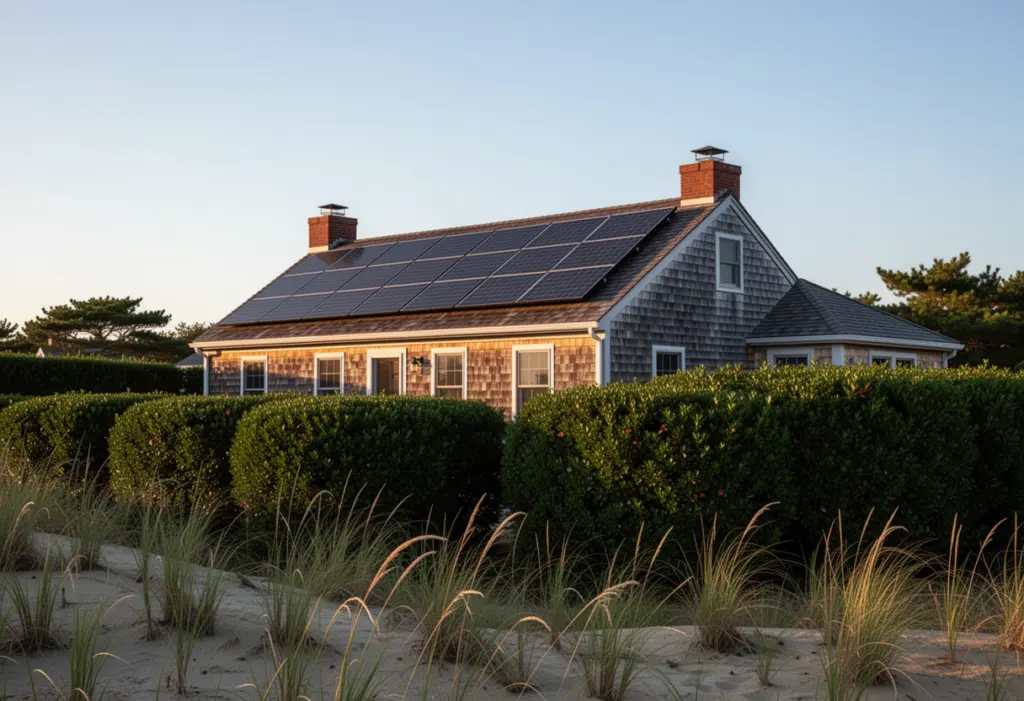
The Town of East Hampton covers the eastern end of the South Fork — East Hampton village, Amagansett, Montauk, Wainscott, Springs and Sag Harbor’s eastern half. ZIP codes here begin 119. Technically the conditions are good: open exposure, strong light, and among the highest electricity rates in the state, which makes every exported kilowatt-hour valuable.
The variable that decides whether a project happens on schedule is review, and here it is the most demanding on Long Island.
Plan for review first
East Hampton operates architectural and historic review, and East Hampton village adds its own. Both can restrict street-visible placement, require particular mounting approaches, or ask for screening. Historic structures and properties within districts face the most scrutiny.
Three things follow:
- Establish which authority covers your address — town or village — and what review applies, before you sign anything.
- Design for approval. All-black modules with black frames, flush mounting, concealed conduit, and placement away from principal elevations remove most of what a board objects to. An installer experienced on the East End will propose this without being asked; one who is not, will not.
- Budget the calendar. Review comes before the building permit, which comes before installation, which comes long before permission to operate. It is the front of the queue.
Seasonal occupancy changes the sizing
Many East Hampton houses are occupied heavily in summer and lightly in winter. That profile matches solar production unusually well — the array generates most when the house consumes most — which is genuinely favourable.
It also makes twelve months of actual PSEG Long Island usage essential rather than optional. A design built from a July bill will oversize the system badly; one built from a February bill will undersize it. Ask what annual consumption figure the design used and where it came from.
A related point: pools, pool heating and air conditioning are a large share of consumption in this market, and they run precisely when the sun does. That is a favourable coincidence and it should be in the model.
Coastal conditions
Wind load is at its most demanding on the South Fork. Racking and attachment must be specified for the local wind zone — ask what load and who confirmed it.
Salt exposure is a real consideration for mounting hardware and outdoor equipment enclosures, more so here than anywhere else in the state.
Flood zones affect equipment placement on many properties, particularly in Montauk and along the bays.
The utility numbers
Phase One net metering credits exports at the full retail rate, held for 20 years from interconnection.
The Customer Benefit Contribution is $1.13 per kW-month of DC system size for LIPA in 2026. Systems here are frequently large, so the number is worth calculating on the actual proposal: 12 kW pays about $13.56 a month ($163 a year), 16 kW about $18.08 ($217 a year). Billed on capacity regardless of production and recalculated annually. Mass-market LIPA projects cannot opt into the Value Stack.
2026 incentives
The 30% federal residential credit under section 25D ended for expenditures made after 31 December 2025, with an expenditure treated as made when the original installation is completed. The interaction with review matters here: a project a board held up past the end of 2025 is a project that lost that credit.
Still available: New York’s 25% credit capped at $5,000 on Form IT-255, which reaches leases and PPAs of ten years or more as well as purchases; the state sales tax exemption; and RPTL 487’s 15-year property tax exemption where the town, the village, Suffolk County and your school district have not opted out, claimed by filing form RP-487 with the assessor by the taxable status date.
NY-Sun is not on that list. As of September 2026 NYSERDA has no open NY-Sun block for homes in any utility territory, and on Long Island the last standard residential block closed in April 2016, so an East Hampton quote should not show a NY-Sun discount unless the household is approved for Affordable Solar. NYSERDA’s April 2026 NY-Sun Program Manual still lists one home incentive on Long Island that is not tied to a block: the Affordable Solar Residential Incentive of $0.40 per watt for income-qualified homeowners, paid to a participating NY-Sun contractor, who must pass it on in your contract. Ask the contractor to confirm funding is still available. Check NYSERDA’s NY-Sun dashboard for a new one.
Note that the state credit is capped at $5,000 regardless of system size, so on the larger systems common in this market it is a smaller proportion of the total than it is elsewhere in New York.
Frequently Asked Questions
Does East Hampton allow solar panels?
Yes, but architectural and historic review applies at town level and East Hampton village adds its own, with the most scrutiny on historic structures and properties within districts. Review can restrict street-visible placement and comes before the building permit.
How do I design a solar system likely to pass East Hampton review?
All-black modules with black frames, flush mounting, concealed conduit and placement away from principal elevations remove most of what a board objects to. An installer experienced on the East End proposes this without being asked.
Does a summer house change how solar should be sized?
Yes. Heavy summer occupancy matches production well, which is favourable, but a design built from a July bill will oversize badly and one from a February bill will undersize. Twelve months of actual usage is essential.
Is the New York solar tax credit worth less on a large system?
Proportionally, yes. The state credit is 25% of qualified expenditure but capped at $5,000 regardless of system size, so on the larger systems common in this market it covers a smaller share of the total than it does elsewhere.
This article is general information, not tax, legal or financial advice. Incentive amounts, eligibility rules and deadlines change and depend on your utility, your tax situation and your property. Confirm current terms with NYSERDA, your utility and a qualified tax professional before making a decision.
NY Solar Incentives
Independent New York solar research. We summarise NYSERDA, NY-Sun and federal programme rules from published sources and state plainly when a figure is an estimate. We are not a government agency and do not sell equipment.
Run the arithmetic on your own system
Check the dated program table and your arrangement before counting an incentive. Standard residential NY-Sun blocks are closed; Long Island Affordable Solar has a conditional income-verification route. The NY credit depends on qualified costs and tax liability, while the NYC abatement reduces future property-tax bills. The estimator keeps those timings separate.