Solar for a Small Business in New York
The residential federal credit ended. The business one did not. Here is what that means for a New York small business, and why demand charges change everything.
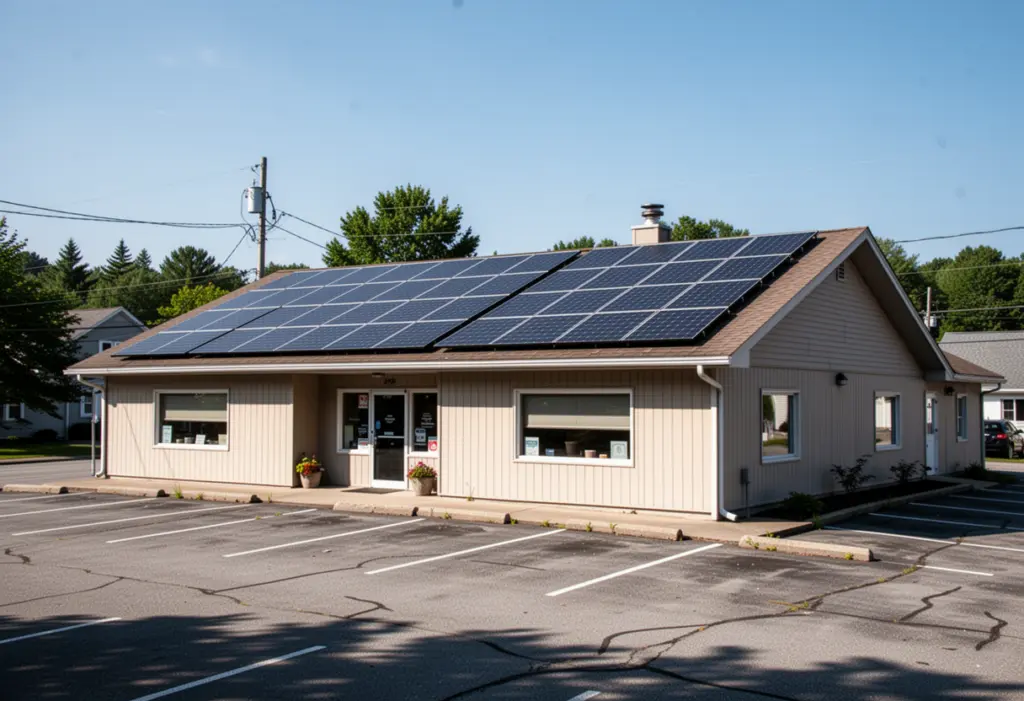
Something important happened at the end of 2025 that has not filtered through to most conversations about solar in New York: the residential federal tax credit ended, and the business-side credit did not. For a small business owner, that inverts the position relative to a homeowner.
The credit position in 2026
Homeowners: section 25D, the 30% residential clean energy credit, was terminated by the One Big Beautiful Bill Act for expenditures made after 31 December 2025. A homeowner buying today claims nothing federally.
Businesses: the investment tax credit on the business side of the code is a different provision with a different life, and it is the reason third-party owners — the companies behind leases and PPAs — still price an incentive into their offers even though the homeowner never claims one.
This is not a small distinction and it is not one to take from a webpage. The business credit has its own rules, its own timing tests and its own conditions, and it is a question for your accountant with your specific numbers and your specific in-service dates. What is safe to say is that the business side is a live question in 2026 in a way that the residential side is not.
Depreciation is the part homeowners never get
A business can depreciate a solar asset. A homeowner cannot depreciate anything. For many small businesses the depreciation treatment is worth as much as the credit, and it is the reason a commercial project can pencil where an identical residential one would not.
Again: your accountant, your figures. But make sure it is in the model, because an installer’s proposal frequently is not built by an accountant.
Demand charges change the whole calculation
This is the single biggest difference between a business and a household, and the one most likely to be handled badly in a sales proposal.
Many New York commercial accounts pay not only for the energy they consume but for their highest instantaneous demand in the billing period. A solar array reliably reduces energy consumption. Whether it reduces demand depends entirely on when your peak occurs.
- A business whose peak is at two in the afternoon on a sunny day may see real demand reduction.
- A business whose peak is at seven on a winter evening will see almost none — the array is not producing then.
- A single cloudy moment coinciding with your peak can wipe out the demand saving for the whole month.
Ask any installer proposing a commercial system how much of the projected saving is energy and how much is demand, and what data they used. If they cannot separate the two, the proposal is not finished. This is also where battery storage earns its place on a commercial site far more often than on a residential one.
One related point: commercial accounts that carry a demand charge are exempt from the Customer Benefit Contribution, the monthly charge that residential solar customers pay on system size.
What else New York offers
- NY-Sun has non-residential incentives, paid through the contractor, with amounts depending on size and region and stepping down as capacity blocks fill.
- Net metering or the Value Stack. Which arrangement suits a commercial account depends on load shape and size, and unlike a household it is a genuine decision. The Value Stack values exports by time and location rather than at a flat retail rate, which can favour a business with the right production profile.
- Property tax. RPTL 487’s exemption applies to commercial as well as residential property, where the municipality has not opted out. The RPTL 487 exemption is not automatic: file form RP-487 with your assessor by the taxable status date (March 1 in most towns; January 2 in Nassau towns; May 1 or June 1 in Westchester towns; set by charter in cities; usually January 1 in villages), and the system must be built before January 1, 2030 (RP-487 instructions).
- Sales tax. Commercial solar has its own treatment; confirm it for your situation rather than assuming the residential exemption applies.
Practical starting points
- Get twelve months of interval data from your utility, not just bill totals. For a commercial account the shape of the load is the analysis.
- Establish who owns the building. If you lease your premises, the roof is not yours and the project becomes a negotiation with the landlord — including who takes the tax benefit and what happens at lease end.
- Check the roof before anything else. A commercial flat roof with under a decade left is a reason to sequence the roof first.
- Bring your accountant in early, before the proposal is built rather than after it is signed.
- Ask whether the system exceeds 25 kW, because that is the ceiling for the Unified Solar Permit and above it you are on the municipality’s ordinary process.
The honest summary
For a New York small business in 2026, solar is a more favourable proposition than it is for a household, and for once that is not a sales claim — it is a consequence of which part of the tax code was repealed and which was not. The complexity is real, though, and it sits in the tax treatment and the demand charge rather than in the panels.
Frequently Asked Questions
Can a New York business still claim a federal solar tax credit in 2026?
The residential credit under section 25D ended for expenditures made after 31 December 2025, but the business-side investment tax credit is a separate provision with its own rules and timing tests. It is a live question for businesses in 2026 and one to put to your accountant with your own figures.
Do solar panels reduce demand charges?
Only if your peak demand coincides with production. A business peaking at two in the afternoon may see real reduction; one peaking on a winter evening will see almost none. Ask any proposal to separate the energy saving from the demand saving.
Do commercial solar customers pay the Customer Benefit Contribution?
Commercial accounts that already carry a demand charge are exempt from it. The charge applies to residential and small commercial customers who interconnected on or after 1 January 2022.
What if I lease my business premises?
The roof is not yours, so the project becomes a negotiation with the landlord covering who owns the system, who takes the tax benefit, and what happens at the end of the lease. Settle that before design work begins.
This article is general information, not tax, legal or financial advice. Incentive amounts, eligibility rules and deadlines change and depend on your utility, your tax situation and your property. Confirm current terms with NYSERDA, your utility and a qualified tax professional before making a decision.
NY Solar Incentives
Independent New York solar research. We summarise NYSERDA, NY-Sun and federal programme rules from published sources and state plainly when a figure is an estimate. We are not a government agency and do not sell equipment.
Run the arithmetic on your own system
Check the dated program table and your arrangement before counting an incentive. Standard residential NY-Sun blocks are closed; Long Island Affordable Solar has a conditional income-verification route. The NY credit depends on qualified costs and tax liability, while the NYC abatement reduces future property-tax bills. The estimator keeps those timings separate.