RG&E Net Metering in Rochester and Monroe County
RG&E covers Rochester and most of Monroe County. Here is how solar exports are credited, what the 2026 CBC costs a typical system, and where interconnection stalls.
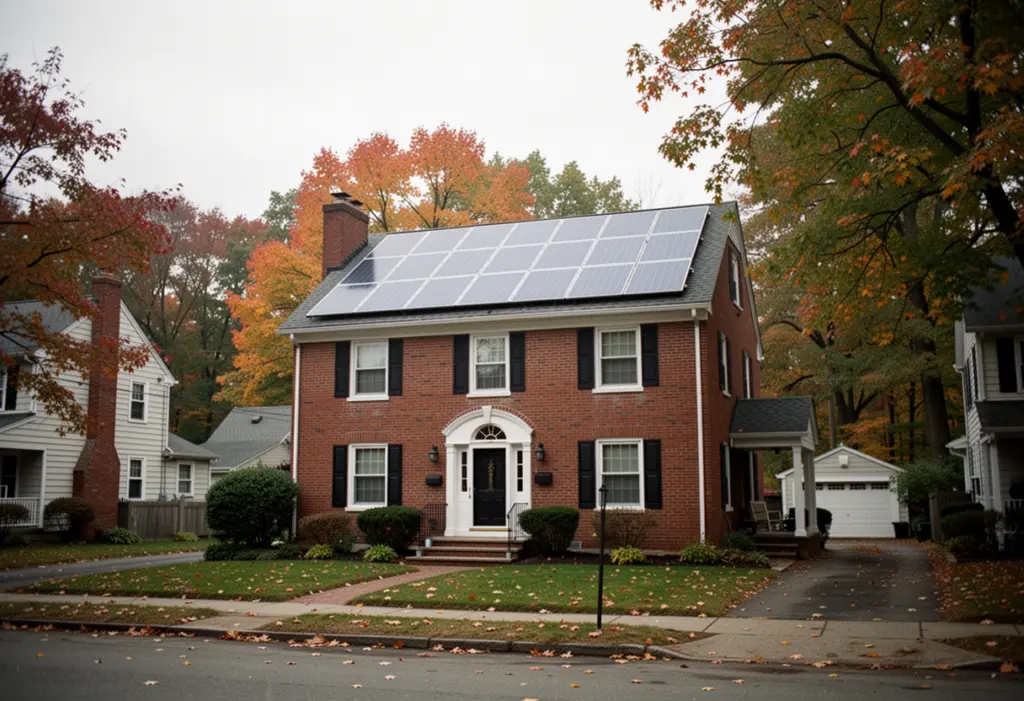
Rochester Gas and Electric serves Rochester and most of Monroe County, and shares corporate ownership with NYSEG — which is why the two utilities run similar processes on different rates. If your bill says RG&E, these are your numbers.
What net metering pays
Everything your array produces is used in the house first. The surplus is exported and metered, and under Phase One net metering each exported kilowatt-hour earns a credit at the full retail rate. Exports at midday offset imports at night, one for one.
A system interconnected today holds that treatment for 20 years. That is a genuine piece of certainty in a policy area that has changed repeatedly, and it attaches to the interconnection date.
Rochester’s seasonal profile
Monroe County sits in one of the cloudier parts of the state — Rochester’s winters are grey as well as cold, and the November-to-February trough is deep. The compensating fact is that summers are long enough and clear enough to build a substantial credit balance, and net metering lets that balance carry across the year.
The practical consequence is the same as everywhere upstate but sharper: size on annual consumption, get your twelve months of RG&E usage before you accept a design, and treat any proposal that models production without a real shading assessment as incomplete.
The Customer Benefit Contribution on RG&E
Residential customers interconnecting on or after 1 January 2022 pay a monthly Customer Benefit Contribution based on the DC size of the system. RG&E’s final 2026 residential rate for net-metered PV is $1.31 per kW-month, the second-highest in the state after Central Hudson.
- A 6 kW system: 6 × $1.31 = $7.86 a month, about $94 a year.
- An 8 kW system: 8 × $1.31 = $10.48 a month, about $126 a year.
- A 12 kW system: 12 × $1.31 = $15.72 a month, about $189 a year.
A curiosity worth noting: RG&E is one of three New York utilities whose small commercial CBC rate is lower than its residential one — $0.96 against $1.31 here, alongside NYSEG and Orange & Rockland. On the Value Stack route the 2026 residential rate is $0.65 per kW-month.
The charge is billed on capacity every month regardless of output, it is recalculated annually rather than fixed at interconnection, and it does not apply to pre-2022 systems, community solar subscriptions or commercial accounts with a demand charge.
Interconnection and permission to operate
- The installer files an interconnection application with RG&E.
- RG&E reviews it against circuit capacity and issues approval to install.
- The system is installed and passes municipal electrical inspection.
- The certificate goes to RG&E and the meter is exchanged or reprogrammed.
- RG&E grants permission to operate. The system may be switched on only now.
Suburban Monroe County towns — Greece, Irondequoit, Henrietta, Penfield, Webster, Pittsford — each run their own building department, so the inspection step varies more by town than the utility step does. Ask which municipality is issuing the permit and what its current turnaround is.
What solar does not remove
The basic service charge and the fixed portion of delivery stay on the bill for as long as the house is connected. Solar reduces the volumetric part. A small monthly bill is the correct expectation, and the CBC is a line that will appear where there was none before.
2026 incentives
The 30% federal residential credit is gone — section 25D was terminated for expenditures made after 31 December 2025, with the expenditure treated as made when the original installation is completed. New York’s 25% credit capped at $5,000 (Form IT-255) remains, as do the state sales tax exemption and the RPTL 487 property tax exemption where the town has not opted out. The RPTL 487 exemption is not automatic: file form RP-487 with your assessor by the taxable status date (March 1 in most towns; January 2 in Nassau towns; May 1 or June 1 in Westchester towns; set by charter in cities; usually January 1 in villages), and the system must be built before January 1, 2030 (RP-487 instructions). The NY-Sun contractor incentive does not: as of September 2026 NYSERDA has no open NY-Sun block for homes in any utility territory; check NYSERDA’s NY-Sun dashboard for a new one.
Frequently Asked Questions
What is the RG&E CBC rate for 2026?
$1.31 per kW-month of DC system size for residential net-metered PV, the second-highest in New York after Central Hudson. An 8 kW system pays about $10.48 a month, roughly $126 a year.
Does RG&E offer net metering to new solar customers?
Yes. New residential rooftop systems receive Phase One net metering, crediting exports at the full retail rate, and the arrangement is held for 20 years from interconnection.
Who inspects a solar installation in Monroe County?
The municipality issuing the permit — Rochester, Greece, Irondequoit, Henrietta, Penfield, Webster or Pittsford each run their own building department. RG&E acts only after the local inspection certificate is filed.
Is Rochester too cloudy for solar to be worthwhile?
Rochester winters are grey, but net metering banks the summer surplus as a credit that carries into winter, so the annual total is what matters. The requirement is honest sizing against a full year of consumption rather than a summer bill.
This article is general information, not tax, legal or financial advice. Incentive amounts, eligibility rules and deadlines change and depend on your utility, your tax situation and your property. Confirm current terms with NYSERDA, your utility and a qualified tax professional before making a decision.
NY Solar Incentives
Independent New York solar research. We summarise NYSERDA, NY-Sun and federal programme rules from published sources and state plainly when a figure is an estimate. We are not a government agency and do not sell equipment.
Run the arithmetic on your own system
Check the dated program table and your arrangement before counting an incentive. Standard residential NY-Sun blocks are closed; Long Island Affordable Solar has a conditional income-verification route. The NY credit depends on qualified costs and tax liability, while the NYC abatement reduces future property-tax bills. The estimator keeps those timings separate.