What the R-454B Refrigerant Change Means for a New York Install
R-454B replaced R-410A in new heat pumps. For a New York install that means A2L-rated technicians, a line set decision, and a service relationship that matters.
On this page 8 sections
- 01Why the refrigerant changed at all
- 02What A2L means on your job site
- 03The line set question, which is where money is won and lost
- 04Servicing, parts and the long tail
- 05Should you look for leftover R-410A equipment instead?
- 06Does any of this affect your rebate?
- 07Vetting the contractor on this specifically
- 08What to do next
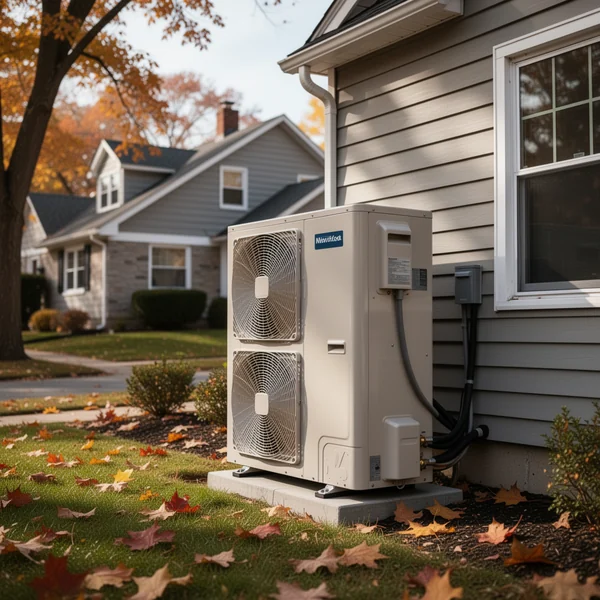
R-454B is the refrigerant that has replaced R-410A in most new residential heat pumps and air conditioners, and for a New York homeowner the heat pump refrigerant R454B change has three practical consequences. Your installer needs A2L-rated training, tools and leak-detection practice; the line set from your old system often cannot simply be reused; and a system bought now cannot be topped up with R-410A later, so the service relationship you sign into matters more than it used to.
None of that is a reason to delay an install. It is a reason to ask three or four specific questions before you sign, because this is the first refrigerant transition in twenty years and the trade is still catching up unevenly.
Why the refrigerant changed at all
The transition was driven by federal regulation rather than by manufacturers deciding to redesign their product lines. The EPA’s rules under the American Innovation and Manufacturing Act set limits on the global warming potential of refrigerants used in new residential air conditioning and heat pump equipment, with the residential comfort-cooling transition biting for equipment manufactured from the start of 2025. R-410A exceeded the limit; R-454B and R-32 sit under it. The EPA’s own pages at epa.gov are the source to check if you want the current regulatory position rather than a summary.
R-454B was widely chosen because it behaves close enough to R-410A on pressure and capacity that manufacturers could adapt existing platforms rather than start over. That is convenient for the industry, and it is also the source of the most common installer mistake — it is close to a drop-in replacement, and it is not one.
What A2L means on your job site
R-454B is classified A2L: low toxicity, mildly flammable. That classification is the single biggest change from R-410A, which is non-flammable, and it changes several things about how the equipment is built and installed.
- Charge limits and room volume. There are limits on how much refrigerant may be in a system serving a given space, which occasionally matters for small apartments, converted attic rooms and tightly zoned installations. A competent designer will have checked; ask whether they did.
- Leak detection and mitigation. Indoor units are built with a refrigerant sensor and a mitigation response — typically running the blower to disperse any leak. That is why the indoor unit needs a continuous power supply and why the controls are not interchangeable with older equipment.
- Tools and handling. Recovery machines, gauges, vacuum pumps and leak detectors have to be rated for A2L. A technician using their R-410A kit on A2L refrigerant is working outside the equipment’s rating.
- Code adoption. Work in New York is governed by the State Uniform Fire Prevention and Building Code, which adopts model mechanical code provisions covering A2L refrigerants, with New York City operating under its own construction codes. Your contractor should be able to say which code edition the local building department is enforcing and how the install complies. In New York City in particular, do not assume the answer is the same as in Westchester.
The line set question, which is where money is won and lost
If you are replacing an old central air conditioner or an existing heat pump, there is a copper line set running from the outdoor unit to the indoor coil, and the obvious economy is to reuse it. Sometimes you can. Often you should not, and the reasons are specific:
- Residual oil. The oil left inside an old line set is matched to the old refrigerant. Mixed with the new system’s oil it can degrade lubrication and foul the compressor — the failure mode that shows up two years later and is not covered by anything.
- Contamination. If the old system failed with a compressor burnout, the line set is contaminated and reuse is not a judgement call.
- Sizing. Line diameters are specified per system. An old line set sized for a different capacity machine is not automatically right for the new one, and undersized suction line is a permanent efficiency penalty you cannot see.
- Pressure rating. The system must be rated for its operating pressures throughout, and old tubing and fittings have to be verified rather than assumed.
A contractor who says “we’ll flush it and reuse it” without inspecting the line set and checking the manufacturer’s position on reuse is taking a shortcut with your compressor warranty. A contractor who quotes a new line set as a line item is not padding the bill — get the reasoning either way.
Servicing, parts and the long tail
This is the part homeowners underweight. A heat pump installed today will need service for fifteen years or more, and during that time:
Your system cannot be charged with R-410A. If it develops a leak, the technician who arrives needs A2L-rated recovery equipment and the correct refrigerant on the van. In dense parts of the state that is already routine. In rural counties — the North Country, the western Southern Tier, parts of the Adirondacks — the depth of A2L-equipped service coverage is thinner, and it is a fair question to ask a contractor how many technicians in their own shop are trained and equipped for it. If the answer is one, ask what happens in February when that person is on holiday.
Parts availability follows the same curve. Early in a platform transition, components for the new systems are less deeply stocked in local supply houses than the parts for the equipment that has been shipping for two decades. That gap narrows every year, but it is real right now.
Should you look for leftover R-410A equipment instead?
Equipment manufactured before the transition can still be sold from existing inventory, and some homeowners have asked for it deliberately on the theory that servicing it will be simpler. Weigh it honestly.
In favour: a very deep existing service base, plentiful parts, technicians who have worked on nothing else for years, and sometimes a discounted price on inventory a distributor wants to move.
Against: R-410A is being phased down in production, which means its price over the life of your system trends the wrong way — exactly the pattern R-22 followed, where the refrigerant eventually cost more than the repair. You would also be buying a platform at the end of its life rather than the beginning, and if you plan to sell the house, a system running an obsolete refrigerant is a line in a home inspection report.
On balance, for a system you intend to keep, the new refrigerant is the right side of the transition to be on. The exception is a genuinely temporary fix on a house you are selling shortly.
Does any of this affect your rebate?
Not directly. NYS Clean Heat — administered by NYSERDA with Central Hudson, Con Edison, National Fuel Gas, National Grid, NYSEG, Orange & Rockland and RG&E — sets its incentives by equipment category and performance qualification, not by refrigerant. What can bite you is timing: qualifying product lists are updated as manufacturers certify new models, and a model that has not yet appeared on the current list cannot be filed against the programme even if its predecessor was eligible.
So confirm the exact model number a contractor is proposing appears on the current qualifying list before you sign, and confirm the rebate level for your address at cleanheat.ny.gov/find-available-rebates. Amounts vary by utility and are revised; there is no single statewide table worth trusting. Nassau and Suffolk households should note that PSEG Long Island is not a Clean Heat sponsor and runs its own programmes.
One more thing to check before you total up a quote: the federal credits are gone. Section 25C applied to property placed in service through 31 December 2025, and Section 25D terminated for expenditures after the same date. A 2026 install in New York receives nothing federal, regardless of refrigerant, efficiency rating or equipment type.
Vetting the contractor on this specifically
The general vetting discipline applies — licence, insurance, workers’ compensation, references, a real load calculation. The guide on how to vet a solar installer in New York lays out that process, and it transfers directly to HVAC work. Understanding what programme participation does and does not certify is worth reading alongside it: what a NYSERDA-qualified contractor actually is.
What to do next
- Ask each contractor how many of their technicians are A2L-trained and equipped, and what their after-hours service coverage looks like in your county.
- Ask whether they intend to reuse your existing line set, and require the reasoning in writing either way.
- Get the exact proposed model number and check it against the current Clean Heat qualifying product list before signing.
- Ask which code edition your local building department is enforcing for A2L work, and confirm the permit covers it.
- Confirm the compressor warranty terms and what the manufacturer requires regarding line set reuse — that clause is usually where a denied claim starts.
- Remove any federal tax credit line from a 2026 quote before comparing totals.
NY Solar Incentives
Independent New York solar research. We summarise NYSERDA, NY-Sun and federal programme rules from published sources and state plainly when a figure is an estimate. We are not a government agency and do not sell equipment.
Run the arithmetic on your own system
Check the dated program table and your arrangement before counting an incentive. Standard residential NY-Sun blocks are closed; Long Island Affordable Solar has a conditional income-verification route. The NY credit depends on qualified costs and tax liability, while the NYC abatement reduces future property-tax bills. The estimator keeps those timings separate.