What a Heat Pump Costs in the Capital Region
Four variables move a Capital Region heat pump price by multiples, not percentages. Here is what your Albany, Troy or Saratoga quote is actually made of, line by line.
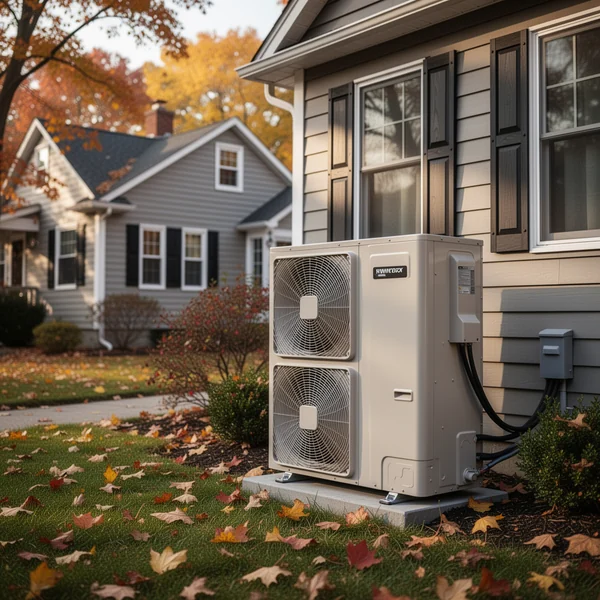
Nobody can tell you the heat pump cost for a Capital Region house without knowing four things: how the house is heated now, whether it has usable ductwork, how leaky the shell is, and what your electrical panel can carry. Those four answers move the price by multiples, not by percentages — which is why a Troy rowhouse and a Guilderland ranch of similar square footage can get quotes that look like they are for different projects.
This page will not print a dollar figure, and you should be sceptical of any page that does without saying where the number came from. What it will do is show you exactly what your quotes are made of, so that when three Capital Region contractors hand you three different numbers you can tell which one is expensive and which one is just complete.
What drives heat pump cost in the Capital Region specifically
The winter you are sizing for
Albany, Schenectady, Troy and Saratoga Springs are sized against a winter design temperature near zero — not the teens a Long Island contractor works with. That is not a small distinction. It means cold-climate rated equipment rather than a standard-efficiency unit, it means the capacity you need at design temperature is a bigger number than the nameplate suggests, and it means a backup strategy is part of the design rather than an afterthought. A quote that specifies equipment without stating its rated capacity at a cold outdoor temperature has not engaged with the Capital Region at all.
The housing stock, which is unusually varied here
- Nineteenth-century brick rowhouses in Troy, Albany’s Center Square and Hudson. Uninsulated masonry, no duct chases, often hot water radiators. Ductless heads or high-static ducted cassettes in soffits. The cost lives in the line-set routing and the finish carpentry, not the equipment.
- Post-war ranches and capes in Colonie, Rotterdam and Niskayuna. Often already ducted for a furnace. The cheapest conversion in the region — if the ducts are sized for the airflow a heat pump needs, which they frequently are not.
- 1990s-onward colonials in Clifton Park, Halfmoon and Malta. Ducted, reasonably tight, two storeys. Usually a straightforward ducted swap, sometimes with a second zone.
- Farmhouses out toward Schoharie, Washington and Greene counties. Big volumes, additions on additions, oil or propane, no gas main. Highest heating load and the strongest running-cost case for switching.
The fuel you are leaving
Most of the urban Capital Region has natural gas. Outside the mains — much of Saratoga, Rensselaer and Schoharie counties — households run on oil or propane, and the operating-cost case for a heat pump is far stronger there, because delivered fuel prices are what they are and electricity in National Grid territory is comparatively stable. The install cost barely changes; the payback changes a lot.
Your panel
A 100-amp service on a 1955 Colonie ranch is the item most likely to turn a predictable job into an unpredictable one. It may be fine — an electrician can calculate an existing dwelling’s load from twelve months of your actual National Grid demand data rather than from nameplate ratings, and that method frequently shows headroom the paper method does not. Get that done before you accept a quote that has a service upgrade in it.
Reading the quote, line by line
| Line | What to check |
|---|---|
| Load calculation | Is there a room-by-room Manual J attached, or a size asserted? No sheet, no confidence. |
| Equipment | Model numbers for both indoor and outdoor units, and the rated heating capacity at a stated cold outdoor temperature. |
| Number of zones or heads | Each head adds equipment and labour. A quote with fewer heads is not automatically cheaper to live with. |
| Ductwork | Reuse, modify or replace — and whether duct sealing and a static pressure check are included. |
| Line-set routing | Length, and whether it runs in conditioned space, a chase, or up an exterior wall in a line hide. |
| Electrical | New circuit, disconnect, panel work, and whether a service upgrade is assumed or verified. |
| Backup heat | Keeping the existing boiler or furnace as backup, adding electric strips, or neither. This is a design decision with a running-cost consequence. |
| Outdoor mounting | Pad or wall bracket, and how high. In this region the unit needs to clear the snow, and pad height is a real line item. |
| Condensate and defrost drainage | Where the meltwater goes so it does not build an ice plinth under the unit by February. |
| Permits | Mechanical and electrical permits with the town or city. Albany, Troy, Schenectady and Saratoga Springs each have their own process. |
| Rebate handling | Whether the NYS Clean Heat rebate is deducted from your invoice or you are expected to chase it. |
Two quotes that differ by a factor of two are usually not two prices for the same job. They are a ductless retrofit versus a full ducted replacement, or a system sized for design temperature versus one sized for a mild day with the boiler quietly carrying the rest of the winter.
The incentives, stated accurately for 2026
There is no federal help this year. Section 25C, which had covered up to $2,000 annually for heat pumps, and Section 25D, the residential clean energy credit, both ended for property placed in service after 31 December 2025. A Capital Region household installing a heat pump in 2026 gets nothing federal. If a contractor’s bottom line shows a 30% federal credit, the proposal was written against last year’s rules and you should ask what else in it is out of date.
NYS Clean Heat is still running. It is NYSERDA together with seven sponsoring utilities: Central Hudson, Con Edison, National Fuel Gas, National Grid, NYSEG, Orange & Rockland and RG&E. Most of the Capital Region is National Grid territory for electricity, with NYSEG serving parts of the surrounding counties — check the name on your bill rather than assuming, because the rebate schedule follows the utility, not the county.
The amounts are not published as a single statewide table. They differ by utility and by equipment type, and the official route is the address-based finder at cleanheat.ny.gov. In practice the rebate is claimed through a participating contractor and shows up as a deduction on your invoice, which is why “is the Clean Heat rebate included in this price or not?” is the most important clarifying question you will ask. NYSERDA also runs income-qualified support through EmPower+ — call 1-866-NYSERDA rather than relying on thresholds quoted online — and financing through the On-Bill Recovery Loan, which is repaid through the utility bill.
If solar is in the same plan, it runs on its own track and is unaffected by the federal change at state level: New York’s Form IT-255 credit is 25% of system cost capped at $5,000 and remains available in 2026, carrying forward up to five years. Our local pages on solar panel cost in Albany and solar incentives in Albany County cover how that side is priced here, and Saratoga County has its own page for households north of the Mohawk.
What to do next
- Find last winter’s fuel bills — gallons of oil or propane, or gas therms — and have them in front of you at every site visit. That is the input that turns a cost question into a payback question.
- Request twelve months of interval or demand data from National Grid or NYSEG and give it to the electrician before anyone prices a service upgrade.
- Take three quotes from NYSERDA-participating contractors and insist each attaches a Manual J and a capacity figure at a stated cold outdoor temperature.
- Ask each one explicitly whether the Clean Heat rebate is already deducted from the price shown.
- Run your own address through cleanheat.ny.gov before the quotes arrive, so you know roughly what should be coming off.
- Get the shell work priced at the same time. Air sealing the attic and band joist shrinks the load, which can shrink the equipment, which sometimes removes the panel question entirely.
NY Solar Incentives
Independent New York solar research. We summarise NYSERDA, NY-Sun and federal programme rules from published sources and state plainly when a figure is an estimate. We are not a government agency and do not sell equipment.
Run the arithmetic on your own system
Check the dated program table and your arrangement before counting an incentive. Standard residential NY-Sun blocks are closed; Long Island Affordable Solar has a conditional income-verification route. The NY credit depends on qualified costs and tax liability, while the NYC abatement reduces future property-tax bills. The estimator keeps those timings separate.