What a Heat Pump Costs in the Hudson Valley
Hudson Valley heat pump pricing is driven by duct condition, panel capacity and old-house labour, plus which of four utilities serves you and therefore which Clean Heat schedule applies.
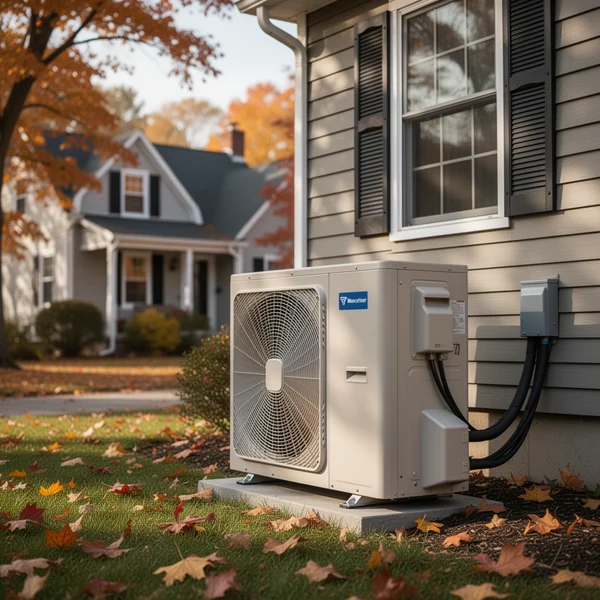
What a heat pump costs in the Hudson Valley is decided by your house, not by your county — duct condition, electrical capacity, how much of the heating load the system is being asked to carry, and whether the crew has to route line sets through 1890s plaster or a 1970s drop ceiling. What is regional is which utility bills you, because that determines which NYS Clean Heat rebate schedule applies to the job and therefore what comes off the price.
Anyone who quotes you a Hudson Valley price without seeing the house is quoting a template. Here is what actually moves the number, and how to find the real rebate for your address instead of taking a salesperson’s word for it.
First: which utility serves you
The Hudson Valley is not one utility territory. Depending on where you sit, your electric account is with Central Hudson (much of Dutchess, Ulster, Orange, Columbia, Greene, Putnam and Sullivan), Orange & Rockland (Rockland and parts of Orange), Con Edison (Westchester), or NYSEG in some outlying areas. All four are sponsoring utilities of NYS Clean Heat, which is run by NYSERDA together with seven utilities — Central Hudson, Con Edison, National Fuel Gas, National Grid, NYSEG, Orange & Rockland and RG&E.
That matters because Clean Heat rebate amounts are not published as a single statewide table. They vary by utility and by equipment type, and they are normally claimed by a participating contractor and shown as a line on your contract rather than filed by you afterwards. The official route to your number is the address-based finder at cleanheat.ny.gov/find-available-rebates. Run it yourself before your first site visit; it takes two minutes and it changes how the rest of the conversation goes.
The federal credits no longer exist
Section 25C, the energy efficient home improvement credit that once covered heat pumps, and Section 25D, the residential clean energy credit, both ended for property placed in service after 31 December 2025. A Poughkeepsie or Kingston household installing in 2026 gets nothing federal — no 30% credit, no $2,000 heat pump credit, nothing.
This is the single most common error in heat pump quotes circulating right now, and it is not a small one. If a proposal shows a “net cost after incentives” that includes a federal line, the headline number on page one is fiction, and you should ask for the whole document to be reissued. New York’s own incentives are unaffected — Clean Heat continues, and for solar the state credit on Form IT-255 is still 25% of system cost capped at $5,000, carried forward up to five years.
What moves the price in a Hudson Valley house
Rather than a made-up range, here is the anatomy of the quote. Every line below is something you can ask about, and the answers explain why two neighbours get very different numbers.
| Line item | What drives it here |
|---|---|
| Equipment and capacity | Output at the local winter design temperature, not at 47°F. The Hudson Valley is meaningfully colder than Long Island; a cold-climate-rated unit is the relevant category. |
| Distribution | Ductless heads, a ducted air handler, or reusing existing ductwork. Reuse is only cheap if the ducts are sized and sealed for the new airflow — often they are not. |
| Number of indoor units | Set by a room-by-room Manual J load calculation and by how the house is divided by doors, not by bedroom count. |
| Electrical work | The most common budget surprise. A 100-amp service, a full panel, or a long run to the outdoor unit adds real cost. Ask whether a service upgrade is assumed or excluded. |
| The old system | Removing an oil tank, abandoning a chimney liner, or keeping a boiler as backup are all separate scopes with separate prices. |
| House construction | Balloon-framed 19th-century farmhouses, stone foundations, plaster-and-lath, and no interior chases make line-set and duct routing slow. Labour hours, not equipment, is where an old Hudson Valley house gets expensive. |
| Whole-home vs partial | A system sized to carry the entire heating load costs more than one that supplements an existing boiler — and may sit in a different rebate category. Ask which classification your quote falls in. |
| Envelope work | Air sealing and insulation are frequently quoted alongside. Done first, they shrink the equipment and can reduce total cost. |
The oil and propane factor
Large parts of Dutchess, Ulster, Columbia, Greene and Sullivan counties are off the natural gas main, so the incumbent system is oil or propane. That changes the economics in your favour compared with a house on cheap piped gas, because delivered fuel prices are volatile and you are paying for delivery as well as fuel. It also changes the scope: an existing oil tank in the basement, or a buried tank in the yard, is a decision in its own right. Decommissioning, removal and any soil questions belong in the quote in writing, not in a handshake.
Historic districts and hamlet review boards
Hudson, Kingston, Rhinebeck, Cold Spring, Beacon and dozens of villages along the river have historic districts or design review. An outdoor condenser on a street-facing elevation can become a review item, and screening or relocation costs money. If your house is in a district, raise it at the first site visit — the placement decision affects line-set length, and line-set length affects both price and performance.
How to get comparable quotes
The reason Hudson Valley homeowners see wildly different prices is usually that they are being quoted different jobs. Force the comparison:
- Give every contractor the same brief: whole-home heating, with the existing system retained or removed (state which), and ask each to price that scope.
- Require the Manual J output as a document — room-by-room loads, and the outdoor design temperature used.
- Require the electrical scope to be explicit: panel and service size found on site, whether a subpanel or service upgrade is included or excluded, and who pulls the permit.
- Require the Clean Heat rebate to appear as a named line with the sponsoring utility named, and check it against the finder result for your address.
- Reject any quote containing a 2026 federal tax credit.
Three quotes built to that brief are comparable. Three quotes gathered casually are not, and the cheapest of them is usually cheapest because something is missing.
Financing, if the price is the obstacle
NYSERDA runs financing options for residential energy work, including an on-bill recovery structure where the loan payment appears on your utility bill — the mechanism is explained in the site’s guide to the NYSERDA On-Bill Recovery Loan. Terms, rates and eligibility change, so confirm current details with NYSERDA (1-866-NYSERDA) rather than with a contractor’s finance partner, and compare against a straightforward home equity option before signing anything a salesperson brings to your kitchen table.
What to do next
- Confirm which utility your electric account is with, then run your address through the Clean Heat rebate finder and screenshot the result.
- Photograph your electrical panel — the main breaker rating and the empty spaces — and send it with your enquiry. It removes the biggest source of quote variance immediately.
- Book three site visits with contractors on NYSERDA’s participating list, using the same written scope for each. The vetting logic in what a NYSERDA-qualified contractor actually is applies directly here.
- Ask for envelope work — air sealing and attic insulation — to be quoted as a separate line, and get it done first if the house is leaky.
- If you are in a historic or design-review district, contact the village or town clerk about condenser placement before the design is finalised.
- For the wider picture of what the state still funds, start with the site’s overview of New York renewable energy incentives beyond solar, and the county pages for Dutchess and Ulster.
NY Solar Incentives
Independent New York solar research. We summarise NYSERDA, NY-Sun and federal programme rules from published sources and state plainly when a figure is an estimate. We are not a government agency and do not sell equipment.
Run the arithmetic on your own system
Check the dated program table and your arrangement before counting an incentive. Standard residential NY-Sun blocks are closed; Long Island Affordable Solar has a conditional income-verification route. The NY credit depends on qualified costs and tax liability, while the NYC abatement reduces future property-tax bills. The estimator keeps those timings separate.