The Load Calculation That Decides Your Electrification Plan
Two documents share the name load calculation and decide different things. Knowing which one you have — and which utility data gets you out of a service upgrade — changes the whole budget.
On this page 6 sections
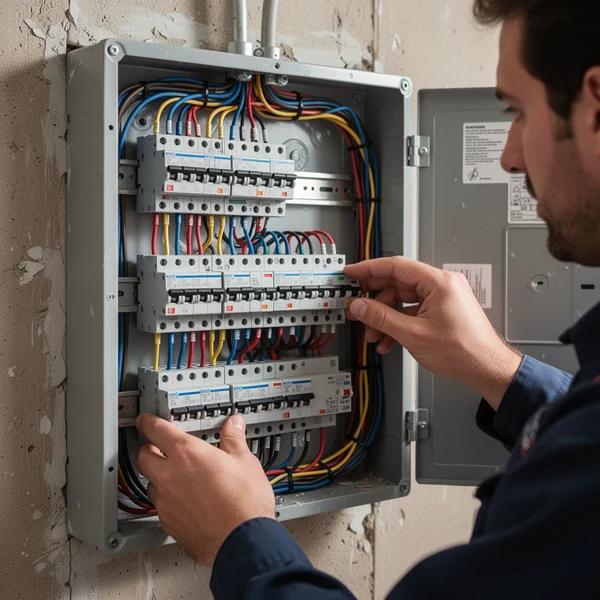
There are two documents called a “load calculation” and they decide completely different things about your house. One sizes the heat pump in BTUs; the other decides whether your electrical service can carry it in amps — and in a New York electrification plan the second one is what turns a straightforward job into a five-figure one, because it is the one that ends with the words “you need a service upgrade.”
Contractors use the same phrase for both. Homeowners hear it once and assume it was done. Knowing which calculation you have in your hand, and which one you are still missing, is the highest-value hour you can spend before signing anything.
The two load calculations, side by side
| Heating and cooling load | Electrical service load | |
|---|---|---|
| Also called | Manual J, heat loss calc, room-by-room | NEC Article 220 calculation, service load calc |
| Answers | How many BTUs does this house lose at design temperature? | How many amps will this house draw, and does the service cover it? |
| Produced by | The HVAC contractor | The electrician, sometimes the utility |
| Decides | Equipment size, number of heads, duct or ductless | 100A vs 200A service, panel replacement, load management |
| What goes wrong | Oversizing, so the unit short-cycles all shoulder season | A default assumption that you “need 200 amps,” priced without checking |
Manual J: the number that sizes the equipment
A real Manual J is room by room. It takes your actual wall assemblies, window areas and orientations, ceiling heights, infiltration rate and the outdoor design temperature for your location, and returns a heating load and a cooling load in BTU per hour. It is not the square footage times a number off a chart, and it is not the size of the furnace you are replacing.
New York spans a genuinely wide range here. The winter design temperature used to size equipment in Plattsburgh or Old Forge is nothing like the one used in Islip, and a Buffalo house also has a lake-effect wind exposure that a sheltered Hudson Valley house does not. Any contractor sizing off a national rule of thumb is guessing in one direction or the other, and in practice they guess large, because an undersized system generates complaints and an oversized one only generates short cycling that nobody blames on them.
Two things shrink the Manual J number before you buy anything, and both are worth doing first:
- Air sealing. Infiltration is a direct input. Sealing the attic plane and the basement band joist genuinely moves the calculated load, which means smaller equipment, smaller electrical draw, and a smaller service question.
- An energy assessment with a blower door. It replaces the assumed infiltration rate with a measured one. A calculation built on a measurement beats a calculation built on a default every time.
The order matters. Do the shell work, then the Manual J, then buy equipment. Doing it in the other order means you pay for capacity you then spend money making unnecessary.
The electrical load calculation that decides your New York electrification plan
This is the one that gets skipped. Article 220 of the National Electrical Code gives more than one method, and which method your electrician uses can be the difference between an afternoon of work and a service upgrade that involves the utility, the town and a trench.
The standard method, and why it fails older houses
The conventional calculation adds up the house’s connected loads on paper — general lighting by square footage, appliance circuits, the largest of heating or cooling, then the new heat pump and the new EV charger — and applies code demand factors. It is conservative by design. Run against a 1950s Levittown cape or a Buffalo double with a 100-amp service, it very often produces a number over 100 amps, and the answer comes back “upgrade to 200.”
The method built for existing houses
The code also allows an existing dwelling to be calculated from what it has actually drawn. Instead of adding up nameplate ratings, the electrician takes the maximum recorded demand over the past twelve months, applies the code’s factor to it, and adds the new load. Because a real house never draws all its nameplate at once, this method very frequently shows that an existing 100-amp service has room for a cold-climate heat pump, an EV charger, or sometimes both.
The input it needs is your own utility interval data. Con Edison, National Grid, NYSEG, RG&E, Central Hudson, Orange & Rockland and PSEG Long Island all hold your usage history, and residential customers can request it — through the online account or by calling and asking specifically for interval or demand data rather than a bill summary. If you have a smart meter, that data exists. Ask for twelve months, including the previous winter, and hand it to the electrician before they price the job.
This single request is the step most likely to show that your existing service is already adequate, and it is free to ask for.
When the answer really is “upgrade”
Sometimes it is. A house with electric resistance backup, a well pump, a hot tub and two EVs on a 100-amp service is genuinely at the limit. In that case the calculation is still worth having, because the alternative is not only a bigger service — code also recognises energy management systems that limit total draw, letting a charger back off while the heat pump runs. Those devices are cheaper than a trench across a Westchester driveway, and an electrician who has never proposed one may simply not use them.
Sequencing an electrification plan around the two numbers
- Book an energy assessment and get a blower door number.
- Do the air sealing and insulation the assessment identifies.
- Get a room-by-room Manual J against your local design temperature, from that post-work house.
- Take the resulting equipment nameplate to an electrician and ask for an Article 220 calculation using twelve months of utility interval data.
- Only then decide between a service upgrade, a load management device, or nothing.
- Run your address through the NYS Clean Heat finder to see what the rebate actually is on the equipment you have now specified.
What this costs, and what 2026 does not give you
Be clear-eyed about the money. Both federal residential credits are gone for 2026. Section 25C, which used to cover part of an insulation, air sealing, panel or heat pump job, and Section 25D, the residential clean energy credit, both ended for property placed in service after 31 December 2025. A New York household electrifying this year gets nothing federal, and any calculator still subtracting 30% is describing a closed programme.
What remains is state and utility. NYS Clean Heat is NYSERDA plus seven sponsoring utilities — Central Hudson, Con Edison, National Fuel Gas, National Grid, NYSEG, Orange & Rockland and RG&E. PSEG Long Island is not a Clean Heat sponsor and runs its own programmes. Rebate amounts are not published as one statewide table; the address-based finder at cleanheat.ny.gov is the only source that will be right for your utility. NYSERDA also runs income-qualified support through EmPower+ and financing through the On-Bill Recovery Loan, which repays through the utility bill rather than a separate lender — useful precisely when the electrical work is the expensive part.
If solar is part of the same plan, note that it runs on a different track: New York’s Form IT-255 credit, 25% of system cost capped at $5,000, is still available in 2026 and carries forward five years. And if an EV charger is in the plan, the panel conversation and the array conversation are the same conversation — see EV charging and solar panels in New York.
What to do next
- Log into your utility account today and request twelve months of interval or demand data. Put the previous winter in the range.
- Photograph the label inside your panel door and the main breaker rating. That tells the electrician your service size in ten seconds.
- When you take HVAC quotes, ask for the Manual J output sheet, not a verbal size. If a contractor will not produce one, that answers a different question.
- Ask your electrician in writing whether they used the standard method or the existing-dwelling maximum-demand method, and to show both.
- Ask specifically whether a load management device would avoid the service upgrade, and get that priced as an alternative line.
- Run the Clean Heat finder for your address before you sign, so the rebate is a known deduction rather than a hope.
NY Solar Incentives
Independent New York solar research. We summarise NYSERDA, NY-Sun and federal programme rules from published sources and state plainly when a figure is an estimate. We are not a government agency and do not sell equipment.
Run the arithmetic on your own system
Check the dated program table and your arrangement before counting an incentive. Standard residential NY-Sun blocks are closed; Long Island Affordable Solar has a conditional income-verification route. The NY credit depends on qualified costs and tax liability, while the NYC abatement reduces future property-tax bills. The estimator keeps those timings separate.