Leaving Propane for a Heat Pump in Upstate New York
Switching from propane to a heat pump upstate is the strongest fuel-switch case in New York. The hard part is the leased tank, the balance point, and the panel.
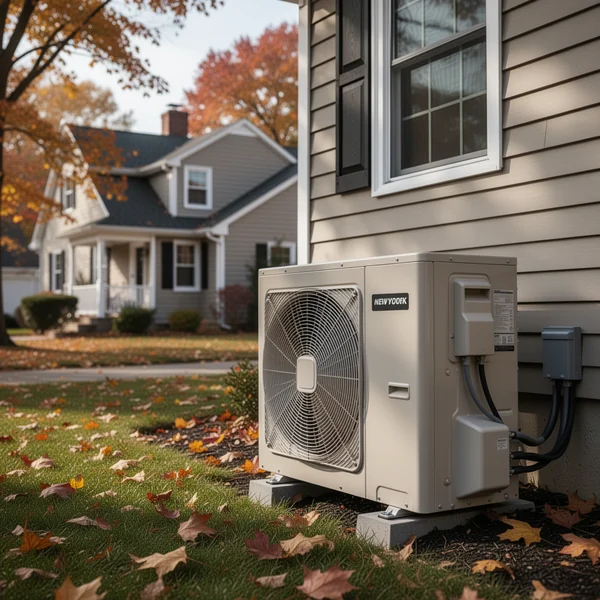
Going from propane to a heat pump in New York is usually the strongest fuel-switch case in the state, because propane is the one heating fuel with no regulated delivery rate and no price you can look up in advance. The catch is not the heat pump — cold-climate equipment handles an upstate winter — it is the tank on the side of your house and the contract attached to it.
Propane is what you burn when there is no gas main on your road. That describes a large share of Delaware, Otsego, Schoharie, Greene, Sullivan, Lewis, Hamilton and Essex counties, and plenty of the rural townships in St. Lawrence, Chenango and Allegany. If you are reading this from a house with a 500-gallon tank behind the garage, none of the “switch from gas” advice written for Long Island applies to you.
Why the propane-to-heat-pump case is different
Utility gas and electricity are delivered under rates filed with the Public Service Commission. You can read them. Propane is a retail commodity. Your price per gallon is whatever your supplier charges you, and it is genuinely personal — it moves with your tank ownership, your contract type, your annual volume, how far the truck drives, and how tight the market is in February.
That has one important consequence for anyone comparing running costs: do not compare a heat pump against a statewide average propane price. Compare it against your own delivery invoices from the last two winters. Pull them out, add the gallons, add the dollars, divide. That is your real number, and it is the only one worth putting in a spreadsheet.
To convert that into something comparable, you need three inputs: your delivered price per gallon, your furnace or boiler’s AFUE rating (it is on the yellow label or the data plate), and the energy content of propane — roughly 91,500 BTU per gallon, the figure the U.S. Energy Information Administration publishes. Against that, put your electric supply plus delivery rate per kWh from an actual bill, not the supply rate alone, and the heat pump’s seasonal efficiency. Anyone who runs that comparison using only the supply half of the electric bill will get an answer that is far too flattering.
The tank is the part that surprises people
In most upstate propane arrangements the tank does not belong to you. It is leased from, or provided by, the supplier — which is precisely why switching suppliers is hard and why leaving propane entirely takes a phone call you should make before you order equipment.
Work through these before install day:
- Who owns the tank? Check the contract, not the tank. If it is leased, ask what the termination terms are, whether there is a removal fee, and how much notice they need.
- What happens to the gas still in it? Suppliers differ on whether they buy back remaining product and at what price. Ask in writing.
- Are you leaving propane entirely, or partly? Many upstate households keep propane for a cooking range, a generator, a fireplace insert or a garage heater. If you keep any of those, you keep the tank, the lease and the minimum-delivery arithmetic — and a small annual volume often carries a worse per-gallon price than a large one.
- Is the tank underground? Removing a buried tank is a different job from picking up an above-ground one, and it is not something to discover in November.
Cold-climate performance, honestly
A modern cold-climate air source heat pump is not the equipment your neighbour installed in 2009. Inverter-driven systems rated for cold climates hold useful capacity well below freezing, and in most of upstate New York a properly sized system carries the house through the great majority of the heating season on its own.
What matters is the design temperature for your specific location, not for “upstate.” Saranac Lake is not Poughkeepsie. Old Forge is not Ithaca. Your contractor should be sizing against the published 99% winter design temperature for the nearest weather station, and you should ask to see which station they used. Getting that wrong by ten degrees changes the equipment selection.
The second number to ask for is the balance point — the outdoor temperature at which the heat pump’s output stops covering the house’s heat loss. Below that, something else has to make up the difference: electric resistance backup built into the air handler, or your existing propane furnace kept as a dual-fuel backup. Both are legitimate. Which one is cheaper depends on your propane price and your electric rate, and on how many hours a year your county actually spends below the balance point.
Should you keep the propane furnace?
In rural New York there is an argument for keeping it that has nothing to do with economics: outages. Ice storms take down rural distribution lines for days. A propane furnace with a battery or generator backup for the blower will heat a house when the grid is down; a heat pump will not, unless you have generation and storage sized for it. Households on long single-phase spurs in the Catskills or the Tug Hill region weigh that differently from households in a village centre.
If you keep it, ask the contractor to wire it as a true dual-fuel setup with an outdoor thermostat and a switchover point you can adjust, rather than leaving two systems fighting each other.
The money: state and utility only
There is no federal credit for a 2026 install. Section 25C, the credit that carried a $2,000 annual cap for heat pumps and heat pump water heaters, was allowed for property placed in service before 31 December 2025. Section 25D, the 30% credit that covered geothermal and solar, terminated for expenditures after the same date. A New York household installing this year gets nothing federal, and any proposal showing a 30% federal line against a 2026 date is wrong. We cover the equivalent change on the solar side in The Federal Solar Tax Credit and New York: What Changed.
What remains is the state layer, and for a propane household it is the whole story:
- NYS Clean Heat. Administered by NYSERDA with seven sponsoring utilities — Central Hudson, Con Edison, National Fuel Gas, National Grid, NYSEG, Orange & Rockland and RG&E. Most upstate propane households sit in NYSEG or National Grid territory, but do not assume: check your address at cleanheat.ny.gov/find-available-rebates. Amounts are not published as one statewide table, and the rebate is claimed by a participating contractor and taken off your invoice.
- NYSERDA financing. The On-Bill Recovery loan repays through your electric bill, which is a useful structure when the whole point is that your energy spend is moving from a propane truck to that bill.
- Income-qualified help. EmPower+ exists and changes; call NYSERDA on 1-866-NYSERDA rather than relying on a third-party summary of the thresholds.
- Solar, if the roof or the land suits it. New York’s Form IT-255 credit is still alive at 25% of system cost capped at $5,000, carried forward up to five years, claimed for the tax year you get Permission to Operate. Rural upstate lots often have the ground space that Westchester does not. See New York State Renewable Energy Incentives Beyond Solar.
The electrical panel question
A propane house that has never had central air often has a 100-amp service and a full panel. Adding a heat pump — and possibly an electric water heater and a car charger behind it — may need a load calculation, a subpanel, or a service upgrade. Have the electrician do a proper calculation rather than eyeballing the breaker spaces, and get that answer before you sign the HVAC contract, because a service upgrade can be a meaningful share of the project cost and it is not covered by the heat pump rebate.
What to do next
- Pull your last two winters of propane invoices and work out your actual delivered cost per gallon and gallons per year.
- Find your tank contract and call the supplier to ask about removal terms and buy-back of remaining gas. Do this first — it is the item most likely to delay everything else.
- Check your address at the Clean Heat finder and note your sponsoring utility.
- Get three quotes from contractors enrolled with that sponsor, each including a Manual J load calculation, the weather station used, the design temperature, and a stated balance point.
- Ask an electrician for a load calculation on your existing service before you commit to equipment.
- Decide deliberately whether the propane furnace stays as outage insurance, and if it does, have it wired as proper dual fuel.
NY Solar Incentives
Independent New York solar research. We summarise NYSERDA, NY-Sun and federal programme rules from published sources and state plainly when a figure is an estimate. We are not a government agency and do not sell equipment.
Run the arithmetic on your own system
Check the dated program table and your arrangement before counting an incentive. Standard residential NY-Sun blocks are closed; Long Island Affordable Solar has a conditional income-verification route. The NY credit depends on qualified costs and tax liability, while the NYC abatement reduces future property-tax bills. The estimator keeps those timings separate.