NYC Property Tax Credit vs Abatement for Solar
A property tax credit, an abatement and an exemption are three different mechanisms, and only two are relevant to a New York City solar installation's property tax. Neither of them is a credit.
On this page 9 sections
- 01What the three terms actually mean
- 02Why New York City uses an abatement
- 03The state credit and historical federal claims
- 04The exemption most people never notice
- 05The abatement has its own deadline
- 06The timing difference that matters most
- 07How a small tax bill can waste an abatement
- 08Co-ops, condos and shared buildings
- 09Frequently asked questions
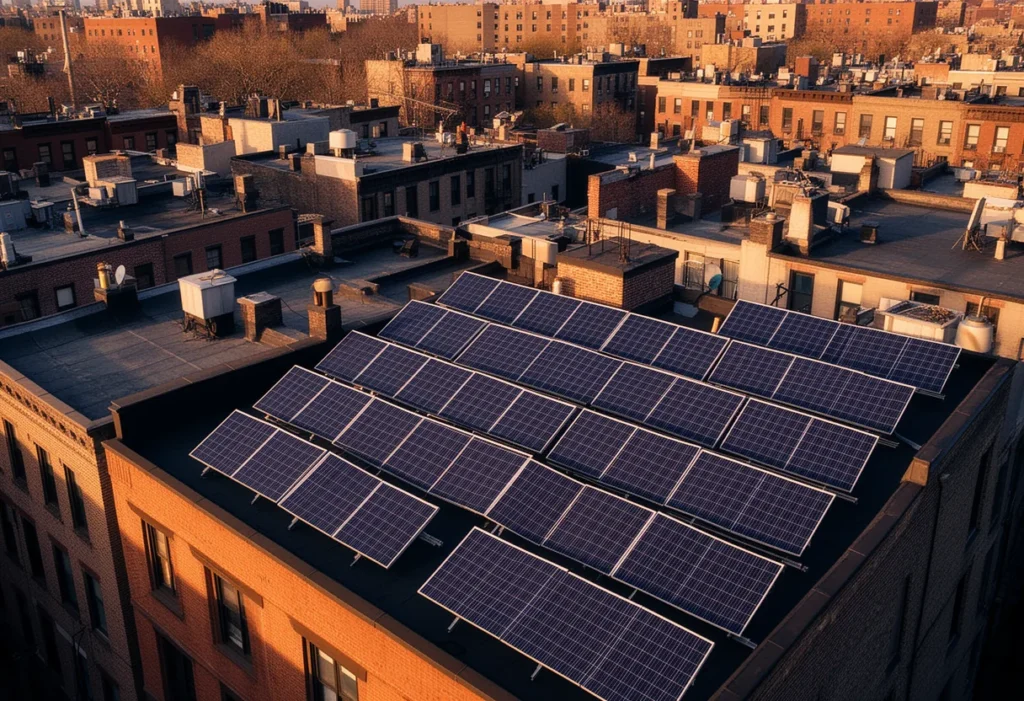
If you are looking for an NYC property tax benefit for solar, the city’s SEGS programme is an abatement, not the New York State income-tax credit. The distinction determines who applies, which bill is reduced, and how annual tax caps can limit the benefit.
A credit, an abatement and an exemption are different mechanisms. For a New York City solar installation, the state income-tax credit, the city SEGS property-tax abatement and the separate clean-energy property-tax exemption each have their own rules. Do not treat them as interchangeable or automatically available together.
What the three terms actually mean
A credit reduces tax under the applicable return calculation. An abatement reduces property tax for a defined period. An exemption excludes qualifying value from taxation when the taxable assessment is worked out; it does not necessarily stop the assessor from recording an increase in market or assessed value.
They arrive differently. A credit shows up when you file. An abatement shows up on a property tax bill. An exemption shows up in the assessment, one step further upstream, and is often invisible unless you compare assessed values year to year.
The confusion is understandable because all three reduce what you pay. The mechanics, the applications and the risks are not interchangeable.
| Mechanism | What it does | Solar example and limitations |
|---|---|---|
| Credit | Reduces available tax liability under return rules | NY State IT-255 purchase credit: 25% of eligible expenditures up to $5,000; nonrefundable with next-five-tax-years carryforward |
| Abatement | Reduces eligible property tax for four tax years | NYC SEGS: 7.5% of eligible cost per year, capped at $62,500 and eligible annual property tax; no annual carryover |
| Exemption | Excludes qualifying added value from taxation | RPTL 487 clean-energy exemption: generally 15 years for eligible added value, with a separate application and applicable local rules |
Why New York City uses an abatement
The SEGS abatement is approved by DOB and applied by DOF. For qualifying systems placed in service on or after 1 January 2024 and before 1 January 2035, each of four annual abatements is the smallest of 7.5% of eligible expenditures, $62,500, or eligible property tax payable for that year. See NYC Department of Finance guidance and Real Property Tax Law section 499-BBBB. A potential 30% four-year total is not an upfront cash payment or a guaranteed saving.
The SEGS abatement does not use household income-tax liability. It uses the eligible building’s property-tax amount, among other property and installation conditions. Different property taxes or eligibility can therefore produce different benefits even where installed costs are identical.
The benefit is applied to the property-tax account rather than carried with a seller to another home. The application process is covered in the abatement filing guide, and current rates, eligible costs and conditions in the abatement overview. Confirm any remaining approved benefit and continuing conditions with DOF during a sale.
The state credit and historical federal claims
The federal household section 25D credit ended for expenditures made after 31 December 2025. The IRS timing FAQ (questions 1 and 7) says a normal equipment expenditure is treated as made when original installation is completed; for construction or reconstruction of a structure, the taxpayer’s original-use date applies. A 2025 deposit does not preserve a credit for an installation completed in 2026. A utility switch-on date alone does not settle the tax-year question.
For a qualifying purchase, the state income-tax credit on Form IT-255 is 25% of eligible expenditures up to $5,000. It requires a New York principal residence and qualifying equipment; electricity-generating systems also have connection and net-metering conditions. It is limited by available tax liability, with unused amounts carried to the next five tax years. Tax liability is not the same as the balance due after withholding. The official Form IT-255 instructions separately permits qualifying written leases and PPAs of at least ten years under payment-based rules; this page does not automate those calculations. A provider’s possible business credit is not one you are claiming. An eligible 2025 household claim and unused federal carryforward are explained on the federal credit page.
The exemption most people never notice
The separate DOF Clean Energy Systems Exemption describes a 15-year exemption for the increase in value attributable to an eligible energy system. It operates under RPTL 487, not the SEGS abatement rules. The statewide exemption is subject to applicable local rules; it does not guarantee that every property charge disappears or that every project qualifies.
An exemption can exclude eligible added value from property-tax calculations without freezing the property’s entire assessment. DOF describes a separate process involving notices and an RP-487 application, submitted on or before 5 January for the following tax year’s effective date. This is a different deadline from the SEGS abatement. Confirm the application and any applicable conditions with DOF before assuming it is already on your account.
Confirm which mechanisms apply to your property
An abatement and an exemption are different benefits with different applications; a property may have one, both or neither. The Department of Finance is the right office to confirm what is on your account. Do not infer your position from a neighbour’s bill in a different class of building.
The abatement has its own deadline
The SEGS service window runs from 1 January 2024 through 31 December 2034. Eligible classes are 1, 2 and 4. DOF identifies incompatible benefits including ICAP, 421-a, 421-b, 421-g and PILOT; the statute also has restrictions for specified municipal charges in arrears. An owner or condominium/co-op board applies, and each property must meet the actual conditions. See NYC Department of Finance guidance and Real Property Tax Law section 499-CCCC.
Coordinate the application with the DOB job and final cost records. Under DOB rule 1 RCNY 105-02(e)(5), the solar abatement application must be submitted with job sign-off; a missing application at sign-off is denied. The request must be filed by 15 March before the tax year beginning 1 July for which the benefit is sought. The statutory final application boundary is before 1 January 2036, which does not extend the service window past 2034. See Real Property Tax Law section 499-CCCC.
The timing difference that matters most
The NY State income-tax credit is claimed on a return, and the amount used depends on available tax liability. An unused part may be used in the next five tax years if sufficient liability exists; it is not guaranteed cash when the installation is purchased. The NYC abatement is applied to the property-tax account after DOB approval.
The SEGS abatement begins on 1 July following DOB approval and runs for four tax years, subject to annual caps and continuing eligibility. The state credit follows its own return and carryforward rules. A qualifying buyer may receive both, but neither benefit establishes eligibility for the other.
How a small tax bill can waste an abatement
In any year, the SEGS abatement cannot exceed eligible property tax payable or the $62,500 cap. An unused portion of the 7.5% calculation is neither paid out nor banked for a later year.
A low eligible annual property-tax amount can limit the SEGS benefit. This differs from the NY IT-255 credit’s next-five-tax-years carryforward; not every income-tax credit has a carryforward. Review the current eligible tax and approval, rather than assuming a quoted maximum will be usable.
Look at last year’s bill first
Review your property-tax bill, approved benefits and expected eligible annual tax with the installer and DOF. Ask for the annual 7.5% calculation and both caps. A recent bill helps estimate the benefit, but cannot by itself prove eligibility or future tax amounts.
Cost base and an illustrative annual cap
NYC eligible solar expenditures exclude financing charges and grants or cash rebates, including NYSERDA grants. The DOB solar FAQ says not to subtract other tax credits, abatements, exemptions or tax rebates as though they were grants. Avoid subtracting a grant twice from an already net eligible cost.
Assume $20,100 of fully eligible cost after any required grant adjustment, an eligible service date and an otherwise qualifying property. The annual 7.5% amount is $1,507.50. If eligible annual property tax is $1,000, that year’s benefit is $1,000 and the remaining $507.50 cannot carry to another year. Do not subtract the NY State income-tax credit from that NYC cost base. All eligibility and tax amounts here are assumptions, not a determination for an actual property.
Co-ops, condos and shared buildings
The building owner or condominium/co-op board applies; unit owners do not submit individual income-tax claims for the SEGS abatement. For a condominium, Real Property Tax Law section 499-BBBB apportions the benefit among condominium tax lots. For a co-op, ask the board how a building-level property-tax benefit affects its accounts and occupants.
The board or managing agent can explain the application and building arrangements, while DOF can confirm approved property-tax treatment. These are different questions. Owners without suitable roof rights can also review community solar, which normally provides electricity-bill credits from an off-site project rather than this property-tax abatement.
Frequently asked questions
Is there an NYC property tax credit for solar?
The city’s SEGS solar benefit is a property-tax abatement, approved by DOB and applied by DOF. For the current service window, it is up to 7.5% of eligible cost annually for four years, limited by the annual $62,500 and property-tax caps. The NY State IT-255 income-tax credit and RPTL 487 exemption are separate benefits.
Can I still claim a federal tax credit as well?
A new installation expenditure treated as made in 2026 does not earn household section 25D. A qualifying 2025 claim and its unused carryforward are different cases, as described in the final 2025 Form 5695 instructions. A provider may qualify for a separate business credit, but that is neither your household credit nor a guaranteed price reduction.
Will installing solar increase my property assessment?
The recorded assessment can change. An approved RPTL 487 exemption can exclude eligible added value from taxation for 15 years, subject to its conditions; it does not freeze the whole assessment or guarantee every property charge stays unchanged. Check DOF’s Clean Energy Systems Exemption instructions and the status of your separate RP-487 application.
What happens if my property tax bill is smaller than the abatement instalment?
The SEGS benefit is capped by eligible annual property tax and $62,500. The unused part of that year’s calculation is not refunded or carried forward. By contrast, the NY IT-255 credit permits unused amounts to carry to the next five tax years; that is a specific rule of that credit, not a rule for all credits.
Can I get both the city abatement and the state credit?
Potentially, if both sets of conditions are met. The NYC abatement requires a qualifying property, cost base, service date and DOB approval; the state credit requires its own principal-residence, equipment and tax rules. The NY State tax credit is not subtracted from NYC eligible expenditures under the DOB solar FAQ, while grant-funded costs must be treated correctly. Different applications and benefit schedules still apply.
Verify with the administering office
Official-source check: 7 October 2026. Confirm the SEGS abatement through DOB and DOF, the separate exemption through DOF’s RP-487 instructions, and the state credit using the final form for the return year. These are separate deadlines and eligibility tests. No professional tax review of this article is claimed.
This article is general information, not tax, legal or financial advice. Incentive amounts, eligibility rules and deadlines change and depend on your utility, your tax situation and your property. Confirm current terms with NYSERDA, your utility and a qualified tax professional before making a decision.
NY Solar Incentives
Independent New York solar research. We summarise NYSERDA, NY-Sun and federal programme rules from published sources and state plainly when a figure is an estimate. We are not a government agency and do not sell equipment.
Run the arithmetic on your own system
Check the dated program table and your arrangement before counting an incentive. Standard residential NY-Sun blocks are closed; Long Island Affordable Solar has a conditional income-verification route. The NY credit depends on qualified costs and tax liability, while the NYC abatement reduces future property-tax bills. The estimator keeps those timings separate.