The Federal Heat Pump Credit Ended. What New York Still Pays.
Both federal credits ended for property placed in service after 31 December 2025, so a 2026 New York heat pump gets nothing federal. Here is what still pays.
On this page 7 sections
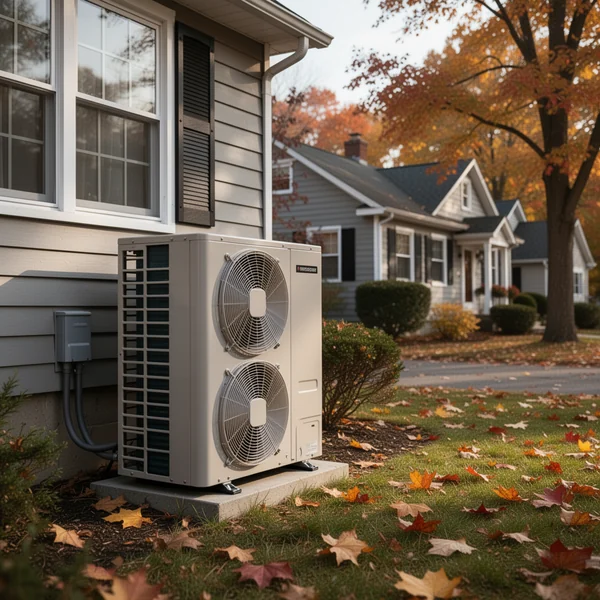
The federal heat pump tax credit ended for equipment placed in service after 31 December 2025, which means a New York household installing a heat pump in 2026 gets nothing from the IRS. What is still on the table is state and utility money: NYS Clean Heat through one of seven sponsoring utilities, NYSERDA’s income-qualified programmes, and low-interest financing — none of which is a tax credit, and all of which works differently from the credit people are still being quoted.
That distinction matters because a lot of contractor paperwork, manufacturer marketing and older blog copy has not caught up. If a quote you are holding shows a “30% federal credit” or a “$2,000 federal rebate” line against a 2026 installation, that line is wrong and the bottom number under it is wrong too.
What exactly ended, and on what date
Two separate federal credits are involved, and they are routinely confused.
- Section 25C, the Energy Efficient Home Improvement Credit. This is the one that covered air-source heat pumps, heat pump water heaters, insulation, windows, doors and biomass stoves. The IRS states the credit applies to qualifying property placed in service on or after 1 January 2023 and before 31 December 2025, and that improvements can be claimed through 31 December 2025. While it existed it was capped annually — $2,000 for heat pumps, heat pump water heaters, biomass stoves and boilers, and $1,200 for the general envelope bucket (with $600 for windows and $500 total for doors, $250 per door). There was no lifetime cap, which is why it was worth staging work across tax years. That planning is now moot.
- Section 25D, the Residential Clean Energy Credit. This is the 30% credit that covered solar, batteries and ground-source (geothermal) heat pumps. It terminated for expenditures after 31 December 2025.
So both doors closed on the same date. Air-source heat pump, ducted or ductless: nothing federal in 2026. Geothermal: nothing federal in 2026 either, which surprises people who assume geothermal was treated more generously and therefore survived.
One thing that is not lost: if your equipment was placed in service during 2025, you claim it on your 2025 return, which you file in 2026, on IRS Form 5695. Filing in 2026 for a 2025 install is normal and fine. The test is the date the equipment went into service, not the date you file. If your installer commissioned the system in late December 2025 but did not invoice until January, dig out the commissioning paperwork before you let anyone tell you it is too late.
The federal heat pump tax credit ended — here is what it does to a New York quote
Practically, it removes a fixed subtraction from the end of the estimate and leaves a variable one in its place. The federal credit was predictable: hit the equipment criteria, have the tax liability, subtract up to $2,000. New York’s remaining support is neither flat nor uniform. It depends on which utility delivers your energy, what equipment you install, whether the heat pump displaces your fossil heating entirely or only partly, and whether your installer is enrolled in the programme.
It also changes who gets the money first. A tax credit arrived months later, after you filed. The main New York incentive is claimed by the contractor and shows up as a discount on your invoice, so you never front it. That is better for cash flow and worse for comparison shopping, because two quotes can show wildly different “after incentive” numbers simply because one contractor is enrolled in the programme and the other is not.
NYS Clean Heat: the seven utilities that still pay
NYS Clean Heat is administered by NYSERDA together with seven sponsoring utilities: Central Hudson, Con Edison, National Fuel Gas, National Grid, NYSEG, Orange & Rockland and RG&E. If one of those delivers your gas or electricity, there is a heat pump incentive attached to your address.
Three things about it are worth knowing before you call anyone:
- There is no single statewide rebate table. Each sponsoring utility runs its own incentive schedule, and amounts vary by utility and equipment type. Anyone quoting you one universal per-ton figure for “New York” is guessing. The official route is the address-based finder at cleanheat.ny.gov/find-available-rebates, which resolves your street address to the sponsor that actually serves it.
- You have to use a participating contractor. The rebate is processed by the installer, not by you, and an excellent HVAC company that never enrolled cannot get you the money afterwards.
- Whole-home displacement is treated differently from partial. Leaving the gas furnace as the primary heat and adding two ductless heads for the back bedrooms is a different category from removing fossil heating as the main system. Ask which category your design falls into before you sign, because it moves the number.
Note also that some New York households buy electricity from a municipal utility rather than one of the seven — village and city systems in places like Rockville Centre, Freeport, Fairport, Jamestown and Massena. Those customers sit outside Clean Heat entirely and need to ask their own utility what it runs.
If you are on Long Island
PSEG Long Island is not a NYS Clean Heat sponsor. It operates the LIPA system in Nassau, Suffolk and the Rockaways, and it runs its own separate efficiency and heat pump programmes with their own rules and their own qualifying equipment lists. A Levittown Cape and a house twenty minutes away in Queens are on different programmes with different paperwork, which is exactly the kind of thing that gets lost in national how-to articles. The same split shows up in solar; our page on the PSEG Long Island solar rebate walks through how that utility’s incentive structure differs from the upstate pattern.
NYSERDA money that is not a tax credit
Two NYSERDA routes matter for heat pumps in 2026.
EmPower+ is the income-qualified programme. It is the largest single lever available to households that qualify, and the qualification thresholds and funding levels change — so rather than repeating a stale number, call NYSERDA on 1-866-NYSERDA or check the live programme page before assuming you are or are not eligible. A surprising number of households assume they earn too much and never check.
Financing is the other half. Where a tax credit used to shave the total, financing changes the monthly, and NYSERDA’s on-bill option lets the payment ride on your utility bill instead of a separate loan account — see how the NYSERDA on-bill recovery loan works. It is worth pricing that against a contractor’s own finance partner, which is often more expensive and rarely presented as a comparison.
The New York tax credit that did not end
New York’s own solar credit survives and is untouched by the federal expiry. Form IT-255, the Claim for Solar Energy System Equipment Credit, is worth 25% of the system cost capped at $5,000, carries forward up to five years if your liability is too small to absorb it in one go, and applies to leased as well as purchased systems. It is claimed for the tax year in which the utility grants Permission to Operate, not the year the panels went on the roof. Our walkthrough of Form IT-255 and how to claim it covers the timing trap in detail.
Be clear about the boundary, though: IT-255 is for solar energy system equipment. It does not cover an air-source heat pump. New York treats geothermal separately again, under its own state credit with its own form — look it up on tax.ny.gov rather than assuming IT-255 stretches to cover a ground loop. And for the full picture of what New York still funds after the federal changes, our overview of NYSERDA incentives still available in 2026 is the place to start.
What to do next
- Put your street address into the Clean Heat rebate finder and write down which of the seven utilities it names as your sponsor. On Long Island, go to PSEG Long Island’s own programme pages instead.
- Ask every contractor you call one question first: “Are you a participating contractor with my Clean Heat sponsor?” If the answer is no, the rest of the quote does not matter.
- If a 2026 quote shows any federal credit line, ask the contractor to reissue it without that line, then re-rank your quotes. The ordering often changes.
- If you had equipment placed in service in 2025, find the commissioning date and give it to whoever prepares your return, with Form 5695 in mind.
- Before you commit, get the load calculation (an ACCA Manual J, not a rule of thumb per square foot) in writing. An oversized heat pump costs more, runs worse and does not earn a bigger rebate.
NY Solar Incentives
Independent New York solar research. We summarise NYSERDA, NY-Sun and federal programme rules from published sources and state plainly when a figure is an estimate. We are not a government agency and do not sell equipment.
Run the arithmetic on your own system
Check the dated program table and your arrangement before counting an incentive. Standard residential NY-Sun blocks are closed; Long Island Affordable Solar has a conditional income-verification route. The NY credit depends on qualified costs and tax liability, while the NYC abatement reduces future property-tax bills. The estimator keeps those timings separate.