Solar Panel Cost in Corning, NY: What the Valley Adds
In Corning the valley itself is a cost item. Where the equipment may be mounted, and how much sky the ridges leave you, both show up in the price.
On this page 7 sections
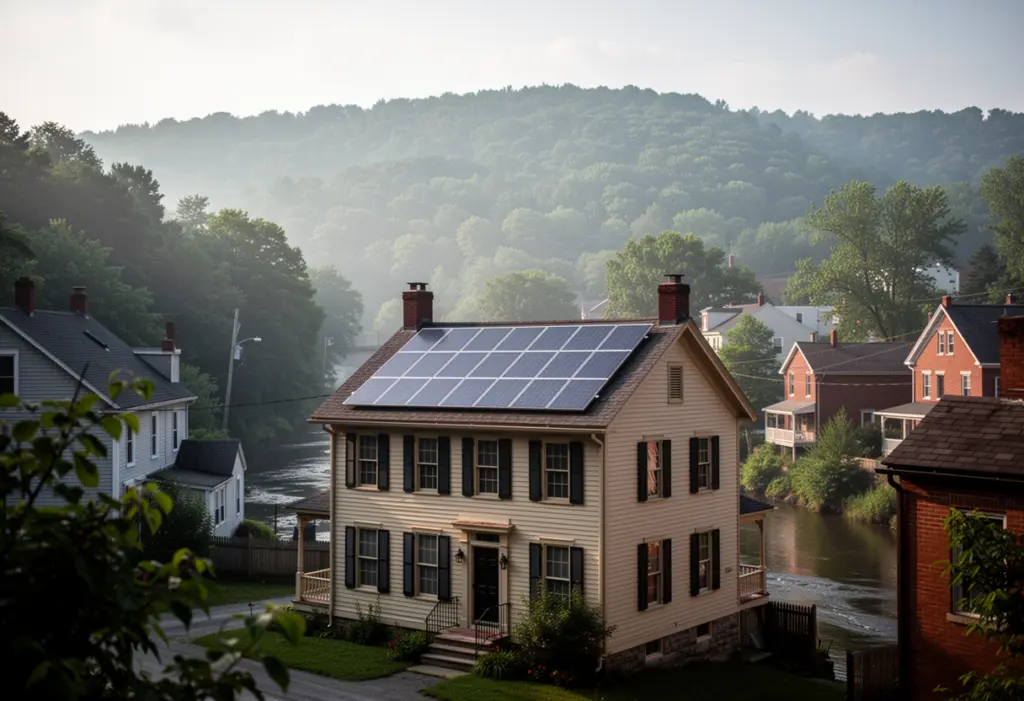
Corning sits on the Chemung River between wooded slopes, and the valley is not scenery as far as a solar quote is concerned — it is a cost input. Where the electrical equipment may legally be mounted, how much southern sky the ridge leaves you, and which utility bills the account all change the number at the bottom of the page. Add the higher NYSEG capacity charge and the Southern Tier arithmetic is genuinely different from the Buffalo or Albany version of the same article.
Start with the line that is no longer true
Any 2026 proposal in 14830 showing a 30 percent federal credit is materially wrong. Section 25D was terminated for expenditures made after 31 December 2025, and the statute treats an expenditure as made when the original installation is completed rather than when the system is energised. The practical effect is narrow but real: a system whose installation was finished in December 2025 can still qualify even if it was switched on in January 2026, while a system installed this year does not, no matter how it is dated. If your quote carries that line, every net cost and payback figure printed under it has to be recalculated.
The flood plain is a balance-of-system cost
Much of the low ground along the Chemung is mapped flood plain, and Corning’s history with the river is not theoretical. Where a property sits in a designated zone, it is not the array on the roof that is affected but everything else: the inverter, the AC and DC disconnects, the production meter and any battery generally have to be mounted above a specified elevation.
That means a different wall, a greater height, or an interior location instead of the convenient spot beside the meter — extra conduit, extra labour, and a design that has to be right before inspection rather than after it. It also usually removes the basement as a battery location, which changes what storage costs and whether it is worth doing. Establish the mapping for your address before a design is drawn, and ask directly what the city requires. An installer working mainly outside the valley may not raise it at all.
The ridge decides the production estimate
A narrow valley with slopes on both sides means the southern horizon varies sharply between properties a few streets apart. A house on the north side of the valley looks out at open sky; one tucked under the southern slope loses the low winter sun much earlier in the afternoon. This is exactly the situation in which a satellite-derived estimate diverges most from reality, and the production estimate is what the entire financial case rests on.
Insist on an on-site assessment, and ask for December and January production as separate figures rather than an annual total. Where two proposals disagree materially on annual output for the same roof, treat the higher one as unproven until somebody explains the difference in terms of the horizon rather than the equipment.
Older housing, historic streets
Corning’s housing skews old, which brings the familiar pair of questions: how many years of shingle life remain, and what is the service panel rated at. Both should appear as their own line items. Older wood-framed roofs also draw a structural engineer’s letter more often than newer construction, which is a modest fee but a real one.
Before agreeing to a street-facing array, ask the city code office whether your address falls inside a historic district or design overlay and whether any review applies ahead of the building permit. Where review does apply it is won at the drawing stage — a rear or secondary roof plane, all-black modules, flush mounting following the pitch, conduit concealed — and lost by submitting a design that was never going to be approved and then appealing it.
NYSEG, and the number the quote will not show
Corning is NYSEG territory. The Customer Benefit Contribution is billed monthly on the DC size of the array regardless of what it produces, and NYSEG’s 2026 residential rate is $1.19 per kW-month. A 7 kW system therefore pays $8.33 a month, about $100 a year. The same array in National Grid territory would pay $6.79 a month. That difference is decided purely by which utility serves the roof, it applies to systems interconnected on or after 1 January 2022, and the rates are recalculated annually rather than fixed when you connect.
Steuben County also contains a municipal electric utility: Bath Electric, Gas and Water Systems, owned by the Village of Bath. A municipal electric customer is outside Public Service Commission jurisdiction, with no state net metering, no Customer Benefit Contribution and no state interconnection process, so the terms have to be requested from the utility directly. Read the utility name on your own bill before accepting any savings figure.
What is left in 2026, and how to check it
With the federal credit gone, the arithmetic in Corning rests on three things. New York’s 25 percent credit capped at $5,000 on Form IT-255 for a principal residence — not a camp, a second home or a rental. The state sales tax exemption on residential solar equipment. And RPTL 487, the 15-year exemption on added value, subject to separate opt-out checks with the city or town, with Steuben County and with the school district, for systems constructed before 1 January 2030. NY-Sun is not one of them: as of September 2026 NYSERDA has no open NY-Sun block for homes in any utility territory, so a per-watt NY-Sun incentive in a 2026 quote should be questioned; check NYSERDA’s NY-Sun dashboard for a new one. Every one of these is subject to change, so confirm the live position with NYSERDA and the New York State Department of Taxation and Finance rather than trusting a printed proposal.
Frequently Asked Questions
Does the Chemung flood plain make solar more expensive in Corning?
It can. Where a property is in a mapped zone, inverters, disconnects, the production meter and any battery generally must be mounted above a specified elevation, which adds conduit and labour and usually rules out a basement battery. Establish the mapping before the design.
How much is the NYSEG capacity charge on a Corning solar system?
NYSEG's 2026 residential Customer Benefit Contribution is $1.19 per kW-month of DC size — about $8.33 a month, roughly $100 a year, on a 7 kW array. The same system in National Grid territory would pay $6.79 a month.
My system was installed in December 2025 but turned on in 2026. Do I get the federal credit?
Possibly yes. Section 25D treats an expenditure as made when the original installation is completed, not when the system is placed in service, so a December 2025 completion can still qualify. New construction follows a different test — ask your accountant.
Why do two Corning production estimates differ so much?
Because the valley slopes change the southern horizon sharply between nearby properties, and satellite tools model that badly. Insist on an on-site shading assessment and ask for December and January production shown separately rather than only an annual total.
This article is general information, not tax, legal or financial advice. Incentive amounts, eligibility rules and deadlines change and depend on your utility, your tax situation and your property. Confirm current terms with NYSERDA, your utility and a qualified tax professional before making a decision.
NY Solar Incentives
Independent New York solar research. We summarise NYSERDA, NY-Sun and federal programme rules from published sources and state plainly when a figure is an estimate. We are not a government agency and do not sell equipment.
Run the arithmetic on your own system
Check the dated program table and your arrangement before counting an incentive. Standard residential NY-Sun blocks are closed; Long Island Affordable Solar has a conditional income-verification route. The NY credit depends on qualified costs and tax liability, while the NYC abatement reduces future property-tax bills. The estimator keeps those timings separate.